
Many believe the entrepreneurial mindset is something you’re born with, but research proves otherwise. Studies show this mindset is a developable skill that can boost SME revenue by up to 30%. For business owners in the UK, Australia, and the US, cultivating these traits transforms decision-making, innovation, and long-term growth. This article defines the entrepreneurial mindset, clarifies misconceptions, compares it to other business approaches, and provides actionable frameworks you can use to develop these critical skills and scale your enterprise.
Table of Contents
- What Is An Entrepreneurial Mindset? Definition And Key Components
- How Entrepreneurial Mindset Drives Business Growth
- Common Misconceptions About Entrepreneurial Mindset
- Entrepreneurial Mindset Vs Other Business Mindsets
- Frameworks For Understanding Entrepreneurial Mindset
- Practical Applications For Developing Entrepreneurial Mindset
- Grow Your Business With Expert Coaching
- Frequently Asked Questions
Key Takeaways
| Point | Details |
|---|---|
| Definition | Entrepreneurial mindset encompasses opportunity recognition, innovation orientation, resilience, and calculated risk tolerance. |
| Growth Impact | Developing these traits correlates with 20-30% higher revenue growth and 15-25% better decision quality. |
| Common Myth | This mindset is not innate; coaching can improve traits by 20-40% within months. |
| Mindset Comparison | Entrepreneurial mindset prioritizes opportunity creation, while managerial mindset focuses on risk minimization and control. |
| Development Strategies | Use frameworks like the 5 Cs Model and evidence-based coaching to cultivate traits systematically. |
What is an Entrepreneurial Mindset? Definition and Key Components
The entrepreneurial mindset is a cognitive and behavioral framework that guides how you perceive opportunities, manage uncertainty, and drive innovation. Unlike managerial thinking, which prioritizes efficiency and control, this mindset includes opportunity recognition, innovation orientation, resilience, and risk tolerance. These four dimensions work together to create a foundation for sustainable growth.
Adaptability sits at the core of this approach. When market conditions shift, entrepreneurs with this mindset pivot quickly rather than freeze. Continuous learning feeds resilience, allowing you to bounce back from setbacks and apply lessons to future challenges.
The contrast with a managerial mindset is striking. Managers typically avoid risk, maintain existing systems, and optimize what already works. Entrepreneurs seek new possibilities, experiment with untested models, and embrace calculated uncertainty. Both mindsets have value, but SME owners need entrepreneurial thinking to identify growth opportunities and navigate competitive markets.
Core traits include:
- Opportunity recognition: spotting gaps others miss
- Innovation orientation: creating novel solutions to persistent problems
- Resilience: recovering quickly from failures and market disruptions
- Risk tolerance: making informed decisions despite incomplete information
Pro Tip: Assess which traits you already possess and which need development. Self-awareness accelerates your growth journey.
How Entrepreneurial Mindset Drives Business Growth
The connection between mindset and performance is measurable. Research consistently shows that entrepreneurial mindset leads to 20-30% higher revenue growth and 15-25% better decision quality compared to businesses led by owners with purely operational thinking. These aren’t marginal gains. They represent the difference between stagnation and sustained expansion.

Decision-making quality improves because entrepreneurial thinkers gather diverse information, weigh multiple scenarios, and act decisively. You don’t wait for perfect data. Instead, you make the best choice with available information and adjust course as new facts emerge. This agility prevents missed opportunities and reduces costly delays.
Team performance also benefits. When you model entrepreneurial traits, your employees feel empowered to innovate. Studies indicate that teams led by entrepreneurial owners show approximately 15% higher engagement and generate more creative solutions. This culture shift compounds over time, creating a competitive advantage that’s difficult for rivals to replicate.
The growth mechanisms include:
- Faster market adaptation through continuous opportunity scanning
- Higher innovation output from empowered, engaged teams
- Improved strategic positioning via proactive rather than reactive decisions
- Stronger customer relationships built on problem-solving approaches
Implementing business growth strategies becomes more effective when paired with the right mindset. Strategy without the cognitive foundation to execute it yields limited results.
Common Misconceptions About Entrepreneurial Mindset
Myth one: the entrepreneurial mindset is innate. Many believe you either have it or you don’t. Evidence contradicts this assumption. Mindset traits can be developed through coaching with 20-40% improvements observed within six to twelve months. Like any skill, deliberate practice and expert guidance accelerate development.
Myth two: entrepreneurial thinking equals reckless risk-taking. This stereotype damages credibility and discourages sound business practices. True entrepreneurs take calculated risks. You assess potential downsides, test assumptions on small scales, and gather data before committing significant resources. Recklessness destroys businesses; informed experimentation builds them.
Myth three: entrepreneurial mindset replaces managerial skills. This binary thinking limits effectiveness. Successful SME owners blend both approaches. You need entrepreneurial vision to identify opportunities and managerial discipline to execute plans efficiently. The best leaders switch between mindsets based on situational demands.
Additional misconceptions include:
- Believing only startup founders need this mindset, when established SME owners benefit equally
- Assuming entrepreneurial thinking means rejecting structure and processes
- Thinking age or experience prevents mindset development
Pro Tip: Track your progress with specific metrics like decision speed, experiment frequency, or team innovation output. Measurement makes development tangible.
Entrepreneurial Mindset vs Other Business Mindsets
Understanding how entrepreneurial thinking differs from other approaches clarifies when to apply each. Entrepreneurial mindset focuses on opportunity creation unlike managerial risk minimization. The table below highlights key distinctions.
| Dimension | Entrepreneurial Mindset | Managerial Mindset | Operational Mindset |
|---|---|---|---|
| Primary Focus | Opportunity creation and growth | Risk management and optimization | Efficiency and consistency |
| Decision Style | Rapid, adaptive, experimental | Deliberate, data-driven, cautious | Standardized, procedural |
| Risk Approach | Calculated risk-taking | Risk avoidance | Risk elimination |
| Innovation Priority | High, constant exploration | Moderate, controlled improvements | Low, stability preferred |
| Time Horizon | Long-term vision with flexibility | Medium-term planning | Short-term execution |
Each mindset serves specific business needs. When launching a new product line, entrepreneurial thinking helps you spot market gaps and test concepts quickly. Once the product succeeds, managerial mindset optimizes operations, controls costs, and ensures quality. Operational mindset then maintains consistent delivery.
The most effective SME leaders consciously shift between mindsets. You recognize which situations demand exploration versus exploitation. This cognitive flexibility prevents common pitfalls: over-innovating stable operations or over-optimizing dying product lines.
Behavioral traits unique to entrepreneurial mindset include comfort with ambiguity, bias toward action, and viewing failure as data rather than defeat. These characteristics enable sustained innovation even in mature markets.
Frameworks for Understanding Entrepreneurial Mindset
Structured models help you conceptualize and develop specific traits systematically. The 5 Cs Model provides a memorable framework widely used in entrepreneurial mindset coaching programs. Each C represents a core dimension:
- Curiosity: actively questioning assumptions and exploring alternative approaches
- Creativity: generating novel solutions by combining ideas from different domains
- Commitment: persisting through setbacks with unwavering focus on long-term goals
- Courage: making decisions despite uncertainty and potential criticism
- Connection: building networks that provide resources, knowledge, and support
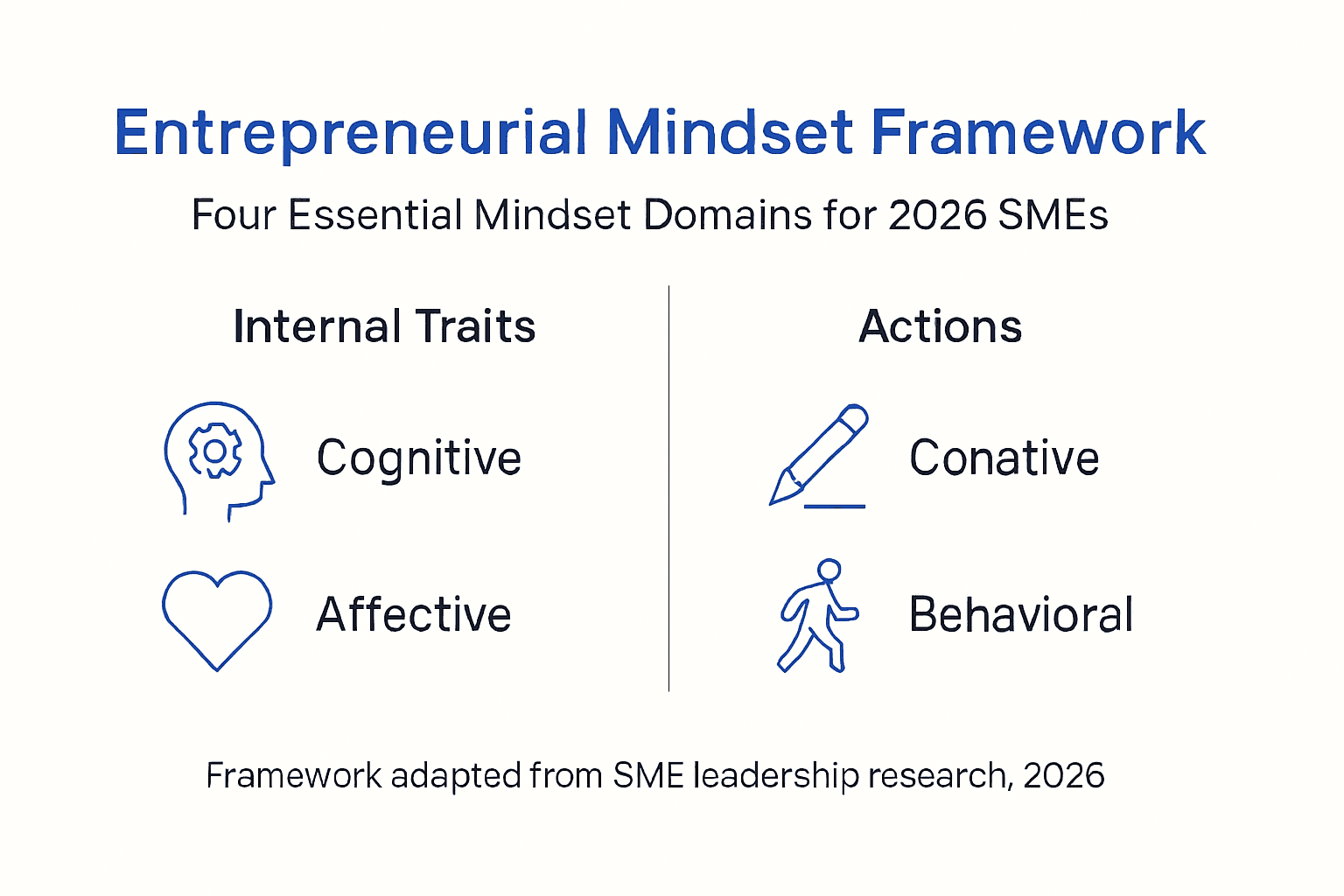
The four-domain framework offers another lens, categorizing traits into cognitive, affective, conative, and behavioral dimensions. Cognitive aspects include opportunity recognition and strategic thinking. Affective dimensions cover passion and resilience. Conative traits involve initiative and persistence. Behavioral elements encompass experimentation and networking actions.
Coaching programs operationalize these frameworks by assessing your current state across dimensions, identifying development priorities, and designing targeted interventions. For example, if curiosity scores low, your coach might assign structured exploration exercises like attending industry events outside your niche or interviewing customers about unmet needs.
Pro Tip: Choose one framework that resonates with you and use it consistently for self-assessment. Rotating between models dilutes focus and slows progress.
Practical Applications for Developing Entrepreneurial Mindset
Developing this mindset requires intentional practice and, ideally, expert guidance. Evidence shows entrepreneurial coaching increases business valuation by 35% on average, far exceeding the investment required. The returns come from improved decision-making, faster opportunity capture, and stronger team alignment.
A stepwise approach maximizes effectiveness:
- Conduct a baseline self-assessment using a validated framework to identify specific trait gaps
- Engage a qualified coach who specializes in performance coaching for SMEs
- Apply new behaviors in low-risk experiments before scaling successful approaches
- Reflect regularly on outcomes, adjusting strategies based on real-world feedback
Integrate mindset development with strategic growth planning. As you learn to recognize opportunities better, update your business growth strategies to capitalize on these insights. Mindset and strategy reinforce each other, creating compounding returns.
Practical exercises include:
- Weekly opportunity journaling: document three potential opportunities you notice, even if you don’t pursue them
- Monthly experimentation: test one small business hypothesis with minimal investment
- Quarterly network expansion: connect with five professionals outside your usual circle
- Annual strategic reflection: assess how your mindset evolution has influenced business outcomes
Understanding the role of coaching for SMEs clarifies how external expertise accelerates development. Coaches provide objective feedback, challenge limiting beliefs, and hold you accountable to growth commitments.
Pro Tip: Schedule mindset development sessions during your peak energy times. Cognitive change requires mental resources; don’t relegate it to leftover time slots.
Grow Your Business with Expert Coaching
Developing an entrepreneurial mindset isn’t a solo journey. Summit SCALE® specializes in helping SME owners transform their thinking patterns and unlock measurable growth. Our evidence-based coaching programs address the specific challenges faced by business owners in the UK, Australia, and the US.
When you invest in coaching, you gain a structured path from current state to desired outcomes. We assess your entrepreneurial traits, design targeted development plans, and provide ongoing accountability. Our clients consistently report faster decision-making, improved team performance, and higher profitability within months.
Whether you’re navigating market uncertainty, scaling operations, or preparing for succession, coaching for SMEs provides the strategic advantage you need. We combine mindset development with practical business applications, ensuring every insight translates into action. Explore how performance coaching drives growth and book your free 15-minute assessment to start your transformation today.
Frequently Asked Questions
Can anyone develop an entrepreneurial mindset?
Yes. Research confirms that entrepreneurial traits are learnable skills, not fixed personality features. With deliberate practice and coaching, most people show 20-40% improvement in key dimensions within a year. Age, background, and current business experience don’t prevent development.
How long does it take to see results from mindset coaching?
Most SME owners notice behavioral changes within 6-8 weeks and measurable business impact within 3-6 months. The timeline depends on your starting point, commitment level, and how consistently you apply new approaches. Early wins like faster decision-making appear quickly, while larger shifts like 30% revenue growth accumulate over 12-18 months.
What is the difference between entrepreneurial mindset and entrepreneurial skills?
Mindset refers to cognitive patterns and attitudes: how you perceive opportunities, handle uncertainty, and approach problems. Skills are specific capabilities like financial modeling, marketing strategy, or negotiation techniques. Mindset determines whether you notice an opportunity; skills determine whether you can execute on it. Both are essential and mutually reinforcing.
Can entrepreneurial mindset help during economic downturns?
Absolutely. Entrepreneurs with developed mindsets identify opportunities others miss during challenging periods. While competitors retreat, you spot market gaps, acquire distressed assets, or pivot to emerging customer needs. Resilience and adaptability, core mindset traits, become survival advantages when external conditions deteriorate.
How does mindset affect team performance?
Your mindset shapes organizational culture. When you model entrepreneurial traits like curiosity, experimentation, and resilience, employees feel empowered to innovate and take calculated risks. This cultural shift typically improves engagement by 15% and generates more creative solutions. Teams mirror leadership behaviors, so your mindset development cascades throughout the organization.

