
TL;DR:
- Entrepreneur performance is best understood through a web of financial metrics, behavioral capabilities, and execution systems that influence profitable growth.
- Focusing on decision quality under pressure and emotional intelligence is crucial for sustainable business success beyond mere revenue figures.
Most business owners treat revenue as the ultimate report card. It rises, and they feel successful. It stalls, and panic sets in. But entrepreneur performance explained properly is far richer than a single headline number. It involves a web of financial metrics, behavioural capabilities, execution systems, and cash disciplines that together determine whether your business grows profitably or simply grows busy. This guide cuts through the noise to give you the frameworks, metrics, and coaching strategies that translate into real growth, real freedom, and a business that works as hard as you do.
Table of Contents
- Understanding entrepreneur performance metrics
- The role of behavioural capabilities in performance
- Using scorecards and execution coaching to improve performance
- Bridging the gap between knowledge and action with readiness assessment
- Managing cash flow fragility for sustainable growth
- Our perspective: the metric you are probably ignoring
- Ready to take your performance from reactive to exceptional?
- Frequently asked questions
Key Takeaways
| Point | Details |
|---|---|
| Track lead and lag metrics | Monitor both predictive metrics like time-to-value and lag results like customer retention to understand performance drivers. |
| Develop emotional capabilities | Improving emotional intelligence and resilience enhances entrepreneurial adaptability and venture success. |
| Use execution coaching | Implement measurable scorecards and leadership rhythms to translate strategy into consistent, scalable action. |
| Assess action readiness | Use structured tools like the LAUNCH Framework to identify and remove barriers between knowledge and action. |
| Manage cash flow rigorously | Regularly review cash runway and maintain rolling forecasts to sustain operations and enable growth. |
Understanding entrepreneur performance metrics
Revenue tells you what happened. It does not tell you why, or whether you can sustain it. That distinction matters enormously when you are trying to build a business that gives you both profit and freedom. Entrepreneur performance, measured properly, requires separating lag indicators (the results that have already occurred) from lead indicators (the signals that predict what is coming next).
Entrepreneur performance can be quantified through profitability and unit-economics metrics: gross margin, contribution margin, customer acquisition cost (CAC), lifetime value (LTV), and CAC payback period. Together, these reveal whether your growth is genuinely profitable or quietly unsustainable.
Here is a quick reference for the metrics every SMB owner should be tracking:
| Metric | What it measures | Why it matters |
|---|---|---|
| Gross margin | Revenue minus direct costs | Shows production or service delivery efficiency |
| Contribution margin | Revenue minus all variable costs | Reveals true per-unit profitability |
| Customer acquisition cost (CAC) | Total sales and marketing spend divided by new customers | Tells you how expensive growth really is |
| Lifetime value (LTV) | Average revenue per customer over their relationship with you | Measures the long-term value of your customer base |
| CAC payback period | Months to recover acquisition cost | Indicates cash pressure from growth |
| Customer retention rate | Percentage of customers who return | The clearest predictor of sustainable revenue |
Understanding the profitability drivers for SMBs is one of the fastest ways to shift from reactive management to confident leadership. When you know your numbers at this level, you stop guessing and start governing.
A few entrepreneur productivity tips to apply right now:
- Track your LTV-to-CAC ratio monthly. A ratio below 3:1 means you are likely spending more to win customers than they return over time.
- Monitor time-to-value, the speed at which a new customer achieves their first meaningful result with your product or service. Faster time-to-value drives retention.
- Separate recurring revenue from one-off revenue in your reporting. Recurring revenue is the foundation; one-off revenue is a bonus.
Coaching for SMEs growth often starts here, with business owners surprised to discover that their “growing” business has a shrinking margin. Revenue quality matters as much as revenue volume.
The role of behavioural capabilities in performance
Numbers only explain half the story. The other half lives in you. Your capacity to regulate your emotions under pressure, communicate clearly when stakes are high, and adapt your strategy when the market shifts are all measurable factors affecting entrepreneur success. These are not soft skills. They are performance capabilities.

Higher emotional intelligence is associated with improved conflict resolution, stakeholder communication, and adaptive strategy formation. Emotional regulation mediates stress resilience and innovation output. In practical terms, this means that a founder who can manage their own emotional state under pressure will make better decisions, lead their team more effectively, and adapt faster than one who cannot.
Resilience is equally important, and often misunderstood. It is not about being unaffected by setbacks. Entrepreneurial resilience enables founders to withstand uncertainty, recover from setbacks, and adapt; it can be developed through experience, mentorship, and ecosystem support. You are not born with it or without it. You build it.
Key behavioural capabilities to develop:
- Emotional self-awareness: Recognising your emotional triggers before they hijack a decision or a conversation.
- Cognitive flexibility: The ability to hold two conflicting ideas simultaneously and choose the most useful response.
- Stress tolerance: Maintaining quality output during high-pressure periods without burning out your team in the process.
- Social influence: Communicating your vision in a way that motivates people without relying on authority alone.
The entrepreneur mentorship benefits that come from working with someone who has already navigated these pressures are hard to overstate. A good mentor does not just share knowledge. They accelerate your ability to act on it.
Pro Tip: The next time a business problem frustrates you, pause before responding. Ask yourself whether your reaction is serving your business or protecting your ego. That single habit, practised consistently, is one of the most powerful entrepreneur mindset and performance shifts you can make.
If you want to master coaching skills as a leader, start with your own emotional capabilities. Your business will never outgrow you.
Using scorecards and execution coaching to improve performance
Strategy without execution is just intention. And intention does not pay salaries. This is where most SMB owners get stuck. They understand what needs to happen but cannot seem to make it happen consistently. The answer is not more motivation. It is structure.
Effective coaching focuses on execution systems, incorporating KPIs, scorecards, meeting rhythms, and accountability checkpoints, to drive real business growth and reduce owner dependency. When you install these systems, you are not working harder. You are making your effort compound.
Here is a practical framework for improving business performance through structured execution:
- Define your scorecard. Identify 5 to 8 KPIs that cover revenue, margin, productivity, leadership performance, and owner dependency. Review them weekly, not monthly.
- Establish meeting rhythms. Weekly team check-ins and monthly leadership reviews keep everyone aligned without creating meeting fatigue.
- Document your processes. Every repeatable task in your business should have a written standard operating procedure. If it is in your head, it is a risk.
- Delegate by design. Use owner dependency as a metric. Track what percentage of decisions require your direct involvement and work to reduce it by 10% each quarter.
- Set a 90-day focus. Most execution failures happen because owners try to improve everything at once. Pick three priorities per quarter and go deep.
Typical improvement timeframes: Business owners who commit to structured execution coaching commonly see 10 to 30% gains in decision velocity, staff retention, profit margins, and overall productivity within 3 to 12 months.
The performance coaching benefits become most visible not when things are going well, but when a crisis hits and your systems hold. Structure is not a constraint on entrepreneurial creativity. It is what makes creativity sustainable.
Pro Tip: Add “owner dependency” as a permanent column on your weekly scorecard. Rate yourself from 1 to 10 on how dependent the business was on you each week. Watch the trend over 90 days. It is one of the most revealing metrics in measuring entrepreneurial success.
Understanding the leadership coaching process from the inside gives you both the clarity and the confidence to lead your team through growth phases without losing your mind in the process.
Bridging the gap between knowledge and action with readiness assessment
Here is an uncomfortable truth: most business owners already know what they need to do. The problem is not knowledge. It is action. Optimising performance in startups and SMBs requires diagnosing why you are not moving, not just what to do next.
The LAUNCH Framework is a diagnostic tool built precisely for this gap. It measures six dimensions of action readiness:
- Leverage: Do you have sufficient resources and relationships to act?
- Action capacity: Do you have the bandwidth to execute right now?
- Urgency: Is there a compelling reason to move immediately?
- Now cost: What is the real cost of not acting today?
- Competitive window: Is there a time-sensitive opportunity at stake?
- Hesitation pattern: What recurring thought or belief is slowing you down?
The LAUNCH Framework measures six dimensions of action readiness and helps overcome barriers that prevent business owners from moving from knowing to doing, improving readiness within 90 days.
“A score below 24 indicates there are structural or psychological obstacles that must be resolved before any new growth strategy will stick. Most owners can move from a score of 16 to 23 up to 24 or above within 90 days of focused work.”
This framework is powerful because it reframes hesitation not as a character flaw but as a diagnostic signal. When you know what is blocking you, you can address it directly rather than pushing harder against an invisible wall.
If you are exploring coaching in entrepreneurship, ask your coach to work through a readiness assessment with you before launching any new initiative. It saves months of wasted effort. And if you are questioning whether it is the right time to invest in coaching, a low LAUNCH score is usually a sign that now is exactly the right time.
Managing cash flow fragility for sustainable growth
You can have brilliant strategy, strong leadership, and a growing customer base, and still go out of business. Cash flow fragility is the silent killer of otherwise healthy businesses. Business performance strategies that ignore cash management are built on sand.
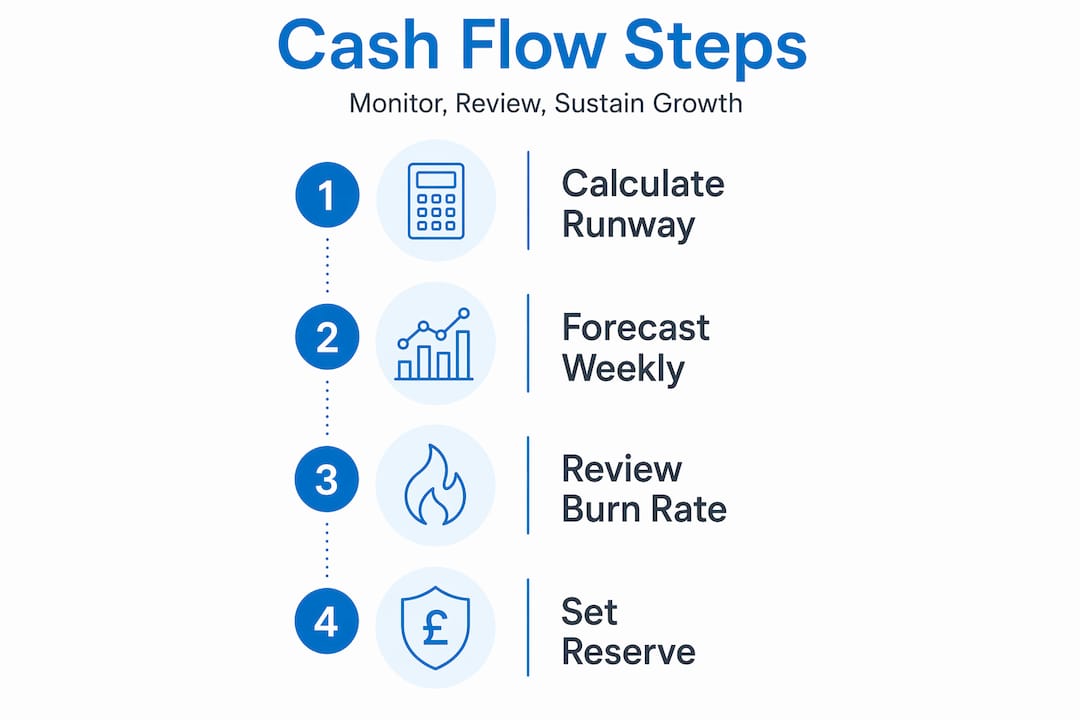
Your cash runway is calculated by dividing your current cash balance by your monthly net burn rate (expenses minus income). Reviewing cash runway weekly helps prevent unexpected failures, especially since 29% of startups fail from exhausted runway. Weekly, not quarterly. Revenue and expenses fluctuate too quickly for any less frequent review to be reliable.
| Forecast type | Review frequency | Primary purpose |
|---|---|---|
| 13-week rolling forecast | Weekly | Catch near-term cash shortages early |
| 12-month forecast | Monthly | Support strategic planning and investment |
| Cash reserve target | Ongoing | Minimum 2 to 3 months of fixed expenses |
A 13-week rolling cash-flow forecast updated weekly is the gold standard for near-term cash management; extending to 12 months is recommended for strategic planning. Many SMB owners fear building forecasts because they assume accuracy is impossible. The goal is not perfection. It is early warning.
Here is a practical cash discipline system:
- Calculate your monthly net burn rate and your current runway every Monday morning.
- Build and update a 13-week rolling forecast each week.
- Set a non-negotiable cash reserve of 2 to 3 months of fixed expenses. Treat it as untouchable except in a genuine emergency.
- Review your 12-month forecast monthly with your leadership team, not just your accountant.
Pro Tip: Name your cash reserve account something meaningful, such as “Business continuity fund.” It sounds minor, but the psychological barrier of withdrawing from a named reserve is real. It reduces impulsive decisions under pressure.
Explore growth strategies for SMBs that are built around cash-positive growth, and pair them with a sound business growth workflow that keeps your financial foundation stable as you scale.
Our perspective: the metric you are probably ignoring
Most articles on how to measure entrepreneur performance focus on what the business produces. Profit, revenue, growth rate. These matter. But in our experience at Summit SCALE, the metric that predicts long-term success more accurately than any financial figure is decision quality under pressure.
The business owners who sustain growth across years are not necessarily the ones with the best strategies. They are the ones who make consistently good decisions when things get uncomfortable. When cash is tight, when a key team member leaves, when a major client walks, those moments reveal whether the owner is truly leading or just reacting.
This is why we believe that entrepreneur mindset and performance are inseparable. You cannot build a high-performance business on a low-resilience foundation. And yet, most performance conversations skip this entirely.
The mistake we see repeatedly is owners investing heavily in marketing or systems while their own decision-making under stress remains unexamined. Turning the mirror around, honestly and consistently, is where sustainable performance begins. If you are serious about improving business performance, start by asking: how do I perform when things go wrong? That answer tells you more than your P&L ever will.
Ready to take your performance from reactive to exceptional?
If this guide has shown you how much is genuinely within your control, imagine what a structured coaching programme could unlock for your business. At Summit SCALE, we work with SMB owners who are tired of guessing and ready to build the clarity, systems, and financial discipline that produce lasting growth.
We start with a free 15-minute assessment call, no pressure, no jargon, just an honest conversation about where your business is and where it could go. We cover the metrics that matter, the behavioural blockers holding you back, and the execution gaps between your current results and your real potential. If you are ready to stop reacting and start leading, book your free call with Summit SCALE today. Your next phase of growth is closer than you think.
Frequently asked questions
What are the most important metrics to explain entrepreneur performance?
The key metrics include customer retention, time-to-value, profitability measures like gross and contribution margins, CAC, LTV, and cash runway. These metrics together reveal both current results and predictive indicators of future success.
How does emotional intelligence affect entrepreneur performance?
Higher emotional intelligence enhances conflict resolution, stakeholder communication, and strategic adaptability, while emotional regulation boosts stress resilience and innovation output, making it a core driver of entrepreneurial success.
What is the LAUNCH Framework and why is it important?
The LAUNCH Framework evaluates an entrepreneur’s readiness to act by measuring six dimensions including urgency and hesitation patterns. It helps identify the specific obstacles blocking execution before you invest time and money in a new growth strategy.
How can coaching improve entrepreneur performance?
Coaching builds leadership discipline through measurable scorecards, documented processes, and regular accountability rhythms. These execution systems enhance decision-making, reduce owner dependency, and drive consistent business growth over time.
Why is cash-flow management critical for small business growth?
Regular cash runway assessment and rolling cash-flow forecasts prevent unexpected cash shortages. Monitoring runway weekly and maintaining rolling forecasts gives you the financial stability needed to invest confidently in growth without risking operational continuity.

