
TL;DR:
- Many SME owners struggle with shrinking profit margins despite steady revenues due to rising, often hidden, costs. Effective cost control requires detailed tracking of fixed and variable expenses, regular analysis, and strategic prioritization to protect value-driving expenditures. Building a sustainable financial discipline with expert guidance ensures long-term profitability and business resilience.
You notice your revenue holding steady, yet your profit margins keep shrinking. Costs creep upward quietly, month by month, and before long the gap between what you earn and what you keep feels impossibly narrow. This is one of the most common and frustrating realities facing small and medium-sized business owners across the UK, Australia, and New Zealand right now. UK SMEs face rising input costs and cash-flow pressure that demands more than vague cost-cutting. What you need is a clear, practical system that protects your profitability without sacrificing the things that make your business grow.
Table of Contents
- Preparing for effective cost control: Laying the groundwork
- Step-by-step cost analysis: How to spot savings early
- Strategic cost management: Cutting the right costs, not just any costs
- Avoiding pitfalls: Common cost control mistakes
- A fresh perspective: Why cost control is about value, not just cuts
- Your next step: Support for sustainable profit and growth
- Frequently asked questions
Key Takeaways
| Point | Details |
|---|---|
| Track and categorise costs | Regularly logging and separating fixed, variable, and one-off costs reveals where money goes and enables smart action. |
| Use a structured analysis | Follow a repeatable process to spot trends, prioritise actions, and compare strategies for the most effective cost control. |
| Prioritise value, not just savings | Cut inefficient expenses while protecting core activities that directly drive revenue and customer satisfaction. |
| Avoid common mistakes | Update your budget regularly and don’t ignore small, irregular, or unexpected costs that can add up quickly. |
| Review and adapt continuously | Staying proactive with monthly reviews and flexible strategies sustains profitability even as conditions change. |
Preparing for effective cost control: Laying the groundwork
With the intention set, let’s clarify what should be tracked and how to organise your cost data for real impact.
Before you can reduce costs meaningfully, you need a clear picture of exactly what you are spending and why. Many business owners skip this foundational step and jump straight to cutting, which often leads to regret. Think of it like trying to navigate without a map. You might move fast, but not necessarily in the right direction.
Understanding your cost types
The first distinction to make is between fixed and variable costs. Fixed costs remain constant regardless of how much you sell or produce. Examples include rent, insurance premiums, loan repayments, and salaried staff. Variable costs, on the other hand, fluctuate directly with your output or sales volume. These include raw materials, freelance labour, shipping, and sales commissions.
Why does this distinction matter? Because the strategies for managing each type are completely different. Fixed costs require long-term renegotiation or structural decisions. Variable costs can be adjusted relatively quickly in response to trading conditions. Knowing which is which gives you far greater control and flexibility.
What to track: Your core cost categories
Managing business costs effectively starts with grouping your expenses into clear categories. Here is what your tracking framework should include:
- Cost of goods sold (COGS): The direct costs tied to producing your product or delivering your service, such as materials and direct labour.
- Operating expenses: Day-to-day running costs like utilities, marketing, software subscriptions, and administration.
- Financial costs: Interest on loans, bank fees, merchant processing charges, and any financing costs.
- One-off expenses: Equipment purchases, refurbishments, legal fees, or other irregular items.
- Buffer allocation: A deliberate reserve, typically 5 to 10 per cent of your total budget, set aside for unexpected costs.
Tracking costs by category using software and monthly reporting helps you spot trends before they become problems. As Wise advises, a well-structured budget includes fixed costs, variable costs, one-off expenses, and a buffer for risk, ensuring your plan can withstand real-world surprises.
Choosing your tracking tools
For most SMEs, the choice comes down to a well-structured spreadsheet or dedicated accounting software such as Xero, MYOB, or QuickBooks. Spreadsheets offer flexibility and no additional cost, but they require discipline and manual updating. Accounting software automates much of the data entry, reduces errors, and generates instant reports. If your business processes more than 20 to 30 transactions per month, software is almost always worth the investment.

Aim to review your costs at least monthly, or fortnightly if your cash flow is particularly volatile. Regular reviews let you spot trends early, such as a supplier quietly increasing prices or a subscription you no longer use.
| Tracking method | Best for | Key benefit | Key limitation |
|---|---|---|---|
| Spreadsheet | Very small businesses, simple structures | Free, fully customisable | Manual, error-prone |
| Accounting software | Growing SMEs, multiple cost streams | Automated, real-time reporting | Monthly subscription cost |
| Bookkeeper or accountant | Complex or high-volume businesses | Expert oversight | Higher ongoing cost |
Pro Tip: Always include a buffer line in your budget. Without it, a single unexpected expense, such as an equipment breakdown or a delayed client payment, can throw your entire plan into disarray.
Step-by-step cost analysis: How to spot savings early
Now with your groundwork complete, it’s time to use a systematic approach for analysing costs and revealing savings opportunities.
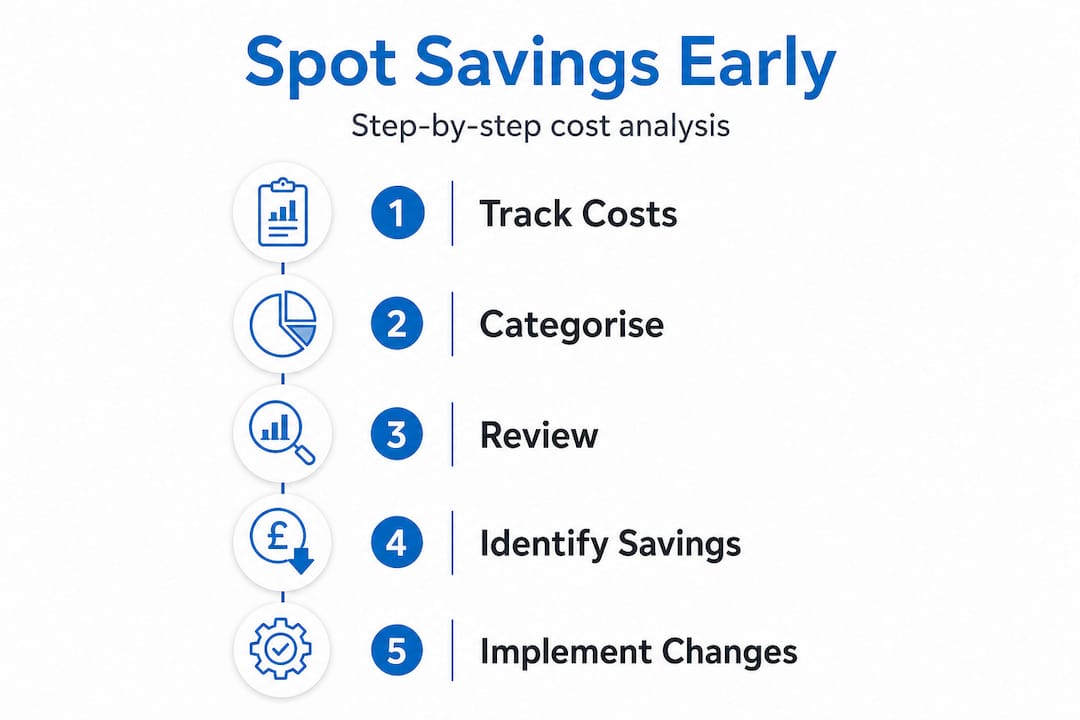
A structured cost analysis is not a one-time event. It is a habit. The business owners who find the most savings are those who look at their numbers consistently and with fresh eyes. Stripe’s cost reduction guide outlines a clear process for conducting cost analysis and identifying savings, such as renegotiating supplier contracts or automating routine work.
Your five-step cost analysis process
- Gather your records. Pull together three to six months of bank statements, invoices, receipts, and payroll records. The more complete the picture, the more reliable your analysis will be.
- Categorise every expense. Assign each transaction to one of your defined categories. Do not leave anything in a vague “miscellaneous” bucket. Ambiguity hides waste.
- Analyse trends over time. Compare month-on-month and year-on-year figures. Are any categories trending upward without a corresponding increase in revenue or output? That is a signal worth investigating.
- Prioritise your targets. Focus first on the categories with the highest spend and the most variability. A 10 per cent saving on a £50,000 annual cost line is far more impactful than eliminating a £200 subscription.
- Plan specific actions. For each priority cost, define a concrete next step. This might be requesting a quote from a competing supplier, automating a manual process, or renegotiating payment terms.
Comparing high-impact savings with risky cuts
Not all savings carry the same risk profile. This comparison table helps clarify where your energy is best directed:
| Action | Potential saving | Risk level | Notes |
|---|---|---|---|
| Renegotiating supplier contracts | High | Low | Often yields 5 to 15 per cent savings |
| Consolidating software subscriptions | Medium | Low | Audit all tools annually |
| Automating manual admin tasks | High | Low | Frees up staff for revenue-generating work |
| Reducing marketing spend | Medium | High | Can shrink your pipeline quickly |
| Cutting core staff | High short-term | Very high | Often damages quality and culture |
| Deferring equipment maintenance | Medium short-term | High | Leads to larger costs later |
For deeper guidance on building sustainable margins, the SME profitability guide and profit growth strategies at Summit SCALE offer practical frameworks tailored to growing businesses.
Pro Tip: Revisit every vendor contract once a year, even if you are satisfied with the arrangement. Markets change, competitors emerge, and loyalty is rarely rewarded unless you ask. A five-minute phone call could save you thousands annually.
Keep an eye out for early warning signs, too. Repeated late payments, dishonoured transactions, or a growing gap between your invoicing and your bank balance are signals that your cost control needs urgent attention.
Strategic cost management: Cutting the right costs, not just any costs
Knowing how to find savings is only half the battle. What matters most is knowing where to cut and where to protect the things that drive your business forward.
This is where many businesses go wrong. Under pressure, it is tempting to slash anything that looks expensive. But not all costs are created equal, and treating them as if they are can cause serious damage. The goal of optimising business processes is not to spend less indiscriminately. It is to spend smarter.
Costs worth protecting
Some expenses are directly connected to your ability to generate revenue, serve clients, and maintain your reputation. These include:
- Core team members whose skills and relationships are central to your service delivery
- Technology and infrastructure that keeps operations running efficiently
- Marketing activities that reliably generate qualified leads
- Training and development that improves your team’s performance
- Quality assurance processes that protect your brand reputation
Cutting any of these without a clear replacement plan is like pulling a load-bearing wall from a building. The structure may hold briefly, but the risk of collapse is real.
Costs worth reviewing and reducing
On the other side of the ledger, there are costs that have grown through habit rather than strategy:
- Manual administrative tasks that could be automated at a fraction of the cost
- Underused software licences or overlapping tools that perform similar functions
- Office or storage space that exceeds your actual operational needs
- Supplier arrangements where you have not benchmarked the market in over two years
- Processes that were designed for a different stage of your business
ICAEW highlights the importance of identifying value-driving and scalable costs, reducing administration through automation, and protecting what genuinely drives performance. Understanding your profitability drivers is essential to making these distinctions with confidence.
“Indiscriminate cutting can harm growth and service delivery. The businesses that emerge stronger are those that make targeted, deliberate reductions while protecting the engine of their value creation.”
This is the mindset shift that separates reactive cost-cutters from strategic leaders.
Avoiding pitfalls: Common cost control mistakes
Even the most robust plan can be undone by common mistakes. Here is how to spot them before they damage your efforts.
Cost control is an ongoing discipline, not a project with a start and end date. The businesses that sustain their profitability over time are those that build cost awareness into their regular routines. Here are the most common traps to avoid:
- Overlooking one-off and irregular expenses. It is easy to track monthly bills but forget about annual licences, insurance renewals, or equipment upgrades. Wise advises listing all costs, including one-off items, and maintaining a budget buffer to avoid being caught off guard.
- Cutting high-impact investments to trim visible costs. If your marketing spend is generating five times its cost in new revenue, cutting it to save money is not frugal. It is counterproductive. Always measure return before you reduce.
- Relying solely on annual reviews. A lot can change in twelve months. Monthly reviews let you catch problems early, when they are still small and manageable. Waiting until year-end means you may be reacting to a crisis rather than preventing one.
- Ignoring process inefficiency as a hidden cost. Time wasted on manual tasks, duplicated effort, or unclear workflows costs money even when it does not appear on an invoice. Quantify the staff hours involved and you will often find significant savings available.
- Failing to act on warning signs. Numbers rarely lie. If you are seeing repeated late payments from clients, dishonoured direct debits, or cash flow shortfalls around the same time each month, these patterns are telling you something important. Do not wait for them to escalate.
Building a strong foundation for long-term business planning means addressing these pitfalls proactively, not reactively.
Pro Tip: Set a calendar reminder each month to review your top five cost categories. Pair this with a simple traffic light system: green for on target, amber for worth watching, and red for immediate action required. It takes less than 30 minutes and keeps cost control embedded in your regular rhythm.
A fresh perspective: Why cost control is about value, not just cuts
After working with hundreds of business owners across the UK, Australia, and New Zealand, we have seen a pattern that repeats itself with remarkable consistency. The businesses that struggle most with cost control are not the ones with the highest expenses. They are the ones with the least clarity about which expenses are working for them.
Here is the uncomfortable truth: most SME owners focus almost entirely on visible costs, the rent, the payroll, the supplier invoices. But the hidden drains, outdated administration systems, duplicated tools, time-consuming processes that were never redesigned as the business grew, often represent an equally significant leak. They just do not show up on a single line of the profit and loss statement.
We have seen business owners cut their marketing budget in a panic, only to watch their lead pipeline dry up six weeks later. We have seen others retain underperforming staff out of loyalty, while carrying a cost that was silently eroding their margins. And we have seen the flip side too: owners who invested deliberately in automation or better systems, and watched their cost per transaction fall by 30 per cent within a year.
The real lever is not cutting more aggressively. It is developing the judgement to know what creates value in your business and what is simply consuming resources without return. That kind of judgement comes from looking at your numbers regularly, asking the right questions, and sometimes having a trusted perspective from outside the business.
Smart leaders who think about increasing business valuation understand that cost control and value creation are the same conversation. A business that manages its costs with precision and intentionality is not just more profitable today. It is more attractive, more resilient, and more sustainable over the long term. That is the real prize.
Your next step: Support for sustainable profit and growth
Cost control at its best is not a spreadsheet exercise. It is a strategic discipline that shapes how your business grows, what it can afford to invest in, and how confidently you can navigate uncertainty. Putting these strategies into practice requires not just knowledge but accountability, clarity, and a clear plan.

That is exactly where a business coach makes a tangible difference. At Summit SCALE, we work directly with SME owners to identify hidden cost drains, build sustainable financial habits, and create the clarity needed to make confident decisions. Understanding why investing in coaching accelerates your results is the first step. Explore how coaching for profitability can transform your cost control approach into a genuine competitive advantage. Book your free 15-minute assessment call today and take the first step toward a more profitable, resilient business.
Frequently asked questions
What is the most effective way to start controlling business costs?
Track all costs by category using monthly reporting, and act promptly on early warning signs such as late payments or unexplained cash-flow gaps.
How do I know which costs are essential versus non-essential?
Essential costs directly support value creation and revenue generation, while non-essential spending tends to be administrative, duplicated, or habitual rather than strategic.
How often should I review and update my business budget?
Budgets should be reviewed monthly, or immediately when significant cost changes or cash-flow disruptions occur, to ensure you can respond quickly rather than reactively.
What’s a common mistake when reducing costs in a small business?
Cutting value-driving costs such as core staff or strategic marketing can damage future performance more severely than the short-term saving justifies.
Why do I need a buffer for business expenses?
A buffer keeps your business stable when costs rise unexpectedly or income slows. Wise recommends a budget buffer so your financial plan can absorb real-world volatility without derailing your operations.

