
TL;DR:
- Most business transformation efforts fail because companies prioritize technology before fixing underlying process gaps. Successful transformation requires a fundamental realignment of people, processes, and technology, with leadership engaged from the start. When executed strategically, transformation can deliver up to 50% revenue growth, leaner operations, and higher business valuation.
Most business owners pour resources into transformation efforts only to watch them stall, lose momentum, or quietly collapse. Research shows that 62% of digital transformations fail because businesses rush to buy technology before fixing the process gaps underneath. If you have ever felt that your growth efforts are not sticking, or that your business is working harder but not smarter, you are not alone. This article will give you a clear definition of business transformation, reveal the most common traps, show you what real results look like, and give you a practical roadmap to get started with confidence.
Table of Contents
- Defining business transformation for modern SMEs
- Why most transformations fail and how to avoid it
- The business impact: measurable benefits of transformation
- Steps to launch a successful business transformation
- Why most advice on business transformation misses the mark
- Ready to unlock growth? Take the next step
- Frequently asked questions
Key Takeaways
| Point | Details |
|---|---|
| Prioritise process gaps | Address process issues before adopting new technologies to avoid costly transformation failures. |
| Measurable results possible | Successful transformation can boost revenue, profits, and efficiency substantially for SMEs. |
| Stepwise execution matters | Follow a clear, staged plan involving leadership, staff, and data-driven goals for lasting impact. |
| Learn from failures | Most failed transformations share common pitfalls—understanding these is key to success. |
| Support is available | Coaching and structured programmes can accelerate business transformation and growth outcomes. |
Defining business transformation for modern SMEs
Let us be direct. Business transformation is not the same as making a few tweaks to your workflow or upgrading your accounting software. It is something far more significant. Think of it as a fundamental realignment of your people, your processes, and your technology so that every part of your business points in the same direction. It is the difference between painting a room and redesigning the whole house.
Incremental improvement is valuable. Fixing a slow invoicing step, reducing one bottleneck, or refining your sales script are all worthwhile. But transformation asks a bigger question: is your entire business model fit for where you want to go? It rewires how work gets done at every level, not just the visible surface.
For SMEs specifically, this distinction matters enormously. Large corporations can absorb years of gradual change. As a small or medium-sized business owner, you often do not have that luxury. Your competitive advantage relies on speed, clarity, and the ability to pivot quickly. The good news? Your size is actually a strength here. You can move faster than a large enterprise and implement change without layers of bureaucracy slowing you down.
Here is what transformation typically addresses for SMEs:
- Growth stagnation: Revenue has plateaued and existing approaches are no longer opening new doors.
- Operational inefficiency: Too much time is spent on tasks that do not generate income or value.
- Team misalignment: People are busy but not productive, and accountability is unclear.
- Market agility: Competitors are adapting faster and customer expectations are shifting.
- Scalability limits: The business cannot grow further without breaking at the seams.
“Business transformation is not an event. It is a decision to look honestly at where your business is, where it needs to go, and to commit fully to closing that gap.”
Done well, following a structured business coaching workflow that aligns strategy with execution, transformation can deliver remarkable results. In fact, 50% revenue growth is achievable for businesses that pursue transformation with the right framework. The key phrase there is “right framework.” Transformation without structure is just disruption. That is why following a step-by-step business growth approach is so important from the outset.
Why most transformations fail and how to avoid it
Here is the uncomfortable truth: most transformations do not fail because of a lack of ambition or funding. They fail because of a fundamental mistake in sequencing. The most common error is purchasing technology before addressing the process problems the technology is meant to solve.
Imagine buying a state-of-the-art espresso machine for a café that has a broken ordering system. The coffee might be excellent, but customers are still frustrated and orders are still being lost. The machine did not fix the underlying problem. The same logic applies to CRM systems, automation tools, and enterprise software installed in businesses with unresolved workflow gaps.
Failed vs. successful transformation: a direct comparison
| Factor | Failed transformation | Successful transformation |
|---|---|---|
| Starting point | Technology purchase | Process audit and redesign |
| Leadership role | Delegated to IT or external vendor | Actively led from the top |
| Team involvement | Minimal, announced after the fact | Co-designed with key team members |
| Success metrics | Vague or absent | Specific, measurable, and reviewed regularly |
| Timeline | Unrealistic or undefined | Phased with clear milestones |
| Culture alignment | Overlooked | Central to the change plan |
As the research confirms, 62% of transformations stumble specifically because technology is prioritised before process clarity. When you optimise business processes first, the technology you eventually adopt has something solid to land on. It multiplies what already works rather than masking what does not.
The second biggest failure point is leadership disengagement. When a transformation is handed off to a manager or an external consultant without genuine owner involvement, it loses authority and momentum. Your team looks to you for conviction. If they sense you are not fully committed, the effort begins to unravel before it gains traction.
Pro Tip: Before investing in any new tool or system, audit your current processes to identify your three biggest bottlenecks. Solving those first will make any technology you later introduce dramatically more effective. Learning to identify and address optimising process gaps is one of the highest-return activities a business owner can undertake.
A practical strategy to sidestep failure is to start with a short, honest assessment of where your business currently stands. Map your core processes from customer acquisition through to delivery and payment. Mark the steps that are slow, inconsistent, or reliant on one individual. That map becomes the foundation for everything else. From there, a structured coaching workflow for transformation can guide you through the redesign with far less risk.
The business impact: measurable benefits of transformation
Numbers matter. Before you commit energy and resource to transformation, you deserve to know what the upside looks like. Here is a clear picture of what effective transformation can deliver.
Sample transformation metrics for SMEs
| Metric | Before transformation | After transformation |
|---|---|---|
| Annual revenue growth | 5 to 8% | 30 to 50% |
| Revenue per employee | Baseline | Up to 2.4x baseline |
| Operational headcount | Higher | Up to 40% leaner |
| Customer retention rate | 60 to 70% | 80 to 90% |
| ROI on transformation investment | N/A | Up to 170% |
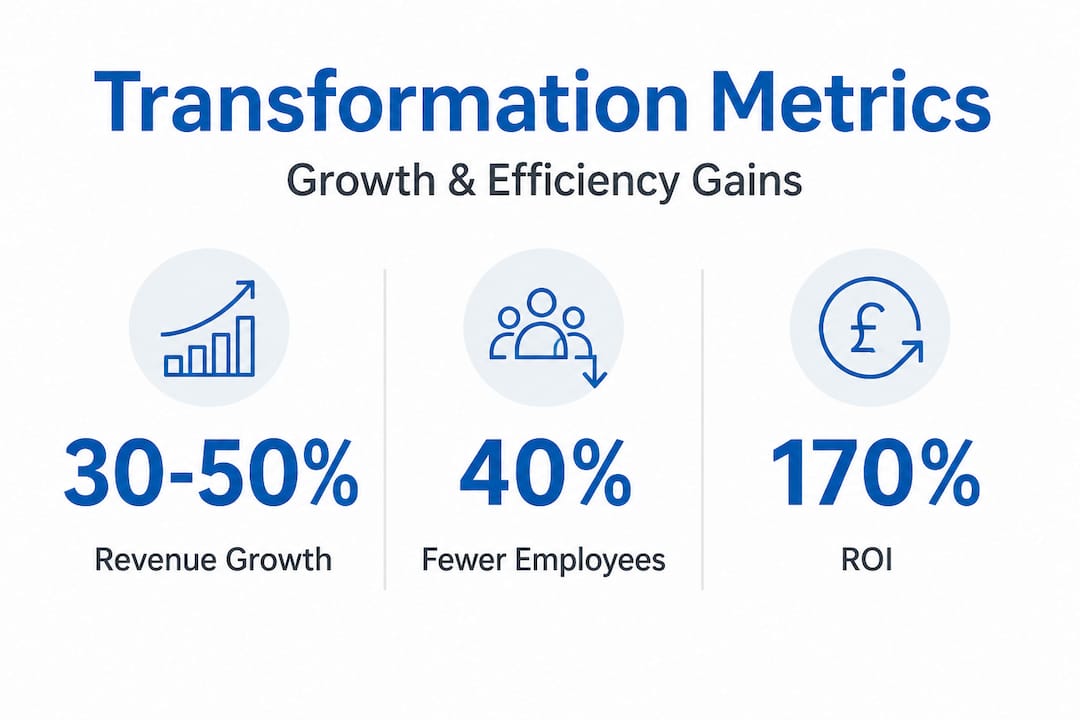
These are not theoretical projections. A real SMB case demonstrates 50% revenue growth and 40% fewer employees, with revenue per employee increasing 2.4 times. That combination, growing revenue whilst reducing the cost base, is the hallmark of a lean, transformed business.
Consider also what happens to your profit when customer retention improves. A 5% retention improvement can boost profits by anywhere between 25% and 95%. That is a staggering return for a relatively modest shift in how you serve existing customers. Retention is not a marketing metric. It is a profitability driver that sits at the heart of transformation.
What does this mean in practice for your business? Here is a checklist of realistic improvements you can expect when transformation is implemented properly:
- Increased profit margins through leaner operations and better pricing discipline.
- Faster decision-making because processes are clear and data is accessible.
- Stronger team accountability with defined roles, responsibilities, and metrics.
- Greater competitive agility to respond quickly to market changes.
- Higher business valuation because a systemised business is worth more than one dependent on the owner.
“Your business should work for you, not consume you. Transformation is the path from exhaustion to freedom.”
The long-term goal is not just a higher revenue line. It is a business that has genuine value independent of your daily presence. Discovering how to increase business valuation is one of the most powerful motivators for committing to the transformation process. When you pair that with setting business goals that are specific and measurable, you create a clear line of sight from where you are today to the business you want to build.
Steps to launch a successful business transformation
Having seen what is possible, the real question is: where do you begin? The answer is not with a purchase order for new software. It starts with clarity.
-
Conduct an honest business assessment. Look at your revenue, profit, team performance, and customer satisfaction without sentiment. Identify the areas where the business consistently underperforms. Be specific. “Things could be better” is not a diagnosis.
-
Set clear, measurable goals. Define what success looks like in concrete terms. Use a step-by-step guide for growth to frame goals around revenue targets, profit margins, team size, and customer retention rates. Ambiguous goals produce ambiguous results.
-
Redesign your core processes. Before anything else changes, map and rebuild the workflows that drive your business. Remove the steps that add no value. Standardise the ones that do. Document everything so your business can run without depending on memory or heroics.
-
Choose tools that serve your processes. Once your processes are clear, select technology that supports them. Not the other way around. The right software for a well-designed process is transformative. The same software dropped into a broken process is just expensive noise.
-
Involve your people from the start. Transformation fails when teams feel it is happening to them rather than with them. Share your vision early. Explain the “why” with honesty and enthusiasm. Invite input on process redesign. People support what they help create.
-
Measure outcomes consistently. Define your key metrics before you start and review them regularly. Tracking the right profitability drivers throughout the process allows you to course-correct quickly rather than discovering problems months later.
Pro Tip: The most overlooked step is number three. Most businesses skip straight from “we need to change” to “let us implement a new system.” Spending two to three weeks mapping and fixing processes before any technology decision can save months of frustration and thousands in wasted investment.
For continuous improvement, keep this checklist visible after launch:
- Are your key metrics improving each quarter?
- Are team members clear on their goals and accountable to outcomes?
- Are customer complaints decreasing and retention improving?
- Are you working fewer hours in the business and more on the business?
- Is the business generating consistent, predictable profit?
SMB results from well-executed transformations, including 50% revenue growth and 170% ROI, are genuinely within reach. But they require discipline, sequencing, and a willingness to lead the change yourself.

Why most advice on business transformation misses the mark
Here is a perspective you will not hear often: most transformation advice is written by people who are selling technology. That shapes the narrative. It places software, platforms, and digital tools at the centre of the story, when the real centre should be culture and process.
We have seen businesses invest heavily in automation, CRM platforms, and analytics dashboards only to find themselves in the same position twelve months later. More data. Same confusion. More complexity. Less clarity. The technology was not the problem. The thinking that led to the purchase was.
The uncomfortable reality is that real transformation requires you to change first. Your business will never outgrow you. If the owner’s habits, beliefs, and ways of making decisions do not shift, the business cannot shift either. That is the part most consultants are reluctant to name because it is personal. It is harder to sell “change how you think” than “buy this platform.”
Shortcuts consistently backfire. Replacing a leadership team member or restructuring the org chart feels decisive. But structural changes without cultural change just rearrange the same dysfunction under different job titles. Lasting transformation is systemic. It goes deeper than the surface.
One of the most powerful things you can do right now is invest in your own continuous learning and build radical transparency into your business. Share numbers with your team. Be honest about what is working and what is not. Create a culture where problems are raised early rather than hidden. Businesses that do this become genuinely resilient, and resilient businesses are the ones that achieve that process optimisation for growth that compounds over time.
The cases that achieve a $100M+ business impact and 170% ROI are not outliers because they had better technology. They are outliers because their leaders committed to the full journey: process, people, culture, and then technology. That sequence is everything.
Ready to unlock growth? Take the next step
Understanding transformation is one thing. Applying it to your specific business, your team, your numbers, and your goals is where real progress happens.
At Summit SCALE, we work alongside business owners and managers who are ready to move from knowing to doing. Whether you are just beginning to question whether your business can perform better, or you are already mid-transformation and feeling stuck, structured coaching makes the difference. Explore why invest in coaching to understand how guided support accelerates results far beyond solo effort. Our performance coaching for growth programmes are built specifically for SME leaders navigating real-world complexity. And if you want a clear view of what is possible in the year ahead, our guide on how to scale profitably in 2026 is a strong place to start. Book your free 15-minute assessment call today and take the first clear step forward.
Frequently asked questions
What is the main aim of business transformation?
Business transformation aims to achieve major improvements in growth, efficiency, or competitive advantage by changing core processes and ways of working. When executed well, it can deliver 50% revenue growth and significantly improve long-term business value.
How long does business transformation take for SMEs?
Business transformation typically takes 12 to 24 months for most small and medium-sized businesses, depending on the scale of change and the complexity of existing operations.
What is more important: people, process, or technology?
Process improvements are the most critical starting point, as 62% of transformations fail when technology is prioritised before process gaps are resolved. People and technology both play vital roles, but only once strong processes are in place.
Can business transformation work in any industry?
Yes, transformation principles apply across industries. Results depend on strong, engaged leadership, specific measurable goals, and adapting proven frameworks to your particular business context.
What are the key outcomes to measure?
Revenue growth, profitability, employee retention, process efficiency, and ROI are the primary measurable outcomes to track. Even a modest 5% retention improvement can boost profits by up to 95%, making retention one of the most valuable metrics to monitor consistently.

