
Professional coaching delivers an impressive 7x return on investment for business owners, yet many entrepreneurs still question its value. If you’re a small to medium-sized business owner seeking sustainable growth, increased profitability, and more personal freedom, understanding how coaching works can transform your business trajectory. This guide cuts through the myths and shows you exactly how to leverage professional coaching for measurable results.
Table of Contents
- Understanding Professional Coaching For Business Owners
- How Coaching Drives Business Growth And Profitability
- Common Misconceptions About Professional Coaching
- Comparing Coaching With Other Growth Strategies
- Practical Guidance: Selecting And Working With A Professional Coach
- Real-World Impact: Case Studies And Success Stories
- Unlock Growth, Profit, And Freedom With Summit SCALE® Coaching
- Frequently Asked Questions About Professional Coaching
Key Takeaways
| Point | Details |
|---|---|
| ROI and Growth | Professional coaching generates approximately 7x revenue growth relative to investment for SME owners. |
| Coaching Myths | Misconceptions about cost, applicability, and instant results prevent many business owners from accessing coaching benefits. |
| Strategic Advantage | Coaching provides personalized accountability and behavioral change that alternatives like consulting or self-education cannot match. |
| Selection Matters | Choosing a coach with SME expertise and compatible methodology directly impacts your success outcomes. |
| Personal Freedom | Effective coaching reduces owner operational workload by 10-15 hours weekly through improved delegation and systems. |
Understanding Professional Coaching for Business Owners
Professional coaching is a structured partnership between you and a trained coach focused on achieving specific business and leadership goals. Unlike mentoring, where someone shares their experience, or consulting, where experts provide solutions, coaching helps you develop your own strategic thinking and leadership capabilities. The role of coaching for SMEs centers on unlocking your potential rather than simply transferring knowledge.
This collaborative approach means your coach asks powerful questions, challenges assumptions, and holds you accountable to the commitments you make. You remain the expert on your business while the coach facilitates clarity and action. The distinction matters because coaching creates sustainable change by building your capacity to solve problems independently.
Key characteristics of professional coaching include:
- Goal-oriented sessions with measurable outcomes
- Customized strategies addressing your specific challenges
- Regular accountability check-ins driving consistent progress
- Focus on mindset shifts alongside tactical execution
Coaching is proactive rather than reactive. You don’t need a crisis to benefit. Many successful business owners engage coaches precisely when things are going well to accelerate growth and prevent future obstacles. This forward-thinking approach separates coaching from emergency consulting or crisis management.
How Coaching Drives Business Growth and Profitability
The mechanisms behind coaching’s impact are concrete and measurable. When you work with a professional coach, you gain clarity on which growth opportunities deserve your attention and which distractions to eliminate. This strategic focus directly translates to improved profitability because you allocate resources more effectively.
Leadership development forms the foundation of coaching’s business impact. As you strengthen skills in communication, delegation, and decision-making, your entire organization performs better. Team members become more engaged and productive when led by a confident, clear-thinking owner. This cultural shift shows up in retention rates, customer satisfaction, and ultimately revenue.

Coaching also transforms how you manage your sales pipeline and operational workflows. Many owners get stuck in tactical execution rather than strategic oversight. A coach helps you implement systems that run without constant intervention, freeing your time for high-value activities like business development and strategic planning.
The data supporting coaching’s ROI is substantial. Professional coaching drives an average revenue growth of approximately 7 times the investment made by business owners. This return stems from multiple sources:
- Increased sales through improved strategy and execution
- Cost reductions from operational efficiency gains
- Better hiring decisions reducing turnover expenses
- Enhanced leadership creating higher-performing teams
Pro Tip: Track specific metrics before starting coaching so you can quantify improvements in revenue, profit margins, and personal work hours. This baseline makes your ROI calculation concrete and helps maintain momentum during challenging phases.
Beyond financial metrics, coaching delivers personal freedom. As your business becomes less dependent on your daily involvement, you reclaim time for strategic thinking, family, or new ventures. This lifestyle improvement represents tremendous value that pure financial ROI calculations miss.
Common Misconceptions About Professional Coaching
Many business owners avoid coaching due to myths that don’t reflect reality. The most persistent misconception is that coaching is only for struggling businesses or failing leaders. Actually, business coaching trends in 2026 show that top performers engage coaches most frequently, viewing coaching as a competitive advantage rather than remedial help.
Another myth suggests that self-guided learning through books, podcasts, and courses delivers equivalent results. While these resources provide valuable information, they lack the personalized application and accountability that coaching provides. You might learn a brilliant strategy from a book but never implement it without external accountability pushing you forward.
Some entrepreneurs believe coaching guarantees instant success without effort on their part. This expectation sets everyone up for disappointment. Effective coaching requires your active participation, honest self-reflection, and consistent action between sessions. Your coach provides guidance and accountability, but you drive the actual change.
Common coaching myths include:
- Only desperate businesses need coaching
- Generic advice works as well as personalized coaching
- Results appear immediately without sustained effort
- Coaching costs more than it returns in value
- Any experienced business person can coach effectively
Pro Tip: View coaching as a strategic partnership requiring mutual commitment. The coach brings expertise and perspective, but you bring the willingness to challenge your assumptions and take uncomfortable action. This shared responsibility produces the best outcomes.
The cost objection deserves special attention. While coaching represents a financial investment, the 7x average return makes it one of the highest-yielding investments available to business owners. Compare this to typical marketing spend or equipment purchases that may never generate positive returns.
Comparing Coaching With Other Growth Strategies
Business owners have multiple options for supporting their growth, each with distinct advantages and limitations. Understanding how coaching compares helps you choose the right approach for your situation and potentially combine strategies for maximum impact.
| Strategy | Personalization | Accountability | Adaptability | Outcome Measurement |
|---|---|---|---|---|
| Professional Coaching | High – tailored to your specific challenges | High – regular check-ins and progress tracking | High – adjusts as your needs evolve | Direct – tied to your defined goals |
| Peer Advisory Groups | Medium – shared learning with diverse perspectives | Medium – group accountability varies | Medium – limited by group focus | Indirect – general business metrics |
| Self-Education | Low – generic content for broad audiences | Low – relies entirely on self-discipline | Low – static material doesn’t respond to you | Minimal – hard to attribute outcomes |
| Management Consulting | Low – standardized solutions and methodologies | Low – ends when project completes | Low – delivers fixed recommendations | Project-specific – limited ongoing impact |
Coaching stands out because it focuses on changing your behavior and thinking patterns, not just providing information or solutions. Consultants might recommend implementing a new CRM system, but a coach helps you develop the leadership mindset to drive adoption across your team. This behavioral focus creates lasting capability rather than temporary fixes.
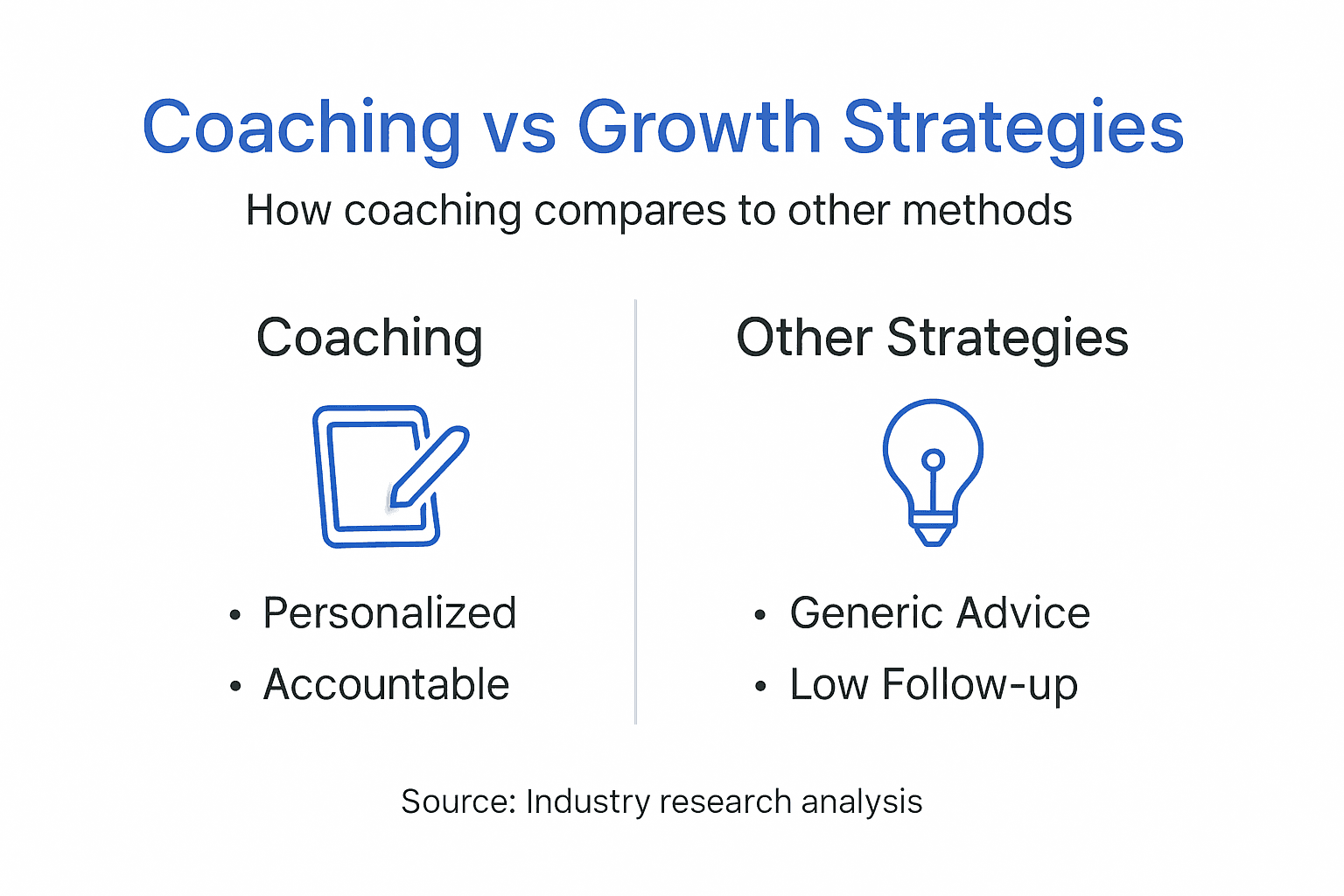
Peer advisory groups offer valuable networking and perspective-sharing but lack the individualized attention coaching provides. You might hear how someone else solved a problem, but applying that solution to your unique context requires translation work. Coaching gives you direct support for that application.
Self-education through books, courses, and conferences delivers knowledge at low cost but struggles with accountability and personalization. Most business owners have shelves of unread books and unfinished courses. The missing element isn’t information but the structure and support to implement what you learn.
Investing in coaching addresses these gaps by combining knowledge transfer with personalized application and consistent accountability. You’re not choosing coaching instead of other learning methods but rather using coaching to maximize the value of everything else you’re doing.
Practical Guidance: Selecting and Working With a Professional Coach
Choosing the right coach significantly impacts your results, so approach this decision thoughtfully. Start by identifying your specific goals. Are you focused on revenue growth, operational efficiency, leadership development, or work-life balance? Clear objectives help you find coaches with relevant expertise and measure progress accurately.
Research potential coaches thoroughly. Look for demonstrated experience working with SME owners in situations similar to yours. A coach who has helped businesses scale from $1M to $5M in revenue understands the challenges you face better than someone who primarily works with Fortune 500 executives. Check credentials, but prioritize real-world results over certifications alone.
Follow these steps for selecting and working with a professional coach:
- Define your top three business challenges and desired outcomes
- Interview at least three coaches to assess compatibility and approach
- Request and contact client references from similar businesses
- Clarify the coaching structure, frequency, and expected time commitment
- Establish clear success metrics before your first official session
- Commit to consistent participation and homework completion
- Review progress quarterly and adjust focus areas as needed
Compatibility matters as much as expertise. You’ll share challenges, frustrations, and vulnerabilities with your coach, so choose someone you trust and respect. During initial conversations, notice whether the coach listens carefully, asks insightful questions, and demonstrates genuine interest in your success. These qualities predict a productive relationship better than impressive resumes.
Pro Tip: Test the relationship with a short-term engagement before committing to a year-long contract. A three-month trial lets you experience the coach’s style and assess early results with limited risk.
Once you’ve selected a coach, maximize the investment by preparing for each session, completing agreed-upon actions, and communicating openly about what’s working and what isn’t. Performance coaching works best when you view it as a partnership rather than a service you passively consume.
Understanding the role of a business coach helps set realistic expectations. Your coach facilitates your growth but cannot do the work for you. The value comes from the combination of their guidance and your committed action.
Real-World Impact: Case Studies and Success Stories
The true test of coaching lies in measurable outcomes achieved by business owners like you. Real examples demonstrate how strategic guidance and accountability translate into tangible business improvements and personal freedom.
Consider a manufacturing company owner who engaged professional coaching while revenue plateaued at $3M annually. Within 18 months of focused coaching on sales strategy and team development, revenue reached $8M. More importantly, the owner reduced personal work hours from 70 to 45 per week by delegating operational responsibilities to a capable management team. This represents exactly the kind of growth and freedom Summit SCALE clients experience.
Another SME owner in professional services struggled with inconsistent cash flow and client acquisition. Coaching sessions identified pricing strategies and sales processes that increased average project values by 40%. The owner also implemented financial controls that stabilized cash flow, eliminating the stress of meeting payroll. Six months post-coaching, the business generated 30% higher profit margins while the owner took a two-week vacation for the first time in five years.
Common results from effective coaching include:
- Revenue increases of 50-200% within 12-24 months
- Owner time reduction of 10-15 hours weekly through better systems
- Improved team performance and reduced turnover
- Enhanced decision-making confidence and strategic clarity
- Better work-life balance and reduced business-related stress
Client testimonials consistently highlight accountability as a key differentiator. One retail business owner noted that knowing she had to report progress to her coach motivated action on challenging priorities she had postponed for months. Another owner credited coaching with helping him recognize and change limiting beliefs about delegation that had kept him trapped in operational details.
The 7x ROI figure represents an average, but individual results vary based on engagement level, business readiness, and market conditions. Owners who fully commit to the process and implement recommendations typically see results on the higher end of the range. Those who participate sporadically or resist uncomfortable changes see more modest improvements.
These success stories share common elements: clear goals, consistent effort, openness to change, and patience for strategies to mature. Coaching accelerates progress but doesn’t eliminate the work required to build a successful, sustainable business.
Unlock Growth, Profit, and Freedom With Summit SCALE® Coaching
If the strategies and outcomes described here resonate with your ambitions, Summit SCALE offers the expertise and structure to transform your business. Our coaching programs specifically address the challenges facing small to medium-sized business owners seeking sustainable growth and greater personal freedom.
We’ve helped dozens of entrepreneurs achieve the kind of results discussed throughout this article. Our approach combines strategic planning, leadership development, and operational optimization tailored to your unique situation. You won’t get generic advice but rather personalized guidance based on proven frameworks and real-world experience.
Starting is straightforward. We begin with a comprehensive assessment of your current situation, goals, and obstacles. This foundation ensures your coaching plan addresses your highest priorities and delivers measurable progress quickly. From there, regular sessions keep you accountable while providing the strategic support you need to navigate growth challenges confidently.
Many business owners discover that investing in coaching represents the turning point in their journey from working in the business to truly leading it. When you understand the role of coaching for SME growth and commit to the process, you position yourself for the kind of transformation others only dream about. Our proven methods for coaching in scaling your business have helped owners just like you achieve remarkable results while reclaiming their time and rediscovering why they became entrepreneurs in the first place.
Frequently Asked Questions About Professional Coaching
Is professional coaching suitable for all business sizes and industries?
Professional coaching delivers value across diverse industries and business sizes, though it particularly benefits SME owners focused on growth and leadership development. The key is selecting a coach with relevant industry knowledge or proven ability to translate principles across sectors. Manufacturing, professional services, retail, and technology companies all successfully leverage coaching when matched with appropriate expertise.
How long does it take to see results from professional coaching?
Initial improvements in clarity, confidence, and decision-making often appear within the first few weeks of coaching. Measurable financial results like revenue increases and profit margin improvements typically emerge within three to six months, depending on your engagement level and implementation consistency. Sustainable transformation usually requires a 12-month commitment for deep behavioral and organizational changes to take root.
What should I look for when choosing a professional coach?
Prioritize demonstrated SME business experience, documented client results, and compatible communication styles when selecting a coach. Verify their coaching methodology aligns with your learning preferences and business philosophy. Always interview multiple candidates and speak with current or former clients before committing. Chemistry and trust matter as much as credentials and experience.
Can professional coaching replace the need for consulting or mentoring?
Coaching complements rather than replaces consulting’s technical expertise or mentoring’s experience-sharing benefits. Consultants provide specialized solutions for specific problems, mentors offer guidance based on their journey, and coaches focus on developing your capability to solve problems independently. Most successful business owners leverage all three at different times, using coaching as the foundation for sustainable growth and personal development.

