
TL;DR:
- Ambition alone does not sustain business growth; accountability, when embedded into daily routines, turns vision into measurable results.
- Entrepreneurs should focus on impact-driven metrics like profit margins and cash flow, avoiding vanity measures that mislead progress.
Ambition is the spark that starts every business, but it rarely keeps the engine running. Many entrepreneurs pour everything into their vision, yet still find themselves spinning their wheels, working longer hours for diminishing returns, wondering where the momentum went. The uncomfortable truth is that drive alone does not create sustainable growth. What separates thriving SME owners from those stuck in survival mode is something far more structured and purposeful: accountability. When properly embedded into your daily rhythm, accountability transforms vision into measurable results, turning good intentions into operational excellence that you can see, track, and build upon.
Table of Contents
- What accountability really means for entrepreneurs
- The solo accountability loop: a proven three-step framework
- Choosing the right metrics: avoiding vanity and driving results
- Building accountability into team and stakeholder relationships
- What most entrepreneurs overlook about accountability
- Accelerate your growth with expert coaching and systems
- Frequently asked questions
Key Takeaways
| Point | Details |
|---|---|
| Structure beats willpower | Accountability systems with regular routines drive consistent entrepreneurial progress. |
| Track what matters | Focus on metrics that influence cash flow and growth to avoid wasted effort. |
| Balance people and process | Combine human support with data tracking for the most sustainable improvements. |
| Avoid accountability pitfalls | Steer clear of vanity metrics and punitive approaches to create a culture of growth. |
What accountability really means for entrepreneurs
Let’s be honest. The word “accountability” gets thrown around a lot. You’ll hear it in leadership seminars, read it in management books, and nod along in business meetings. But what does it actually mean for a business owner working in the real world?
Accountability, in an entrepreneurial context, is not about blame. It is not about policing yourself or your team. It is the practice of being answerable for your outcomes, not just your efforts. There is a meaningful difference between saying “I worked hard this week” and “I moved the needle on revenue by three per cent.” One measures activity, the other measures impact. That shift in perspective is where real operational efficiency begins.
The role of accountability in coaching is well established: it creates the structure that transforms coaching insights into tangible business actions. Without accountability, even the best strategy remains theoretical.
Here is why this matters for SME owners specifically:
- Clarity over chaos: When you know exactly what you are accountable for, decision-making becomes faster and less stressful.
- Execution over intention: Accountability closes the gap between planning and doing, which is the most common failure point for growing businesses.
- Focus over busyness: It forces you to prioritise the activities that genuinely move your business forward rather than filling days with low-value tasks.
- Resilience over reaction: A structured accountability system means you respond to challenges with data and confidence rather than emotion.
“Accountability is closely tied to measurement methodology in operations: translating strategy into metrics like margins, productivity ratios, and cash-flow discipline helps create execution discipline.”
The point here is powerful. Accountability without measurement is simply wishful thinking. When you attach your goals to a small set of directly influential operating metrics, you give accountability its teeth.
With a clear definition established, we shift to the specific systems entrepreneurs can adopt to embed accountability into their daily workflow.
The solo accountability loop: a proven three-step framework
Now that we have set the foundation, let us break down a specific, actionable system you can implement, especially if you are running a business solo or with a small team. The challenge for many entrepreneurs is that traditional accountability structures, like performance reviews or management hierarchies, simply do not apply. You need something leaner and more self-directed.

The solo accountability loop offers exactly that: a repeating methodology that combines daily self-tracking, weekly human check-ins, and monthly strategic reviews into a cycle that keeps you honest, focused, and consistently progressing.
The three steps in detail
-
Daily self-tracking: At the end of each working day, spend ten minutes reviewing what you completed, what you did not, and why. Rate your effort and output honestly. This is not about guilt; it is about building self-awareness. Consider using a simple journal or tracking work goals with a digital tool that integrates with your workflow. The key is consistency over perfection.
-
Weekly human check-ins: Once per week, speak with an accountability partner, a business peer, or a coach. Share what you committed to, what you achieved, and what blocked you. This step is critical because human connection creates a layer of commitment that self-tracking alone cannot replicate. Knowing someone will ask the questions keeps you honest in ways a spreadsheet never will.
-
Monthly strategic reviews: At the close of each month, step back from the operational detail and look at the bigger picture. Assess your key business metrics, review your goals for the quarter, and recalibrate as needed. This is where you connect the dots between daily efforts and long-term direction.
The power of this loop comes from its rhythm. Performance coaching for business growth consistently reinforces that sustainable progress requires regularity, not intensity. Short, frequent accountability touchpoints outperform annual reviews every time.
| Accountability step | Frequency | Time investment | Primary benefit |
|---|---|---|---|
| Daily self-tracking | Every working day | 10 minutes | Self-awareness and focus |
| Weekly human check-in | Once per week | 30 to 60 minutes | Commitment and honest reflection |
| Monthly strategic review | Once per month | 2 to 3 hours | Direction and metric alignment |
Pro Tip: Set your weekly check-in at the same time and day each week. Treat it with the same seriousness as a client meeting. Inconsistency is the fastest way to unravel any accountability system you build.
Choosing the right metrics: avoiding vanity and driving results
With your accountability routine set, the next step is ensuring you measure what truly matters. Here is how to choose metrics that correlate with real-world progress rather than simply making you feel productive.
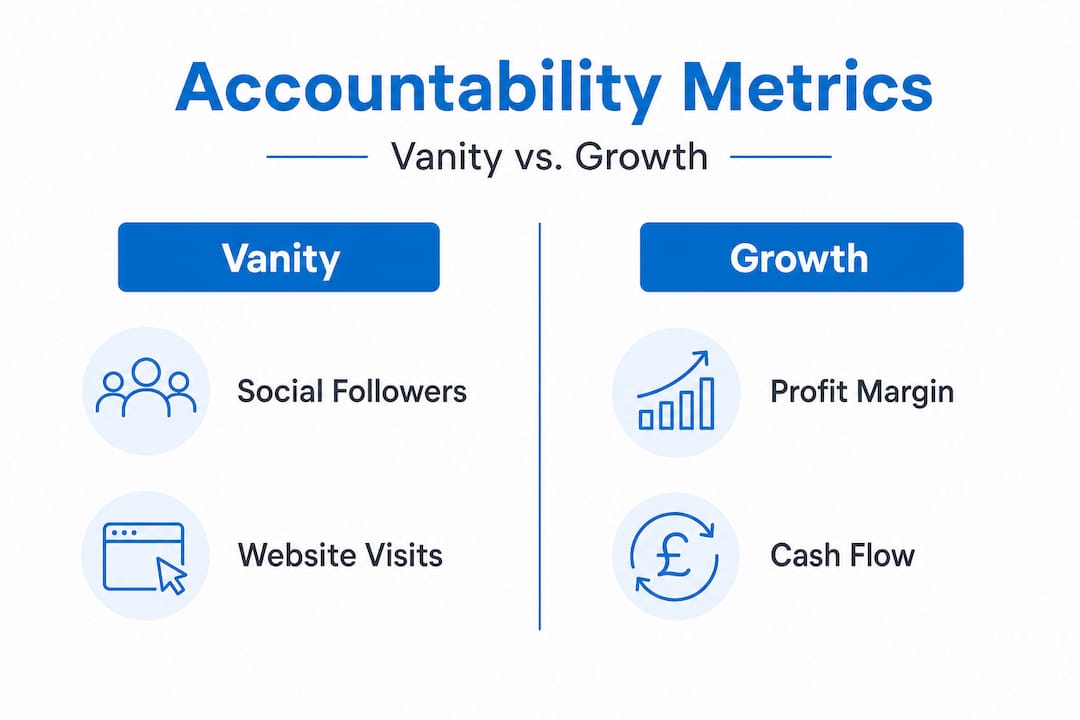
One of the most common mistakes SME owners make is tracking the wrong things. Website visits, social media follower counts, email open rates: these figures feel meaningful because they are easy to see and can go up quickly. But they are what experts call “vanity metrics.” They look good on a dashboard but rarely correlate with revenue, profitability, or operational efficiency.
As a manager’s guide to accountability makes clear, the pitfall lies in choosing metrics tied to activity rather than outcomes. When metrics are used to trigger fear or simply track how busy people look, they lose their strategic value entirely.
So what should you measure? Think about metrics that are directly connected to the health and growth of your business:
- Gross profit margin: Are you actually keeping enough from each sale to sustain and grow?
- Cash flow: Do you have visibility on when money comes in and goes out each month?
- Days Sales Outstanding (DSO): How long does it take for customers to pay you? A high DSO is a silent cash-flow killer.
- Customer acquisition cost (CAC): Do you know what it costs you to win each new client?
- Revenue per employee: Are your team members productive enough to justify the investment?
The principle of translating strategy into operating metrics is about selecting a small number of indicators that directly influence your profit and loss. Less is genuinely more here. Three to five well-chosen metrics will give you more clarity than a sprawling dashboard of twenty.
Understanding profitability and growth metrics is a crucial step for any business owner who wants to make confident decisions based on data rather than instinct alone.
| Metric type | Example | What it tells you |
|---|---|---|
| Vanity metric | Social media followers | Brand awareness only, not conversion |
| Operational metric | Gross profit margin | Actual profitability of your sales |
| Efficiency metric | Revenue per employee | Productivity and team ROI |
| Cash metric | Days Sales Outstanding | Speed of cash collection |
| Growth metric | Customer acquisition cost | Sustainability of growth spend |
Pro Tip: Revisit your chosen metrics every quarter and ask one honest question: “Is this number actually influencing my decisions?” If the answer is no, replace it with one that does. Metrics should evolve as your business matures.
Consider also tracking work accomplishments at a personal level alongside your business figures. Combining professional metrics with personal performance data creates a complete picture of where you are gaining ground.
Building accountability into team and stakeholder relationships
While personal systems are critical, scaling accountability means embedding these principles in team and stakeholder interactions. If you are leading a team, whether two people or twenty, the way you structure accountability within those relationships will either fuel your growth or quietly undermine it.
The goal is not to create a culture of surveillance or pressure. In fact, punitive accountability is one of the fastest ways to destroy team morale and trust. Instead, the most effective approach connects individual performance to the broader mission of the business, making every team member feel that their contribution genuinely matters.
Entrepreneur.com advises aligning goals with the company mission, using clear milestones and checkpoints, fostering transparency, and using metrics as a tool for improvement rather than fear. That last point deserves emphasis. When your team associates accountability with growth rather than criticism, they become active participants in the process rather than reluctant observers.
Here are practical strategies to build positive team accountability:
- Connect individual goals to company outcomes: Every team member should understand how their daily work contributes to the overall business mission. This creates intrinsic motivation alongside external accountability.
- Use regular meeting rhythms: Weekly or fortnightly check-ins that focus on progress rather than problems keep the team aligned and informed. Structure these meetings with clear agendas so they are productive every time.
- Make commitments visible: When team members share their weekly priorities openly, peer accountability naturally emerges without the need for top-down pressure.
- Celebrate milestones openly: Recognising progress publicly reinforces the behaviours you want to see repeated.
Rethinking your business coaching workflow to include structured team check-ins can make an immediate difference to execution quality and team cohesion.
“A team shifted from monthly status reports to brief, focused weekly check-ins tied to specific milestones. Within six weeks, project completion rates improved by over 30 per cent, and team members reported feeling more connected to the company’s direction.”
The structure of your meetings matters too. Ensuring your professional business meetings are productive every time is not just about efficiency. It signals to your team that their time is valued, which builds the trust that underpins genuine accountability.
What most entrepreneurs overlook about accountability
Here is a perspective that most business growth articles will not tell you. The entrepreneurs we see struggling most with accountability are not the ones who lack ambition. They are the ones who are outstanding at setting goals and genuinely terrible at following through with the same energy two months later.
Goal-setting has become almost a ritual in entrepreneurship. Vision boards, annual planning retreats, quarterly OKRs: the tools are everywhere and many business owners use them enthusiastically. But sustained follow-through? That is rare. And the reason is simple: goals alone create excitement, but they do not create structure. Excitement fades. Structure does not.
The entrepreneurs who genuinely thrive are those who combine three elements simultaneously: hard numbers (metrics that do not lie), other people (partners, coaches, peers who ask difficult questions), and consistent rhythm (regular touchpoints that make accountability a habit rather than an event). Remove any one of these three and the whole system becomes fragile.
Here is the part that might challenge your current approach. The biggest breakthroughs in accountability rarely come from a better spreadsheet or a more sophisticated tracking tool. They come from candid conversations. The kind where someone looks at your numbers with you and asks the question you have been avoiding. That is where entrepreneurial mentorship creates genuine leverage: not by giving you answers, but by asking better questions than you would ask yourself.
Our challenge to you is this: try one month of radical transparency with your team or adviser. Share your real numbers, your real concerns, and your real gaps. Notice what shifts. You might be surprised to discover that the accountability you were most afraid of is precisely the thing your business needed most.
Accelerate your growth with expert coaching and systems
If you are ready to operationalise what you have learnt, expert support can accelerate your results and strengthen your accountability frameworks far beyond what self-directed effort can achieve alone.

At Summit SCALE, we work with SME owners who are ready to move beyond good intentions and build the kind of structured, measurable accountability that produces real business growth. Our coaching programmes are designed to help you implement the exact frameworks explored in this guide, from choosing the right operating metrics to embedding accountability rhythms across your team and stakeholders. Whether you are just starting to build your systems or looking to scale what already works, we provide tailored support that meets your business where it is. Explore why investing in business coaching pays dividends, discover the role of coaching in profitability, or learn how entrepreneur development programmes can compress your growth timeline. Book a free 15-minute assessment call and take the first structured step forward.
Frequently asked questions
What is the difference between accountability and responsibility in entrepreneurship?
Responsibility refers to assigned tasks or duties, while accountability means being answerable for results and outcomes, ensuring follow-through and measurable improvement over time.
How can small business owners make accountability stick long term?
Use structured check-ins, track key metrics consistently, and review performance on a regular schedule so that accountability becomes a habit; the solo accountability loop combining daily tracking, weekly check-ins, and monthly reviews is one proven approach.
Which metrics should entrepreneurs track for effective accountability?
Choose metrics directly linked to profitability and operations, such as gross profit margin, cash flow, and productivity ratios; as noted in the operating metrics framework, a small set of influential metrics creates far stronger execution discipline than a broad dashboard of activity figures.
Is there a simple accountability system for solo entrepreneurs?
Yes, the solo accountability loop is specifically designed for solo operators, combining daily self-tracking, weekly human check-ins, and monthly strategic reviews into a repeating cycle that builds momentum over time.
How can teams avoid the downside of punitive accountability?
Focus on transparency, shared milestones, and using metrics as tools for growth rather than blame; a manager’s guide emphasises aligning individual goals with the broader company mission to make accountability feel purposeful rather than punitive.

