
TL;DR:
- Most business owners delay conducting assessments until problems arise, risking preventable crises. Regular evaluations reveal operational, financial, and market insights, enabling proactive growth and resilience. Embedding assessments into routine management, complemented by coaching, maximizes long-term success and sustainable scaling.
Most business owners only think about getting a formal review when something has gone wrong. Revenue dips, team friction builds, or the numbers just stop making sense. But waiting for a crisis to ask hard questions about your business is a bit like ignoring the warning light on your dashboard until the engine fails. Knowing why you should schedule a business assessment before problems surface is one of the most underrated habits of owners who genuinely scale. This guide covers what a business assessment is, when to schedule one, and how to turn its findings into real, lasting progress.
Table of Contents
- What is a business assessment and why it matters
- Core components and process of a business assessment
- When and why small businesses should schedule assessments
- Key financial and operational metrics to track with assessments
- How to make the most of your business assessment results
- Rethinking business assessments: beyond the one-time check-up
- Unlock your business potential with professional coaching and assessments
- Frequently asked questions
What is a business assessment and why it matters
To understand why scheduling a business assessment is essential, first we need to clarify exactly what one is and what it covers.
A business assessment is not an audit. It is not a forecast. It is, as described by business advisors, “a structured, honest review of operations, finances, market position, and risks to inform decisions.” Think of it as turning the mirror around on your business so you can see it clearly, without bias, and without the blind spots that come from being too close to the day-to-day.
What does a thorough assessment actually look at?
- Financial health: Cash flow, profitability, cost structure, and revenue trends
- Operational efficiency: How work gets done, where bottlenecks live, and which processes waste time or money
- People and leadership: Team capacity, gaps in skills, and whether the right people are in the right roles
- Market position: How you compare to competitors and where your real growth opportunities lie
- Systems and technology: Whether your tools support or hinder your team’s output
The importance of business evaluation at this level is that it replaces guesswork with evidence. You stop making decisions based on how things feel and start making them based on how things are. Using a business assessment tool can help you begin this process in a structured way, even before engaging external support.
Core components and process of a business assessment
Now that you know what a business assessment is, let us look at which parts of your business it typically covers and how the process unfolds.
Business assessments review operations, finances, leadership, systems, and growth potential before producing clear, actionable recommendations. That breadth is precisely what makes them so valuable. You are not just checking one lever. You are reviewing the whole machine.
A well-run assessment typically follows these steps:
- Leadership conversations: Structured interviews with founders and key managers to surface priorities, frustrations, and blind spots
- Team input: Gathering frontline perspective on where friction exists in daily operations
- Data review: Examining financial statements, KPIs, customer data, and operational metrics
- Gap analysis: Comparing current performance against benchmarks and business goals
- Report and recommendations: Producing a documented output with prioritised findings and clear next steps
| Assessment area | What is evaluated | Why it matters |
|---|---|---|
| Finances | Margins, cash flow, cost ratios | Identifies profitability leaks |
| Operations | Workflows, bottlenecks, output | Reveals inefficiency and waste |
| Leadership | Decision-making, culture, clarity | Uncovers people-related risk |
| Systems | Tools, processes, automation | Highlights productivity barriers |
| Growth potential | Market fit, pipeline, capacity | Points to untapped opportunity |
The output is not a document to file away. It becomes your roadmap. Revisit it monthly. Track progress against it. Use it to shape your long-term business planning so that each quarter builds on the last.
Pro Tip: Treat your assessment report as a living document. Schedule a 30-minute review each month to check whether your priorities have shifted and whether your actions are producing the results you expected.
When and why small businesses should schedule assessments
Understanding the assessment process helps, but when should you actually schedule one? Here are the key triggers and timing advice.
Schedule assessments when results fluctuate, growth stresses your systems, or month-end close delays occur, to realign your strategy and operations. But do not wait for those signals to become crises. Early assessment is always cheaper than crisis management.
Here are the clearest signs it is time to schedule one:
- Inconsistent results: Your revenue swings without a clear reason, and you are not sure what is driving it
- Rapid growth stress: The business is growing but feeling increasingly chaotic and difficult to manage
- Delayed financial closes: Your team struggles to produce timely, accurate financial reports
- Team tension: Roles feel unclear, accountability is slipping, and conflict is rising
- A significant decision ahead: Hiring a senior leader, launching a new service, or entering a new market
Beyond reactive triggers, the best approach is to build assessments into your calendar proactively. A full strategic review annually, supported by quarterly operational check-ins, gives you a rhythm of clarity. Your business planning checklist can help anchor these reviews to the right milestones throughout the year.
Pro Tip: If you have never done a formal assessment before, do not wait for the “perfect” time. A business at any stage, whether you are two years in or twenty, benefits from seeing itself clearly.
Key financial and operational metrics to track with assessments
Having decided to schedule an assessment, it is important to know which financial and operational indicators you should prioritise monitoring.

UK SMEs tracking 10 KPIs quarterly, including debtor days, cash runway, and net profit margin, gain early warning signals that allow timely intervention. Numbers only become useful when you know what they are telling you.
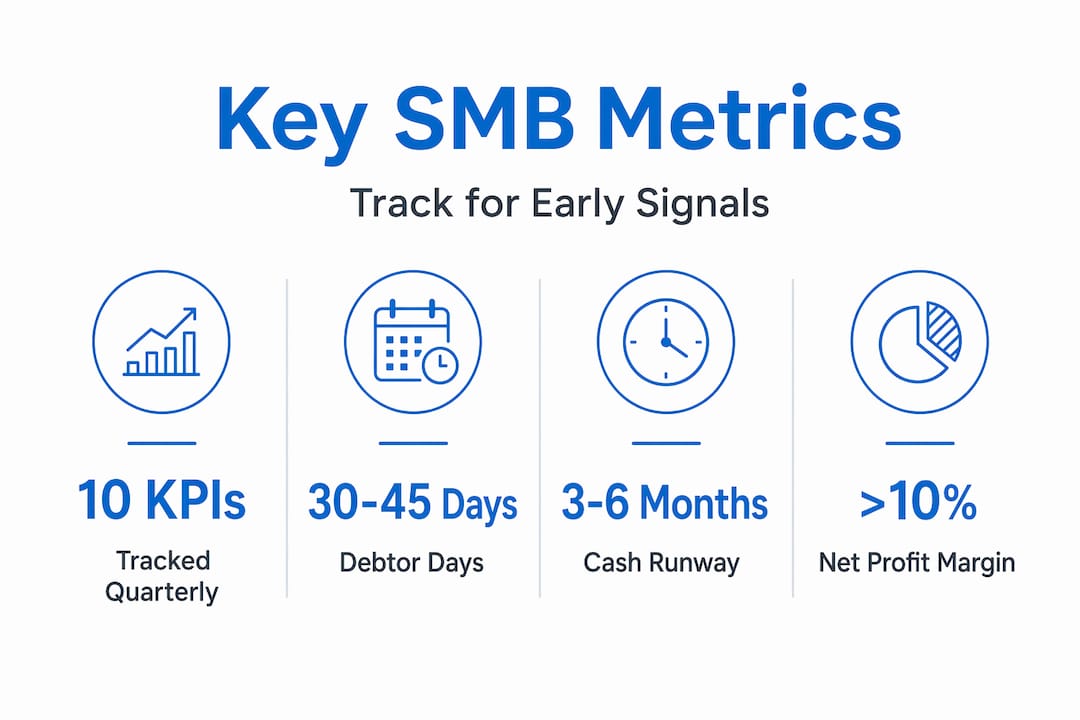
Here are the critical metrics your business performance review should include:
| Metric | Target range | What it tells you |
|---|---|---|
| Debtor days | 30-45 days | How quickly clients pay and where cash is being held |
| Cash runway | 3-6 months | How long the business can operate without new revenue |
| Net profit margin | 10% or above | The true efficiency of your revenue generation |
| Revenue per employee | Varies by industry | Team productivity and capacity utilisation |
| Customer acquisition cost | Lower than lifetime value | Sustainability of your sales and marketing spend |
Missing any of these metrics in a review is not just a gap in data. It is a blind spot that compounds over time. For example, a business with strong revenue but debtor days creeping above 60 is quietly building a cash crisis. An assessment catches that trend before it becomes a threat.
Regular financial health checks also surface opportunities. If your net profit margin is below 10%, the assessment will point to where costs can be reduced or pricing adjusted. If your cash runway is tight, it highlights the need to accelerate collections or restructure payment terms. These insights directly support increasing business valuation, because a buyer or investor reads your numbers exactly the same way.
How to make the most of your business assessment results
Finally, let us explore how to turn assessment insights into real improvements that drive your business forward.
Actionable recommendations after assessments improve efficiency and position SMBs for growth within weeks to months when implemented properly. The difference between a business assessment that changes everything and one that gathers dust is entirely in how you act on the findings.
Here is a practical approach to making your results count:
- Prioritise by impact and urgency: Score each finding using a simple Impact x Urgency matrix. Address high-impact, urgent issues first. Do not let the long list paralyse you.
- Assign ownership: Every action item needs a named owner and a deadline. Vague commitments fade. Specific accountability drives change.
- Set a 90-day sprint: Focus your team on the top three to five improvements within the next 90 days. Small wins build momentum and confidence.
- Schedule a follow-up review: Book your next check-in before you leave the current one. Progress only compounds when it is measured.
- Engage support where needed: For complex operational changes or team restructuring, consider whether external expertise would accelerate results.
Optimising business processes based on assessment findings is one of the fastest routes to improved margins and team morale. You are not reinventing the business. You are removing what is slowing it down.
The professional coaching benefits for business owners who implement assessments with guidance are well-documented. A coach helps you interpret findings without bias, set realistic timelines, and maintain accountability through the uncomfortable parts of change.
Pro Tip: Use the Impact x Urgency scoring method on every action item that comes out of your assessment. Give each a score from one to five for both dimensions, multiply them, and rank the results. It removes emotion from prioritisation and keeps your focus where it matters most.
Rethinking business assessments: beyond the one-time check-up
Here is an uncomfortable truth that many coaches and consultants are reluctant to say plainly: a single business assessment, however thorough, will not transform your business. What transforms a business is the habit of honest, regular evaluation.
Many SMBs treat assessments as one-time events, but regular reviews catch issues early and build planning rhythm. That reactive, occasional approach limits the value enormously. An assessment done once in response to a problem is like seeing a doctor only when you are already ill. It helps, but it misses the whole point of preventive care.
The businesses we see build genuine resilience are the ones that make evaluation part of their culture, not just their calendar. Monthly KPI reviews, quarterly operational check-ins, and an annual strategic review create a layered system of awareness. Problems surface earlier. Opportunities are spotted faster. Decisions become cleaner because the data is always current.
There is also something powerful about the documentation that comes from regular assessments. When you have 12 months of structured reviews, you stop managing your business from memory and start managing it from evidence. You can trace exactly when a trend began, what decision triggered an improvement, and where a gap was first identified. That clarity is not just useful. It is genuinely freeing.
Investing in coaching alongside consistent assessments unlocks another layer of value. A skilled coach does not just review findings with you. They help you develop the self-awareness and leadership capacity to act on them without falling back into old patterns. Your business will never outgrow you as a leader, so growing yourself and your business simultaneously is the most durable path to scale.
The mindset shift we encourage is this: stop seeing a business assessment as something you do to your business when it needs fixing, and start seeing it as something you do with your business because you are committed to its growth.
Unlock your business potential with professional coaching and assessments
You now understand the genuine depth and value that a well-structured business assessment can bring. But knowledge alone does not drive change. Knowing where to look is only half the work. Having the support to act on what you find is what moves the needle.
At Summit SCALE, we guide SMB owners through the full assessment journey, from scheduling and interpreting findings to building action plans that deliver measurable results. Our coaching is tailored to where you are now and where you genuinely want to go. If you are ready to gain clarity, build confidence, and lead your business with real focus, explore why invest in coaching and discover the role of coaching for SMEs. When you are ready to take the next step, unlock business optimisation and start building a business that works as hard as you do.
Frequently asked questions
What is the main purpose of a business assessment?
The main purpose is to provide an honest, structured review of your company’s operations, finances, and market position so you can make informed, evidence-based decisions rather than relying on assumptions or gut feel.
How often should small businesses conduct business assessments?
Small businesses should complete a full assessment at least annually, but the best results come from combining that with quarterly operational reviews and monthly KPI tracking to maintain a consistent planning rhythm.
What financial metrics are most important in a business assessment?
The three most critical are debtor days targeting 30-45 days, a cash runway of three to six months, and a net profit margin above 10%, as these give the clearest picture of financial health and sustainability.
Can I conduct a business assessment myself?
Yes. Self-assessments using SWOT analysis and basic financial reviews are a strong starting point, though businesses facing major decisions or periods of stagnation benefit significantly from the objectivity an independent third party brings.
How do business assessments improve profitability?
Assessments surface inefficiencies and misalignments that quietly drain profit, and the resulting action plans give you a clear path to working smarter, reducing unnecessary costs, and aligning your team around higher-value activities.

