
Small business owners lose 96 minutes daily to unproductive activities, yet many underestimate this drain on their success. Effective time management isn’t just about squeezing more tasks into your day. It’s about reclaiming control, focusing on strategic growth, and transforming how you run your business. This guide reveals proven strategies and real examples to help you regain productive hours, reduce stress, and unlock the business outcomes you’ve been working towards in 2026.
Table of Contents
- Why Time Management Is Critical For Small Business Success
- Strategies To Prioritise And Plan Your Time Effectively
- Tools And Techniques To Maximise Focus And Productivity
- Leveraging Delegation And Automation To Free Up Time
- Monitoring And Reviewing Time Management For Continuous Improvement
- Unlock Your Business Potential With Expert Coaching
- What Is The Role Of Time Management In Business?
- How Can Small Businesses Effectively Prioritise Their Tasks?
- What Tools Support Better Time Management In Small Businesses?
- Why Is Regular Review Important For Time Management Success?
Key takeaways
| Point | Details |
|---|---|
| Strategic planning boosts productivity | Prioritising tasks using frameworks like SMART goals and the Eisenhower Matrix can reduce time on non-essential work by up to 40%. |
| Time-tracking reveals inefficiencies | Tools like Toggl and RescueTime help identify where hours disappear, enabling you to optimise workflows. |
| Delegation frees growth time | Outsourcing routine tasks and automating processes reclaim strategic planning hours for business owners. |
| Focus techniques reduce burnout | Methods like Pomodoro and Power Hour improve concentration and prevent exhaustion through structured work intervals. |
| Regular reviews sustain improvements | Weekly time audits ensure alignment with goals and maintain productivity gains long term. |
Why time management is critical for small business success
Poor time management silently steals productivity from your business every single day. Businesses lose about 20% of productivity due to ineffective time use, yet most SMB owners don’t realise how much this costs them. You’re not alone if you feel constantly busy but struggle to see real progress.
The culprit is often what experts call the tyranny of the urgent. This trap pulls you towards immediate demands like answering emails, handling customer complaints, or fixing operational hiccups. These tasks feel productive because they’re visible and pressing. However, they steal hours from strategic activities that actually grow your business, such as developing new revenue streams, building your team, or improving systems.
This reactive mindset creates a vicious cycle. You spend your days firefighting whilst important growth initiatives languish on your to-do list. The result? Increased stress, stagnant revenue, and the nagging feeling that you’re working harder without moving forward. Recognising this pattern is your first step towards breaking free.
Proactive planning changes everything. When you intentionally allocate time to both urgent and important tasks, you regain control. You create space for strategic thinking whilst still managing daily operations effectively. The small business tips for growth and work life balance approach emphasises this balance as fundamental to sustainable success.
“The key is not to prioritise what’s on your schedule, but to schedule your priorities. Most business owners confuse being busy with being productive.”
Start by acknowledging that not all tasks deserve equal attention. Some activities directly impact your bottom line and future growth. Others simply keep the lights on. Your job as a business owner is to identify which is which, then protect time for the former.
Strategies to prioritise and plan your time effectively
Begin each day with 10 to 15 minutes of focused planning. This small investment prevents hours of wasted effort later. During this time, review your goals, identify your top three priorities, and block time for them before anything else claims your attention.
Setting SMART goals and prioritising tasks provides the foundation for effective time management. SMART stands for Specific, Measurable, Achievable, Relevant, and Time-bound. Instead of vague intentions like “grow sales,” you create concrete targets such as “increase monthly recurring revenue by 15% within the next quarter through three new client contracts.” This clarity makes prioritisation straightforward because you know exactly what moves the needle.
The Eisenhower Matrix transforms how you categorise tasks. Named after President Eisenhower, this framework divides work into four quadrants based on urgency and importance. Research shows the Eisenhower Matrix reduces time on non-essential tasks by up to 40%, freeing capacity for strategic work.

| Quadrant | Urgency | Importance | Action |
|---|---|---|---|
| Do First | Urgent | Important | Handle immediately yourself |
| Schedule | Not urgent | Important | Block dedicated time |
| Delegate | Urgent | Not important | Assign to team members |
| Eliminate | Not urgent | Not important | Remove from your list |
Applying this matrix reveals surprising insights. Many tasks you handle personally belong in the delegate or eliminate quadrants. Meanwhile, crucial activities like strategic planning, team development, and system improvement sit neglected in the schedule quadrant.
Here’s how to create your daily priority list:
- List every task competing for your attention today
- Assign each task to an Eisenhower quadrant
- Identify your top three “Do First” and “Schedule” items
- Block specific time slots for these priorities in your calendar
- Batch similar tasks together to minimise context switching
- Review and adjust as urgent matters arise
Time blocking takes prioritisation further by treating your calendar as sacred. Instead of a vague list, you assign specific hours to specific tasks. This approach from business coaching workflow growth success principles ensures high-value activities actually happen rather than getting perpetually postponed.
For example, block 9am to 11am every Tuesday for strategic planning. During this window, you’re unavailable for meetings, emails, or interruptions. This protected time allows deep work on business growth objectives that require sustained concentration.
Pro Tip: Schedule your Power Hour at your peak energy time, whether that’s early morning or mid-afternoon. Use this dedicated hour exclusively for your most important project, the one that will genuinely transform your business outcomes.
Tools and techniques to maximise focus and productivity
Time-tracking tools provide objective data about where your hours actually go, often revealing surprising patterns. Time-tracking tools help identify time-consuming tasks and highlight opportunities for improvement you might otherwise miss.
Popular options include Toggl, which offers simple one-click tracking with detailed reports. RescueTime runs automatically in the background, categorising your computer activities and showing productivity scores. Clockify provides free unlimited tracking for teams, making it ideal for small businesses monitoring multiple people.
| Tool | Key Features | Pricing | Best For |
|---|---|---|---|
| Toggl | One-click tracking, detailed reports, project categorisation | Free tier, paid from £8/month | Individual owners and small teams |
| RescueTime | Automatic tracking, productivity scoring, distraction blocking | Free tier, premium £10/month | Understanding computer-based work patterns |
| Clockify | Unlimited users, timesheet approvals, project budgets | Free tier, paid from £8/user/month | Team time management and billing |
The Pomodoro Technique structures your workday into focused intervals. You work intensely for 25 minutes, then take a five-minute break. After four cycles, you take a longer 15 to 30 minute break. This rhythm prevents mental fatigue whilst maintaining high concentration during work periods.
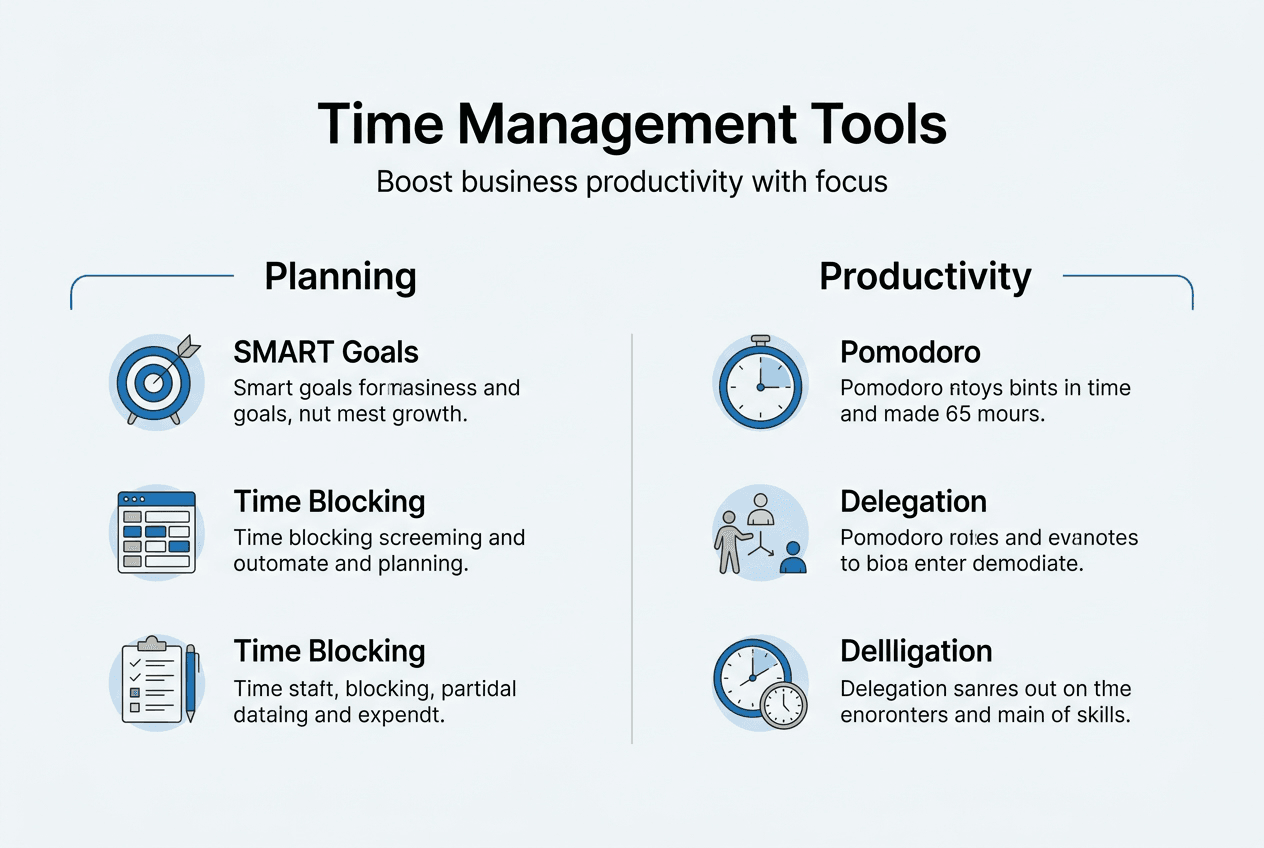
Research shows the Pomodoro technique personalises productivity and can improve work-life balance by creating clear boundaries between focused work and rest. The frequent breaks refresh your mind, preventing the burnout that comes from marathon work sessions.
Power Hour takes a different approach by dedicating one uninterrupted hour to your single most important task. No emails, no phone calls, no team questions. Just you and the work that will genuinely move your business forward. Many owners find this daily practice transforms their progress on strategic initiatives.
Benefits of these focus techniques include:
- Reduced decision fatigue through structured work periods
- Improved concentration by eliminating multitasking
- Tangible progress tracking via completed intervals
- Lower stress from regular breaks and boundaries
- Enhanced work quality through sustained attention
Pro Tip: Combine time tracking with Pomodoro by logging each 25-minute session to specific projects. After a week, you’ll have precise data showing which activities consume your time and whether they align with your priorities. This insight from delegation mastery training helps you make informed decisions about what to keep, delegate, or eliminate.
Leveraging delegation and automation to free up time
Identifying delegatable tasks starts with honest assessment. Which activities could someone else handle with proper training or systems? Common candidates include invoicing, social media posting, customer service responses, data entry, appointment scheduling, and basic bookkeeping. These tasks are necessary but don’t require your unique expertise or decision-making authority.
Delegation and automation free up time and improve business outcomes by allowing you to focus on strategic leadership. The goal isn’t to shirk responsibility but to multiply your impact by empowering others whilst you concentrate on activities only you can do.
Tasks suitable for delegation or automation include:
- Invoice generation and payment follow-up
- Social media content scheduling and posting
- Email filtering and initial customer enquiry responses
- Appointment booking and calendar management
- Expense tracking and receipt organisation
- Basic report compilation and data entry
- Routine customer onboarding processes
A compelling example comes from a small business productivity case study where implementing Salesforce automation led to 40% productivity gains. The company automated lead tracking, follow-up emails, and sales pipeline management. This freed sales staff to focus on relationship building and closing deals rather than administrative tasks.
Automated dashboards improved forecasting speed and reliability, giving leadership real-time visibility into business performance. What previously required hours of manual data compilation now updated automatically, enabling faster, more informed decisions.
Businesses that automate tasks report a 20% reduction in time spent on administrative duties. This isn’t about replacing humans but about redirecting human creativity and judgement towards higher-value activities that machines can’t replicate.
Start small rather than attempting wholesale transformation overnight. Choose one repetitive task that consumes significant time, then find a tool or process to automate it. Once that’s working smoothly, tackle the next one. This incremental approach from delegation mastery training builds confidence and capability without overwhelming your team.
“The best leaders don’t do everything themselves. They build systems and teams that multiply their impact. Every task you delegate or automate creates space for strategic thinking that grows your business.”
Pro Tip: When delegating, invest time upfront creating clear processes and training materials. This initial effort pays dividends through consistent results and reduced supervision needs. Document the task, expected outcomes, and decision criteria so team members can work independently with confidence.
Monitoring and reviewing time management for continuous improvement
Weekly review sessions keep your time management effective and aligned with evolving priorities. Weekly review sessions help stay accountable and improve time management by creating regular checkpoints for reflection and adjustment.
Here’s how to conduct a productive weekly review:
- Schedule 30 minutes every Friday afternoon or Monday morning
- Review your time-tracking data from the previous week
- Calculate your Time Utilisation Rate by dividing productive task time by total work hours
- Identify your three biggest time wasters and plan specific countermeasures
- Assess progress towards your quarterly goals and adjust priorities accordingly
- Plan next week’s schedule, blocking time for your top priorities first
- Note what worked well and what needs improvement
Time Utilisation Rate provides a simple metric for assessing productivity. If you worked 50 hours but only 30 were spent on tasks aligned with your goals, your utilisation rate is 60%. This number reveals whether you’re truly productive or just busy. Tracking it weekly shows whether your time management improvements are working.
Focus areas for your review include:
- Progress towards specific business goals and milestones
- Time spent on strategic versus reactive activities
- Effectiveness of delegation and automation implementations
- Alignment between daily tasks and quarterly objectives
- Energy levels and signs of approaching burnout
Statistic Callout: Companies like Basecamp reduced burnout by 30% with better time management and a four-day workweek. This demonstrates that working smarter, not longer, produces better outcomes for both business performance and personal wellbeing.
Adapting work patterns based on review insights creates continuous improvement. Perhaps you discover that client meetings drain your energy, so you batch them on specific days. Or you find that deep work happens best in early morning, prompting you to protect those hours fiercely. These adjustments compound over time, gradually optimising your entire approach.
The 6-step small business checklist for growth and freedom emphasises regular assessment as essential for sustainable scaling. Without periodic review, even excellent systems gradually drift off course as circumstances change.
Pro Tip: Involve your team in time management reviews. Ask them to track their own time and identify bottlenecks or inefficiencies. This collective accountability creates a culture of continuous improvement whilst surfacing insights you might miss from your perspective alone. When everyone owns productivity, results multiply.
Unlock your business potential with expert coaching
Mastering time management strategies transforms your business, but implementing them consistently whilst handling daily operations can feel overwhelming. Professional coaching accelerates this journey by providing tailored guidance, accountability, and proven frameworks specific to your situation.
Summit SCALE offers specialised coaching for SME owners and managers focused on practical implementation of growth strategies. Services include delegation mastery training that teaches you to build capable teams, leadership development that enhances decision-making, and workflow optimisation that creates sustainable systems.
Investing in coaching delivers measurable returns through faster scaling, improved profitability, and the business freedom you started your company to achieve. Expert guidance helps you avoid costly mistakes, implement best practices efficiently, and maintain momentum through inevitable challenges.
What is the role of time management in business?
Time management organises and plans how you divide hours between activities to maximise productive outcomes. It improves decision-making by ensuring you allocate attention to tasks that genuinely drive business growth rather than simply reacting to whatever feels urgent. Effective time management prevents burnout by creating sustainable work rhythms with appropriate breaks and boundaries. It directly connects to achieving business goals efficiently because it ensures your daily actions align with strategic objectives rather than drifting towards busywork.
How can small businesses effectively prioritise their tasks?
Use SMART goals to set clear, measurable priorities that guide daily decisions. Apply the Eisenhower Matrix to divide tasks by urgency and importance, then focus on activities that are important regardless of urgency. Start each day with 10 to 15 minutes planning your top three tasks, blocking time for them before anything else claims your attention. This proactive approach ensures strategic work happens rather than getting perpetually postponed.
What tools support better time management in small businesses?
Time-tracking applications like Toggl, RescueTime, and Clockify provide objective data showing where hours actually go, revealing inefficiencies you might otherwise miss. Techniques such as Pomodoro enhance focus through structured 25-minute work intervals followed by short breaks. Automation tools reduce repetitive workload by handling routine tasks like invoicing, email responses, and social media scheduling, freeing your attention for strategic activities.
Why is regular review important for time management success?
Weekly reviews help identify bottlenecks and inefficiencies before they become entrenched habits consuming significant time. They ensure your daily activities remain aligned with evolving business goals rather than drifting towards comfortable but unproductive routines. Regular checks sustain productivity gains by catching problems early and celebrating successes that reinforce effective behaviours, ultimately reducing stress through visible progress and control.

