
TL;DR:
- Profitability, not revenue, is the true measure of a healthy business because it reveals efficiency after costs. Focusing on margins and operational efficiency helps prevent growth from masking underlying inefficiencies that threaten long-term value. Implementing disciplined measurement and targeted strategies, supported by coaching, ensures sustainable, balanced profit growth.
Many business owners celebrate the moment their revenue crosses a new milestone. It feels like progress, and it looks impressive on paper. But here is the uncomfortable truth: revenue alone is not proof of a healthy business. A company can generate millions in turnover and still haemorrhage value, burn through cash, and leave its owner exhausted with little to show for it. Profitability is the metric that cuts through the noise. It tells you whether your business is truly working for you, or whether you are simply working harder to fund inefficiencies you have not yet found the courage to confront.
Table of Contents
- What profitability really means for your business
- Profitability versus growth: avoiding common traps
- Setting realistic targets: benchmarking profitability in your sector
- How to focus on profitability: practical coaching frameworks
- The risks of profit-obsession: what most get wrong
- Our take: why profit is not always king
- How coaching can unlock profit the right way
- Frequently asked questions
Key Takeaways
| Point | Details |
|---|---|
| Profit reflects real value | Revenue can be misleading—profitability reveals how efficiently your business creates lasting owner value. |
| Benchmark, don’t guess | Profit targets should be set with reference to industry standards, not arbitrary numbers. |
| Prioritise high-impact levers | Focusing on pricing, product mix, and process efficiency drives profit more safely than blanket cost-cutting. |
| Profit is not the sole focus | Balance profit goals with smart investments in customer experience and growth to build a resilient business. |
What profitability really means for your business
With a clear context in mind, it is essential to dig into what profitability actually represents, and where many business owners get it wrong.
Profitability is not the same as turnover. The formula is straightforward: profitability equals revenue minus all costs, divided by revenue. What remains after every supplier, employee, overhead, and tax obligation is met is the true measure of your business’s efficiency. Yet so many owners fixate on the top line while ignoring what is happening underneath it.
There are two key profit metrics you need to understand clearly.
- Gross profit is your revenue minus the direct costs of delivering your product or service. It tells you how efficiently you create value at the delivery level.
- Net profit is what remains after every cost, including overheads, administration, marketing, and financing. This is the number that ultimately reflects owner value.
- Gross profit margin can look healthy while net profit margin is razor thin or even negative, a scenario that deceives many growing businesses.
- Revenue growth can and often does mask operational inefficiencies, poor pricing discipline, or mounting overhead creep.
“Profitability is the clearest measure of value creation after costs, and it is the lens that separates genuinely strong businesses from those merely generating activity.”
The reason this matters so much is that revenue growth alone can be misleading. You might win a large contract, celebrate the win, hire to deliver it, and then discover three months later that the margin was so thin it barely covered your additional costs. Profitability is the discipline that prevents that trap. When you learn to improve profitability as a core business habit, you shift from chasing numbers to building genuine owner value.
Profitability versus growth: avoiding common traps
Understanding profitability sets the right frame to examine how growth ambitions can actually work against your long-term value if not managed wisely.
The growth myth is deeply embedded in entrepreneurial culture. Investors celebrate it, business media glorifies it, and peer comparison reinforces it. But pushing for growth at all costs can destroy the very value you set out to build. More revenue requires more resource, more complexity, and more risk. Without a clear profit framework, scaling up simply scales your problems.
Consider two businesses with identical annual revenue of £500,000. The comparison below shows how drastically different their realities can be.
| Metric | Business A | Business B |
|---|---|---|
| Annual revenue | £500,000 | £500,000 |
| Direct costs | £150,000 | £300,000 |
| Gross profit | £350,000 (70%) | £200,000 (40%) |
| Overheads | £200,000 | £190,000 |
| Net profit | £150,000 (30%) | £10,000 (2%) |
| Owner value | Strong | Fragile |
Business B has worked just as hard as Business A, possibly harder. But its owner is one bad quarter away from a loss. The revenue figure tells you almost nothing useful on its own.
Statistic callout: Research consistently shows that many SMEs operate on net profit margins below 5%, meaning that a modest increase in costs or a dip in revenue can push the entire business into loss territory.
Focusing on profit growth strategies rather than revenue growth forces you to ask better questions. Which clients are actually profitable? Which services carry the best margin? Where is your time being spent relative to the return it generates? These are the questions that transform a busy business into a resilient one.
Understanding your profitability drivers means knowing not just where money comes in, but where it quietly leaks out.

Pro Tip: Before pursuing your next growth opportunity, calculate its projected net margin. If it falls below your current average, think carefully about whether the additional complexity and risk is genuinely worth it.
Setting realistic targets: benchmarking profitability in your sector
Once the dangers of unbalanced growth are clear, the next step is understanding what good actually looks like for your company and industry.
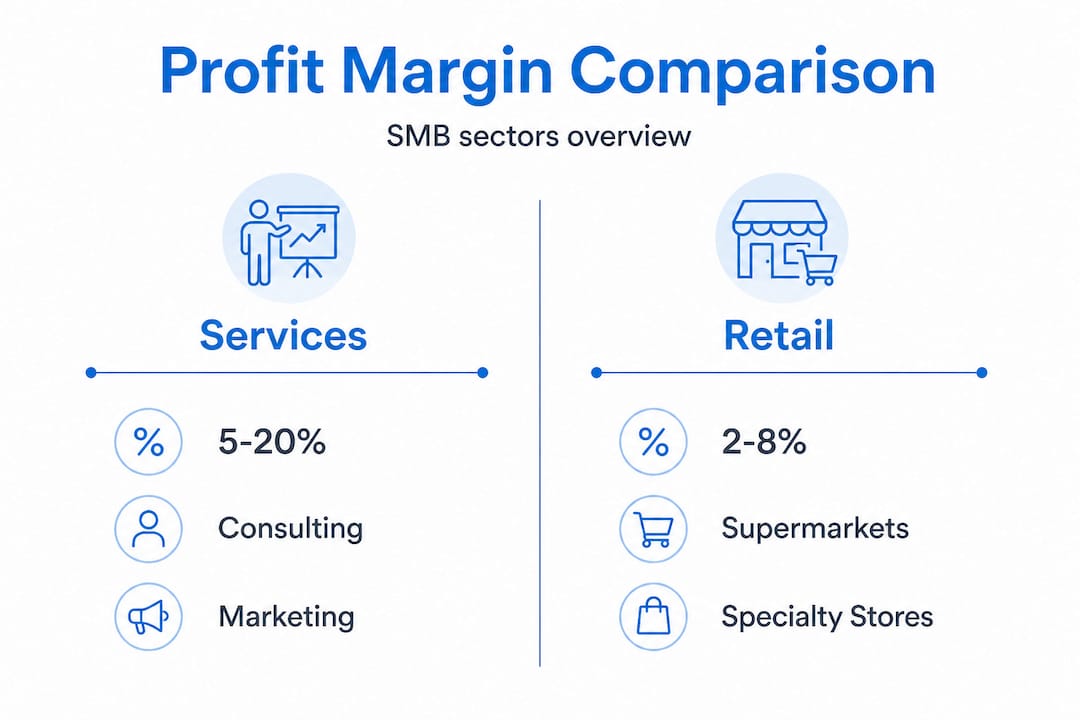
There is no single magic number that defines a healthy profit margin. A 5% net margin might be exceptional in supermarket retail but would be cause for concern in professional services. Context is everything. Profitability benchmarks are highly industry and model dependent, which is why comparing your numbers against sector-specific data is so important.
Here are approximate net profit margin ranges across selected sectors to give you a sense of the landscape.
| Industry | Typical net profit margin |
|---|---|
| Professional services | 15% to 30% |
| Construction and trades | 3% to 8% |
| Retail (general) | 2% to 6% |
| Technology / SaaS | 20% to 40% |
| Food and hospitality | 3% to 9% |
| Healthcare services | 5% to 15% |
These figures are starting points, not ceilings. Your goal should be to understand where you sit relative to your sector and then pursue a clear pathway to improvement. To do that well, follow these three steps.
- Find your sector benchmark. Use industry association reports, accountancy databases, or resources like the NYU Stern margin data to identify what is normal and what is exceptional for your type of business.
- Calculate your own margins clearly. Not just gross profit, but net profit after all real costs, including owner salary at fair market rate. Many SME owners understate costs by underpaying themselves, which inflates margins artificially.
- Set a specific, time-bound target. Saying “I want better margins” is not a plan. Committing to moving your net profit margin from 8% to 12% within 18 months is a plan. It gives you something to measure, report on, and coach against.
Accessing quality SME profitability benchmarks is one of the most practical steps you can take right now, because it replaces vague ambition with grounded clarity. Once you know your target, you can optimise profitability with precision rather than guesswork.
Pro Tip: When benchmarking, always compare like for like. A sole trader in professional services and a 20-person agency in the same field will have very different cost structures. Segment your comparison carefully.
How to focus on profitability: practical coaching frameworks
Having set your profit target realistically, here is how you can apply proven frameworks and coaching methods to steadily improve margin outcomes.
The first principle is deceptively simple: you cannot improve what you do not measure. Profitable execution for SMBs often starts with measurement, meaning you need clear, consistent visibility of your key margin metrics before you can act on them meaningfully. Many owners rely on year-end accounts rather than monthly or weekly margin tracking. That gap in awareness is where profit quietly erodes.
Here is a practical framework for building your profitability focus.
- Identify your highest-margin revenue streams. Not all products or services are equal. Some carry excellent margins; others barely cover their costs. Map your revenue by product or service line and rank by net contribution.
- Review your pricing discipline. Underpricing is one of the most common profit killers in SMEs, often driven by fear of losing clients rather than real market evidence. A modest price increase of 5% to 10% on your core offering, if well communicated, can have a dramatic effect on net profit.
- Audit your operational inefficiencies. Where does time get wasted? Which processes create rework? Where do delays cost you money? Even simple improvements in workflow can release meaningful margin.
- Optimise your product and service mix. If a service line is consistently unprofitable, the question is not how to make it cheaper but whether it belongs in your portfolio at all.
- Protect value-generating investments. Do not cut marketing, client service, or staff development in a knee-jerk drive to improve margin. These are profitability drivers in disguise.
Key habits that support sustained profit focus include:
- Reviewing gross and net margins at least monthly, not just at year end
- Setting a clear profit target as a percentage of revenue, not just an absolute figure
- Sharing relevant margin data with your leadership team so decisions are made with full awareness
- Building a quarterly rhythm of pricing reviews to ensure you are keeping pace with cost increases
The smartest move is to align profitability with growth rather than treating them as competing priorities. And when you are ready to scale, the ability to scale profits intelligently is what separates lasting businesses from short-lived ones.
Pro Tip: Fewer high-leverage changes outperform scattergun cost cutting every time. Pick two or three areas with the biggest margin impact and go deep on those before moving on to anything else.
The risks of profit-obsession: what most get wrong
Implementing profit frameworks is powerful, but without caution, some approaches can undermine your business more than they help.
There is a version of profit focus that is actually self-defeating. It goes like this: margins feel squeezed, so the owner cuts training budgets, reduces customer service staffing, delays marketing investment, and renegotiates supplier terms so aggressively that quality suffers. Short term, the numbers improve. Medium term, the business begins to hollow out.
Profitability initiatives can fail or backfire when they are interpreted purely as cost-cutting exercises. Profit is not just about spending less. It is about creating more value per pound of resource deployed. That is a very different mindset.
Here is a practical guide to distinguishing good cost control from value-destroying cuts.
- Good cost control: Eliminating duplicate software subscriptions, streamlining procurement, reducing waste in delivery processes, renegotiating contracts where quality is maintained.
- Value-destroying cuts: Reducing the quality of core product delivery, cutting client-facing service, reducing training budgets, under-investing in team development, or slashing marketing to the point where pipeline dries up.
“The businesses that build lasting profit are those that invest wisely in what creates value while ruthlessly eliminating what does not.”
Consider a real-world scenario. A consultancy firm decides its margins are too thin and responds by cutting its client account management team from three people to one. Client response times slow, relationship quality drops, and within six months two of its five largest accounts have moved to competitors. The margin improvement it pursued cost far more in lost revenue than it saved.
Balance is essential. You must maintain enough investment in growth, innovation, and customer experience to protect the revenue base that makes profit possible. The goal is to boost business margins sustainably, not to strip your business of the very things that make it attractive to clients.
Our take: why profit is not always king
After analysing the evidence and frameworks, it is worth pausing for some hard-won perspective you rarely hear in traditional business guides.
Here is the honest truth. Profit is the scorecard, not the playbook. It tells you whether the game is going well, but it does not tell you how to play it. Businesses that chase margin above all else often find themselves winning the metric and losing the market. They cut corners quietly, underinvest in their people, and discover too late that their competitive edge has quietly eroded.
The SMBs we see thriving over the long term are prudent with profit but generous with strategic investment. They protect their margins fiercely while also aligning profitability with growth in a way that respects customer value and team capability. As research confirms, even when profitability is the goal, strategy must still respect the tradeoffs between customer value and growth investment.
Obsessing over margins without investing in service quality, innovation, or team development limits your long-term potential. It is like tightening the strings on a guitar until they break. The instrument looks optimised right up until the moment it stops working entirely. True profitability is a living system, not a one-time fix. It requires continuous attention, honest measurement, and the courage to invest in the right places even when short-term margins feel uncomfortable.
How coaching can unlock profit the right way
To put these lessons into practice with experienced guidance, consider how the right coaching partnership accelerates your profit journey.
Understanding profitability in theory is one thing. Embedding it as a core discipline in the way you run your business is another challenge entirely. That is where expert coaching makes a genuine difference.

At Summit SCALE, we work with business owners to diagnose where profit is being lost, benchmark performance against sector standards, and prioritise the specific changes that will have the most meaningful impact. You do not need a complete overhaul. You need clarity, focus, and a structured approach that builds momentum without burning you out. Exploring coaching’s impact on profitability is a logical next step if you are serious about moving from busy to genuinely profitable. When you are ready to take that step, find out why so many owners choose to invest in coaching as the single highest-return decision they make for their business.
Frequently asked questions
Why is profitability more important than revenue for business owners?
Profitability shows how much value your business creates after costs, while revenue alone can hide inefficiencies or actual losses. A business with strong revenue but poor margins may be less financially secure than a smaller, leaner competitor.
How do I know what a ‘good’ profit margin is for my sector?
Profit margins vary widely by industry, so benchmarking against reliable sector averages is essential. A 5% margin could be exceptional in retail but concerning in professional services.
Can focusing on profitability hurt my business?
Yes, if it leads to extreme cost-cutting that undermines quality or client experience, profitability strategies can backfire. The goal is smarter value creation, not simply spending less across the board.
What is the first step to improving profitability?
Start by measuring the right margins consistently, then identify the two or three levers with the most impact. As coaching methodology for SMBs confirms, profitable execution always begins with honest measurement before any meaningful change is possible.
Recommended
- Profitability drivers: How SMBs unlock lasting growth
- Why prioritise profitability: unlock growth and stability
- SME profitability guide: 11.3% average and how to beat it
- Why sales growth is critical: sustain and profit in 2026
- Winning email marketing strategies to boost SMB sales
- Zo realiseer je winstmaximalisatie: stappen voor ondernemers | Ambition Valley

