
TL;DR:
- Building high-functioning leadership teams early enables SMEs to drive innovation, reduce owner dependency, and scale more effectively. Such teams improve decision-making, accountability, and resilience, resulting in faster growth and better talent retention. Waiting to build a leadership team limits growth potential and increases personal and business risks.
Most business owners assume that leadership teams are something you build after you’ve grown. The reality is the opposite. High-functioning leadership teams are 447% better at driving innovation and 592% stronger at advocating for talent, meaning the SMEs that invest early are the ones that pull ahead while everyone else waits for the “right time.” If you’ve ever felt like the bottleneck in your own business, or if key decisions can’t move without you, this article is exactly what you need to read.
Table of Contents
- Why do SMEs need a leadership team?
- What makes a high-functioning leadership team?
- How do leadership teams drive SME growth?
- Common pitfalls and expert tips for SME leadership teams
- The uncomfortable truth most SME owners miss about leadership teams
- Take the next step: develop your leadership team for scale
- Frequently asked questions
Key Takeaways
| Point | Details |
|---|---|
| Reduces owner dependency | A leadership team frees owners from daily operations, letting them focus on strategy and growth. |
| Drives innovation and engagement | High-functioning teams foster greater creativity, retain talent, and boost productivity. |
| Prepares for scaling | Building leadership early supports smooth expansion and enables businesses to tackle new revenue milestones. |
| Enhances decision-making | Diverse leadership groups make faster, better decisions, strengthening the organisation overall. |
Why do SMEs need a leadership team?
Here’s a question worth sitting with: if you stepped away from your business for three months, would it thrive, survive, or quietly fall apart? For most SME owners, the honest answer is uncomfortable.
Owner-dependency is the single biggest growth bottleneck in small and medium-sized businesses. When every key decision, client relationship, and strategic call runs through you, the business isn’t really a business. It’s a job with your name on the door. This is why scaling a business requires more than a great product or a loyal client base. It requires a leadership structure that can operate without you at the centre of every conversation.
Building a leadership team in SMEs directly reduces owner dependency, enabling scale-up at critical revenue milestones like £5M, £10M, and £25M. These aren’t arbitrary numbers. They’re the points where businesses either breakthrough or plateau, and the difference is almost always the quality of the leadership team around the owner.
The benefits go beyond just freeing up your time. Strong leadership teams improve decision-making, accountability, and financial performance across UK SMEs. When you have the right people carrying strategic weight, the business becomes more resilient, more innovative, and more attractive to future investors or buyers.
Here’s what a well-built leadership team delivers:
- Distributed decision-making, so the business moves faster without creating bottlenecks
- Clearer accountability, so every team member owns their outcomes
- Reduced financial risk, because strategic errors are caught earlier by a broader set of experienced eyes
- Greater resilience, so the business adapts when markets shift or key people move on
- A more attractive business, whether you’re planning for growth, investment, or an eventual exit
“The goal is not to build a business that needs you. The goal is to build one that wants you.” That distinction is where lasting growth strategies begin.
Now that the basic premise is established, let’s define what a leadership team actually is and what makes it high-functioning.
What makes a high-functioning leadership team?
Not every group of senior managers qualifies as a high-functioning leadership team. In fact, many SMEs already have a collection of people in leadership roles who are pulling in slightly different directions, avoiding difficult conversations, and defaulting to the founder whenever things get hard. That’s not a team. That’s a reporting structure.
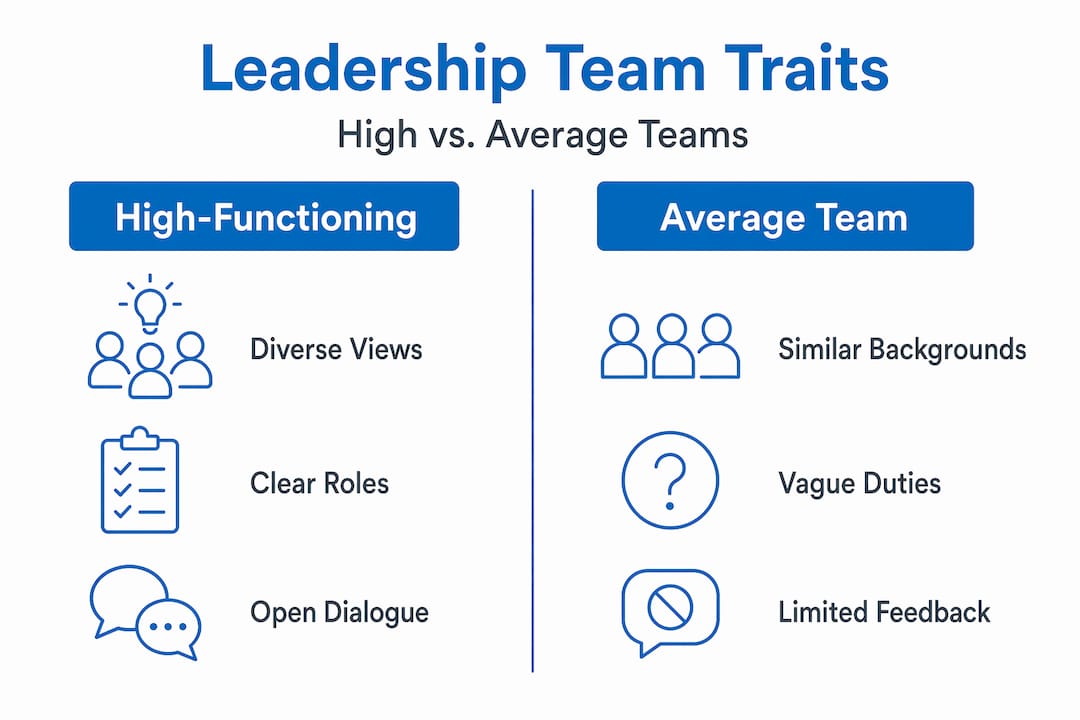
A genuinely high-functioning leadership team has five defining characteristics: diversity of background, clearly defined roles, psychological safety, structured accountability, and a consistent bias for action. Each of these matters on its own, but the real power comes when they work together.
Diversity isn’t just about gender or cultural background, though both matter. It’s about bringing together people who think differently, who have built expertise in different functions, and who are willing to challenge each other respectfully. Clear roles prevent the overlap and ambiguity that kills momentum. Psychological safety, which means the ability to share honest views without fear of judgement, is what separates teams that innovate from teams that play it safe.
High-functioning leadership teams are 447% better at driving innovation and 592% stronger at advocating for talent compared to average teams. That gap is enormous, and it doesn’t happen by accident.
Here’s how high-functioning and average teams compare across the metrics that matter most:
| Factor | High-functioning team | Average team |
|---|---|---|
| Innovation capacity | 447% above average | Baseline |
| Talent advocacy | 592% above average | Baseline |
| Accountability culture | Strong, shared ownership | Diffuse, often avoided |
| Staff turnover | Significantly lower | Higher, particularly in management |
| Adaptability to change | Proactive and structured | Reactive and inconsistent |
The contrast is stark. And the good news is that these characteristics can be developed. They don’t require hiring an entirely new team. They require investing in the right coaching skills for leaders and creating the structures that allow your existing team to perform at a higher level.
You can also review high-performing team benchmarks to understand the specific behaviours and traits that research consistently associates with top-tier team performance.
Pro Tip: Most owners overestimate how open their team is to new ideas. If you’ve never formally built psychological safety into your team culture, assume the gap is larger than you think. Start by introducing structured challenge sessions where disagreement is expected and rewarded, not tolerated.
Understanding the characteristics of an effective team sets up the question: How does building such a team tangibly impact your business metrics?
How do leadership teams drive SME growth?
The impact of a strong leadership team isn’t abstract. It shows up in revenue growth, talent retention, operational efficiency, and the owner’s ability to work on the business instead of in it.

Research consistently shows that diverse leadership backgrounds drive better outcomes. TMT functional background heterogeneity, which means having top management team members with varied professional histories, positively affects SME performance by enhancing dynamic capabilities. In plain terms: teams that bring together people from sales, operations, finance, and marketing don’t just cover more ground. They solve problems in fundamentally better ways.
Here’s what that looks like in practice across key growth metrics:
| Outcome area | Impact of strong leadership team |
|---|---|
| Revenue growth | Faster scaling through distributed strategy ownership |
| Innovation rate | Dramatically higher with diverse functional backgrounds |
| Talent retention | Lower turnover when leadership culture is strong |
| Operational resilience | Better crisis response and market adaptability |
| Owner wellbeing | Significantly reduced stress and time dependency |
The role of coaching in scaling is particularly relevant here. Coaching isn’t just for the owner. When your leadership team members are actively developing their skills, the entire organisation benefits.
There are three sequential improvements that a well-structured leadership team delivers:
-
Faster, better decisions. When capable people own their domains, decisions get made quicker and with more relevant expertise behind them. The owner stops being the approval bottleneck, and momentum builds naturally across the business.
-
Enhanced engagement and retention. People stay when they feel led well. Poor leadership contributes to 30% of UK employee turnover, driven by engagement and culture failures. A strong leadership team creates the kind of environment where talented people want to grow.
-
More scalable and resilient operations. When leadership responsibilities are spread across a capable team, the business can absorb shocks, pursue new markets, and sustain growth through transitions that would otherwise derail a founder-dependent operation.
That 30% turnover figure deserves particular attention. Replacing a single mid-level employee typically costs between 50% and 200% of their annual salary when you factor in recruitment, onboarding, and lost productivity. Multiply that across even a modest team, and the financial case for investing in leadership development for growth becomes impossible to ignore.
With these benefits in mind, it’s important to address the nuanced realities and frequent pitfalls that SME owners face when building their teams.
Common pitfalls and expert tips for SME leadership teams
Knowing you need a leadership team and actually building a great one are two very different things. Most SME owners who invest in team-building hit the same set of obstacles, and the results are predictably frustrating.
The most common pitfalls include:
- Under-investment in development. Hiring experienced people and then leaving them to figure it out is not team-building. It’s wishful thinking. Regular training, coaching, and structured feedback are what turn capable individuals into a cohesive leadership team.
- Defaulting to directive leadership. Many founders build teams in their own image, surrounding themselves with people who execute rather than challenge. This feels comfortable but kills the diversity of thought that drives innovation.
- Confusing activity with accountability. Busy teams are not always accountable teams. Without clear ownership of outcomes, and consequences for missing them, accountability becomes a word you use in meetings rather than a reality in your culture.
- Neglecting the trust foundation. Accountability without trust creates a blame culture. Trust without accountability creates a nice culture that doesn’t perform. The balance between the two is what balanced leadership behaviours research consistently identifies as central to high-performing teams.
In the Australian context, this challenge is particularly acute. Australian SMEs chronically under-invest in leadership development, and it shows in productivity figures that continue to trail behind comparable economies. The investment gap isn’t just a business problem. It’s a cultural one, where leadership development is seen as a cost rather than a growth lever.
Pro Tip: Build a formal feedback mechanism into your leadership team rhythm. A quarterly 360-degree review, even an informal one, forces the conversations that most teams avoid. It’s not comfortable at first. But discomfort is where growth lives, and the sustainable business scaling that follows is worth every awkward moment.
Actionable steps to get started:
- Actively seek diversity when appointing or developing leadership roles, not just in demographics but in functional expertise and cognitive style
- Balance task-focused skills with relationship and communication capabilities across your leadership team
- Build regular structured reviews into your leadership team calendar so the team itself is always being developed, not just the business
With practical tips in hand, let’s reflect on what most SME owners miss about leadership team value.
The uncomfortable truth most SME owners miss about leadership teams
Here’s the perspective that most articles on leadership won’t say directly: waiting until you’re “big enough” to build a leadership team is not caution. It’s the reason you’re not growing faster.
We’ve worked with business owners who had the talent, the market, and the ambition, but who couldn’t scale because every strategic decision still ran through them personally. The business had technically grown, but the owner was more stretched, more exhausted, and more at risk than ever. That’s not growth. That’s a bigger cage.
The invisible ceiling that founder-dependency creates is one of the most costly forces in any SME. It limits revenue because the business can only move as fast as one person can think. It limits talent retention because strong people leave when they can’t lead meaningfully. And it limits the owner’s personal freedom, which was probably the reason they started the business in the first place.
Firms that invest early in leadership structures grow faster, experience lower owner stress, and navigate volatile markets with more agility. This isn’t theory. It’s the pattern we observe consistently. The owners who are scaling for freedom aren’t the ones who built a team once they were successful. They’re the ones who built a team to become successful.
Leadership is not a reward for growth. It’s the engine of it. And if you’re waiting for the right moment, the uncomfortable truth is that the right moment was probably two years ago. The second-best time is now.
Take the next step: develop your leadership team for scale
You’ve seen the data, the pitfalls, and the opportunity. The question now is what you do with it. Building a high-functioning leadership team doesn’t happen by accident, and it rarely happens without structured support.
At Summit SCALE®, we work with SME owners across the UK and Australia who are ready to stop being the bottleneck and start building businesses that scale without them at the centre of everything. Whether you’re exploring coaching for business owners, looking to access focused leadership development resources, or want to understand the leadership coaching process that has helped our clients build stronger teams and reclaim their time, we’re here to help. Book your free 15-minute assessment call and take the first real step towards building the leadership team your business deserves.
Frequently asked questions
What is the main benefit of building a leadership team for SMEs?
A leadership team enables scalability, better decision-making, and reduces owner dependency, making business growth and resilience genuinely attainable. As the evidence shows, scale-up at key revenue milestones like £5M and £10M becomes significantly more achievable with a capable team in place.
When should I start building a leadership team in my business?
It’s best to start before hitting major revenue milestones, typically as you approach £5M turnover, to avoid growth bottlenecks. Early team-building at revenue milestones consistently outperforms the reactive approach of building later under pressure.
Does diversity matter in SME leadership teams?
Yes, diversity in background and skills boosts innovation and helps SMEs adapt to change more effectively. Research confirms that TMT functional heterogeneity directly and positively affects SME performance through enhanced dynamic capabilities.
How does poor leadership affect staff retention?
Poor leadership is a top driver of employee turnover, with 30% of UK workers citing poor engagement and culture as the reason they leave. Investing in strong leadership is one of the highest-return retention strategies an SME can make.

