
TL;DR:
- Strong team culture boosts profitability, reduces turnover, and enhances decision-making.
- Building a deliberate culture involves defining core values, embedding them in hiring, and regular feedback.
- Managers play a crucial role in sustaining culture through consistent, empathetic leadership and feedback.
Team culture is not about ping-pong tables or motivational posters on the wall. For small to medium-sized business owners, it is one of the most powerful commercial levers available. Strong team cultures produce 23% higher profitability and up to 51% less turnover, yet most SMB leaders treat culture as an afterthought. The reality is that culture shapes how decisions get made, how clients are treated, and whether your best people stay or leave. This guide will show you how to define, build, and evolve a team culture that produces real, measurable business results.
Table of Contents
- Why team culture makes or breaks SMB growth
- The mechanics of building a thriving team culture
- Managers: The engine of team engagement
- Handling culture breakpoints and pitfalls as you scale
- A fresh perspective: Why team culture is harder and more vital than anyone admits
- Take the next step: Strategise for lasting culture and growth
- Frequently asked questions
Key Takeaways
| Point | Details |
|---|---|
| Culture drives results | High-performing cultures deliver higher profit, productivity, and retention in SMBs. |
| Manager impact is critical | Managers shape up to 70% of team engagement, so invest in their development. |
| Scaling breaks culture if unmanaged | Culture can fracture in rapid growth—explicit values and safety nets are essential. |
| Action beats slogans | Embed values into daily routines and measure impact with clear metrics like retention. |
Why team culture makes or breaks SMB growth
So, what exactly is team culture? It is the shared values, expectations, and daily behaviours that define how your team operates together. It is not a mission statement on a wall or a Friday afternoon drinks ritual. It is what happens when a difficult client calls, when a deadline slips, or when two team members disagree. Culture is the invisible operating system of your business.
The financial case is compelling. Businesses with high-engagement cultures enjoy an 85% net profit increase over five years, and research shows that strong team culture drives a 47% share price premium in the AI era compared with companies that neglect it. Those are not marginal gains. They are transformational.
For SMBs, the stakes are even higher because there is less margin for error. You cannot afford prolonged disengagement, costly staff turnover, or a reputation as a difficult place to work. Yet many business owners fall into the trap of conflating culture with perks. Free lunches and team away-days are pleasant, but they do not replace the clarity that comes from shared values lived out in daily interactions.
“Culture eats strategy for breakfast.” This famous quote from Peter Drucker remains as relevant as ever. You can have the most brilliant growth plan in place, but if your team’s behaviours do not align with your goals, execution will always fall short.
The tangible benefits of investing in culture are wide-ranging:
- Retention: Fewer people leaving saves thousands in recruitment and training costs
- Productivity: Engaged teams work with more focus, urgency, and ownership
- Market value: Investors and acquirers pay a premium for businesses with strong cultures
- Resilience: Teams with shared values navigate setbacks far more effectively
Your leadership coaching process is one of the most effective vehicles for embedding culture from the top down. When leaders model the values visibly, the rest of the team follows.
The mechanics of building a thriving team culture
Knowing that culture matters is one thing. Building it deliberately is another. Here is a practical framework you can start using immediately.
- Define three to five core values with observable behaviours. Do not settle for abstract words like “integrity” or “excellence”. Attach each value to a specific behaviour. For example, if “ownership” is a core value, the behaviour might be: “We flag problems and propose solutions, never just problems.”
- Embed values into hiring and onboarding. Use values-based interview questions. Make cultural expectations explicit within the first 30 days of employment, not after six months.
- Build recognition systems around values. Call out specific value-aligned behaviours in team meetings, not just results. This reinforces what matters.
- Create regular feedback loops. Use structured 1:1s and team check-ins. Culture lives and dies in conversation, not in policy documents.
- Measure and track. Use a 90-day playbook to define, embed, measure, and iterate, tracking progress via employee Net Promoter Score (eNPS) or 30/90-day retention rates.
Pro Tip: Actions always outweigh words when it comes to culture. Run three-month cycles of visible improvement, focusing on one value at a time rather than trying to overhaul everything at once. Progress compounds.
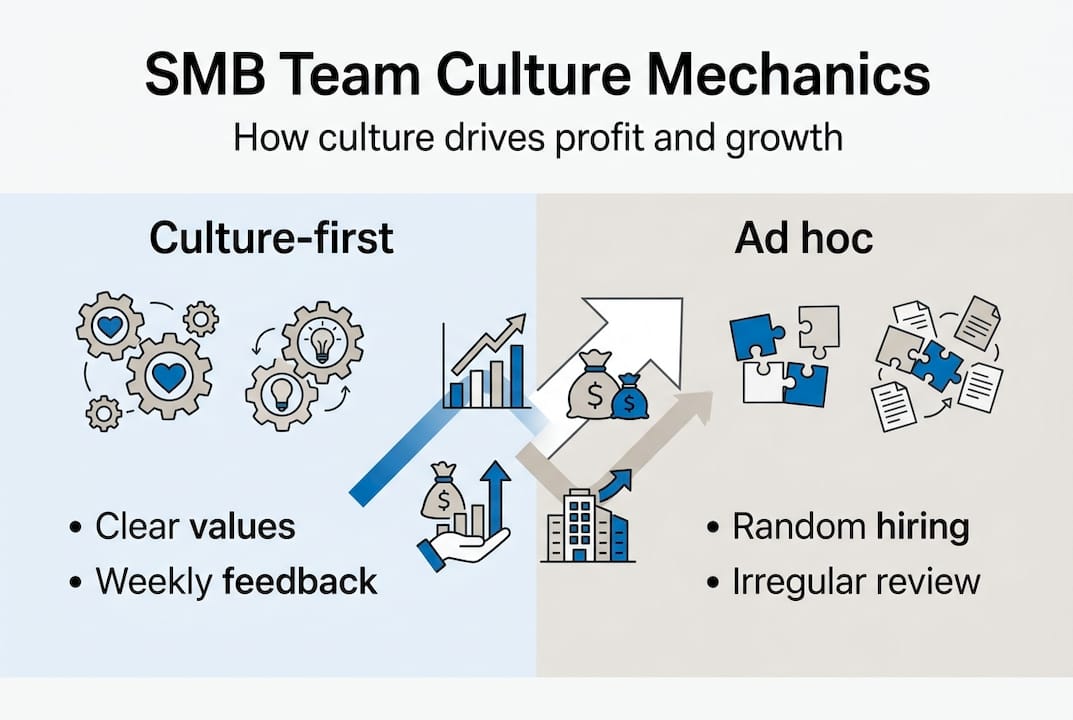
Here is a comparison of two approaches to culture to help you see the difference clearly:
| Area | Culture-first approach | Ad hoc approach |
|---|---|---|
| Hiring | Values-based interviews | Skills-only interviews |
| Onboarding | Explicit culture immersion | Task-focused only |
| Recognition | Behaviour-aligned praise | Output-only recognition |
| Feedback | Regular structured 1:1s | Annual reviews only |
| Measurement | eNPS, retention tracking | No formal measurement |
For further context on how business culture insights apply to growing businesses, McKinsey’s research reinforces that culture-first companies scale with significantly fewer people problems. Pair this with team growth steps designed for SMBs and you have a clear path forward.
Managers: The engine of team engagement
You can define values, run great onboarding, and build recognition systems, but if your managers are not on board, none of it will stick. Managers are the single most influential factor in how culture is experienced day to day.
Managers account for 70% of the variance in team engagement according to Gallup research. That is a staggering figure. It means the culture your team actually lives is largely a reflection of manager behaviour, not company policy. Understanding the manager engagement rule is essential for any SMB serious about performance.
So, what do high-performing managers do differently? They consistently demonstrate four key behaviours:
- They give specific, timely feedback rather than vague annual reviews
- They ask before they tell, creating space for team members to think and problem-solve
- They hold people accountable with empathy, separating behaviour from identity
- They model the values visibly, especially when it is inconvenient to do so
Developing manager talent does not require a large budget. It requires intentionality. Invest in coaching, create peer-learning opportunities, and give managers the tools to run effective 1:1s. Explore leadership development programmes tailored to SMBs as a practical starting point.
Pro Tip: Shift your feedback cadence from annual to weekly. Even brief, informal check-ins between managers and team members turbocharge engagement and prevent small frustrations from becoming resignations.
The return on investing in your managers is not linear. It compounds. A skilled manager retains talented people, accelerates performance, and actively protects your culture as you grow. When you are building your business team, treat manager development as a first-order priority, not a nice-to-have.

Handling culture breakpoints and pitfalls as you scale
Even the most intentional cultures face pressure as the business grows. And it often happens sooner than you expect.
Culture breaks most commonly occur when a business reaches the 20 to 30-employee mark. What worked informally in a small team begins to unravel. Psychological safety, the ability of team members to speak up without fear of punishment, boosts productivity by 20% when actively maintained. Lose it, and you lose your competitive edge.
Watch for these warning signals that your culture may be under strain:
- Sudden increase in resignations, especially among your strongest performers
- Decline in candid conversations during team meetings or 1:1s
- Inconsistent behaviour from managers under pressure
- “Brilliant jerk” behaviour being tolerated because of short-term results
- New hires struggling to integrate despite strong skills
Here is a snapshot of common culture pitfalls and how to respond:
| Pitfall | Early sign | Mitigation strategy |
|---|---|---|
| Rapid unplanned hiring | Values misalignment | Slow down, use structured interviews |
| AI adoption friction | Team confusion or resistance | Communicate the “why” clearly and early |
| Toxic high performer | Others disengaging | Address behaviour directly and swiftly |
| Values drift post-merger | Competing subcultures | Run culture alignment sessions |
| Leadership inconsistency | Team uncertainty | Re-anchor managers to core values |
Psychological safety is not a soft metric. It is a business strategy. Teams that feel safe to raise concerns, admit mistakes, and challenge assumptions innovate faster and retain better.
For businesses navigating AI culture dissonance, the key is transparency. Introduce AI tools with honest conversations about their purpose and impact on roles. Explore how to navigate scaling business challenges before they become crises. Proactive frameworks and explicit cultural principles are far cheaper than reactive damage control. Your leadership coaching process for growth should include regular culture health checks at every stage of scaling.
A fresh perspective: Why team culture is harder and more vital than anyone admits
Here is the uncomfortable truth most culture articles will not tell you: building a strong team culture in an SMB is genuinely hard work, and it is never finished. No framework, workshop, or values poster will make it easy.
Contrary to what polished case studies suggest, every growing business goes through messy cultural moments. Values get tested. People disappoint. Managers struggle. The goal is not perfect harmony. It is the discipline to return to your core principles when things get difficult. Culture is revealed under pressure, not in the good times. Anyone can live out their values when business is booming. The real test is what happens when a key person leaves, a contract falls through, or a difficult conversation needs to be had.
If your culture work feels uncomfortable right now, that is likely a sign you are doing it properly. Growth requires friction. Lean into it with clarity and consistency, and your team will follow. Discover business growth steps that align personal leadership with cultural development for lasting results.
Take the next step: Strategise for lasting culture and growth
A high-performing team culture does not emerge by accident. It is engineered through clear values, deliberate systems, skilled managers, and consistent leadership. The good news is that you do not have to figure it out alone.
At Summit SCALE, we work with SMB owners and managers to design practical, people-first strategies that drive performance, reduce costly turnover, and build the kind of culture that attracts brilliant talent. Explore the business coaching benefits that our clients experience firsthand, learn how coaching for SMEs can be tailored to your specific stage of growth, and discover our performance coaching insights to accelerate your journey. Ready to build something exceptional? Book your free 15-minute assessment call with Summit SCALE today.
Frequently asked questions
What is the most important element of team culture?
Defining values and daily behaviours is the foundation of strong team culture. Without observable, consistent behaviours attached to each value, culture remains aspirational rather than operational.
How do you measure team culture in a small business?
Use leading indicators such as 30/90-day retention rates, eNPS, and structured team feedback to track progress. Retention and engagement metrics give you an honest, ongoing picture of cultural health.
Why do cultures often break when a business grows fast?
Sudden scaling creates gaps in values alignment and informal communication. Culture breaks at 20 to 30 employees and requires more explicit systems, documented principles, and manager development to hold things together.
What is psychological safety and why does it matter?
Psychological safety means employees feel secure enough to speak up, admit mistakes, and challenge ideas without fear of negative consequences. Psychological safety boosts productivity by 20% and cuts turnover by 27%, making it one of the most commercially valuable cultural investments you can make.

