
TL;DR:
- Clear, targeted growth objectives guide SME focus and accountability effectively.
- Small businesses should prioritize sustainable growth and profitability over rapid scaling.
- Quarterly, leading indicator-based targets enhance agility and operational alignment.
Setting growth objectives feels straightforward until reality bites. Many business owners pour energy into ambitious targets, only to find that chasing growth can quietly erode profitability, exhaust teams, and create more pressure than progress. UK SME data shows most business owners aim to grow sales, yet persistent barriers like taxation and rising costs continue to derail even the best-laid plans. The truth is, growth objectives are not simply about doing more. They are about doing the right things, in the right order, with the right level of clarity. This article will help you cut through the confusion and build a smarter approach.
Table of Contents
- What are growth objectives and why do they matter?
- The benefits and risks of setting growth objectives
- How to set effective growth objectives for your business
- Applying growth objectives: real-world SME scenarios
- Why sustainable growth beats ‘more for more’s sake’
- Unlock your business potential with coaching
- Frequently asked questions
Key Takeaways
| Point | Details |
|---|---|
| Objectives drive innovation | Setting growth objectives pushes your business to innovate and maximise performance. |
| Strategic growth avoids risk | Choosing targets that suit your capacity and market helps prevent burnout and margin loss. |
| Quarterly targets work best | Updating growth objectives every quarter is proven to keep SMEs agile and operationally sound. |
| Focus on leading metrics | Tracking indicators like new leads is more effective than chasing pure revenue growth. |
What are growth objectives and why do they matter?
Growth objectives are specific, measurable targets that a business sets to drive meaningful progress over a defined period. They are not vague aspirations like “grow the business” or “make more money.” They are concrete commitments: increase monthly recurring revenue by 15%, reduce client churn to below 5%, or hire two skilled team members by the end of Q3. Understanding growth objectives explained in this precise way is the first step toward using them effectively.
For small and medium-sized enterprises (SMEs), growth objectives serve a critical strategic purpose. They give your team a shared direction. They force you to prioritise resources rather than spreading effort thinly across every opportunity. And they create accountability, which is the engine that keeps momentum alive when motivation fades.
Here is why growth objectives matter beyond the obvious:
- Clarity over chaos: Without clear targets, teams default to busyness rather than productivity.
- Focus on leading indicators: Objectives shift attention from lagging results (last month’s revenue) to the actions that create future results.
- Alignment across roles: Everyone from sales to operations understands what “winning” looks like.
- Confidence in decision-making: Clear objectives make it easier to say no to distractions that do not serve the goal.
One critical distinction in goal-setting is the difference between stretch goals and realistic targets. Stretch goals drive innovation per goal-setting theory, but they carry real risks of burnout and failure when the resources to support them are absent. This is not a reason to play small. It is a reason to plan intelligently.
“The goal is not to grow fast. The goal is to grow right.” This distinction separates businesses that scale sustainably from those that collapse under their own ambition.
Professional coaching consistently reinforces this point. Quarterly realistic targets are emphasised over sweeping annual plans because they keep teams responsive, motivated, and anchored in what is actually achievable. Annual goals are useful for vision. Quarterly targets are where execution lives.
The benefits and risks of setting growth objectives
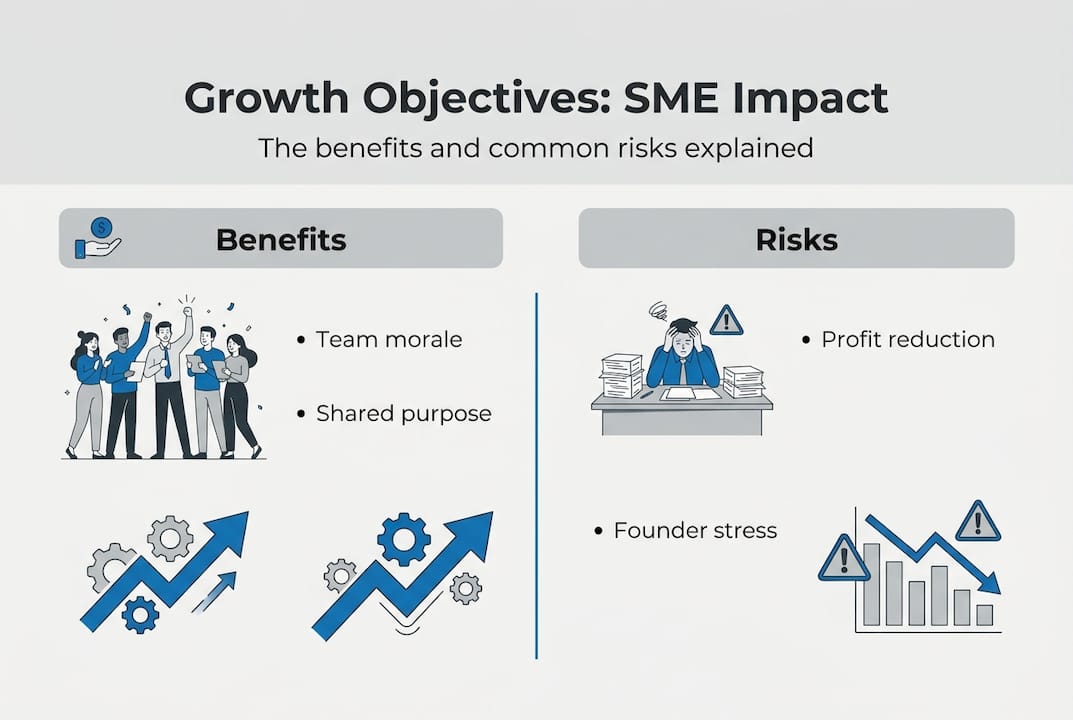
Growth objectives, when set well, are genuinely energising. They create team engagement because people want to contribute to something meaningful. They spark innovation because constraints force creative thinking. They also provide clarity, which reduces the anxiety that comes from working in a business without a clear destination.

But there is a side to growth objectives that does not always make it into the motivational content. Setting the wrong targets, or pursuing growth without a sustainable plan, can quietly cause serious damage.
| Factor | Benefit of clear objectives | Risk of poorly set objectives |
|---|---|---|
| Team morale | Shared purpose and direction | Burnout from unrealistic pressure |
| Profitability | Focus on high-value activity | Margin squeeze from scaling costs |
| Innovation | Problem-solving under focus | Tunnel vision on the wrong metrics |
| Leadership | Confident, decisive action | Reactive, fire-fighting mode |
Aggressive growth objectives often reduce profit margins and can impact founder wellbeing significantly. Scaling requires investment before it generates return, and many SMEs underestimate the cost of that gap. More clients means more operational complexity. More staff means more management overhead. Suddenly, a growing business feels harder to run than a smaller one.
This is why the question of profitability vs growth deserves honest consideration. Growth for its own sake is not a strategy. Strategic smallness, staying lean and highly profitable at your current size before expanding, can actually outperform indiscriminate scaling in the long run. Insights into optimal profitability reveal that businesses that grow with discipline consistently outperform those that grow with urgency.
Pro Tip: Before setting a new growth objective, ask yourself: “Do we have the systems, people, and cash flow to support this goal?” If the answer is no, build those foundations first. Growth on shaky ground accelerates failure, not success.
The key risks to watch for include:
- Margin erosion: Revenue grows but profit does not follow.
- Team fatigue: High targets without adequate support lead to disengagement.
- Over-reliance on one metric: Chasing revenue while ignoring retention or culture creates fragility.
When you understand both the power and the pitfalls, you can move forward with confidence rather than blind optimism. And that is precisely where the real opportunity lives. Understanding prioritising profitability as the foundation of sustainable growth changes how you set every objective going forward.
How to set effective growth objectives for your business
Having explored the trade-offs, the next step is mastering the process for setting effective objectives. The good news is that there is a clear framework you can follow, and it does not require a business degree to apply it.
- Audit your current capacity. Before setting any target, understand what your business can genuinely support. Operational systems and capacity must be prioritised before growth objectives are layered on top. A leaky bucket cannot hold more water, no matter how fast you pour.
- Separate leading from lagging indicators. Lagging indicators measure past performance (monthly sales, annual profit). Leading indicators predict future performance (number of proposals sent, website leads generated, client retention rate). Build your objectives around leading indicators because those are the actions you can actually control.
- Use a quarterly rhythm. Set 90-day objectives that are ambitious but achievable within your current capacity. Review and adjust at the end of each quarter. This keeps your business agile and prevents the drift that kills annual goals.
- Align objectives across your team. Every department should understand how their daily work connects to the business objective. Misalignment is one of the most common reasons growth targets fail.
- Measure weekly, not monthly. Weekly check-ins on key metrics catch problems early, before they become expensive. Monthly reviews are often too slow for fast-moving SMEs.
| Objective type | Example target | Review frequency |
|---|---|---|
| Sales growth | 20 new client enquiries per month | Weekly |
| Team capacity | Hire one specialist by end of Q2 | Monthly |
| Cost control | Reduce overheads by 8% this quarter | Monthly |
| Client retention | Achieve 90% renewal rate | Quarterly |
Pro Tip: Write your quarterly objectives on a single page. If you cannot summarise your growth plan in one page, it is too complex to execute. Simplicity creates focus, and focus creates results.
Explore proven growth strategy steps to see how this framework applies across different SME contexts. If you want to understand how professional guidance supports this process, the business coaching process offers a practical overview of what structured support looks like in action.
Applying growth objectives: real-world SME scenarios
With the framework in hand, let us see how these principles play out in real business examples. Theory is useful. Numbers are convincing.
Consider a marketing agency with eight staff members. Their objective is to grow monthly revenue from £45,000 to £60,000 within two quarters. Rather than simply chasing new clients, they focus on a leading indicator: increasing average client value through upselling existing accounts. Within 90 days, they add £9,000 in monthly recurring revenue without a single new client. The objective was smart because it was tied to operational capacity they already had.
Or take a trades business with three employees. Their growth objective is to reduce reliance on the owner for daily operations. They measure success not in revenue but in the number of jobs completed without owner involvement. Within six months, the owner reclaims 12 hours per week. That is a growth objective that creates personal freedom, not just business metrics.
These scenarios reflect a broader reality. Rising costs impact 57% of UK SME growth plans, making it essential to focus on leading indicators like lead generation and client retention rather than simply pushing for higher revenue.
Here are the most common growth focus areas SMEs apply objectives to:
- Sales pipeline growth: Tracking weekly leads and conversion rates.
- Client retention: Measuring renewal rates and satisfaction scores.
- Team productivity: Setting output targets per role rather than hours worked.
- Cost efficiency: Identifying and eliminating low-ROI expenditure each quarter.
“You cannot manage what you do not measure. But more importantly, you cannot grow what you do not understand.”
Understanding the profitability drivers behind each objective helps you pick the targets that actually move the needle, rather than the ones that simply look impressive on a spreadsheet.
Why sustainable growth beats ‘more for more’s sake’
Here is an uncomfortable truth most growth content will not say plainly: not every growth opportunity is worth pursuing. The pressure to scale, to always do more, serve more, and earn more, can quietly become the thing that breaks a business that was perfectly profitable at a smaller size.
At Summit SCALE, we have seen business owners double their revenue and halve their quality of life. That is not success. That is a trap dressed up as ambition. Strategic smallness may actually optimise profitability over unchecked scaling, and that insight challenges almost everything the business growth industry promotes.
The businesses that thrive long-term are not the ones that grew fastest. They are the ones that grew with intention. They set objectives tied to their values, their capacity, and their vision for the life they want their business to support. When you understand sales growth priorities through that lens, every target you set becomes a deliberate choice rather than a reaction to external pressure. That shift in perspective is where sustainable success genuinely begins.
Unlock your business potential with coaching
Setting growth objectives is only valuable when you have the clarity, structure, and support to act on them consistently. That is exactly where professional coaching makes the difference.
At Summit SCALE, we work with ambitious SME owners to build focused, profitable growth plans grounded in operational reality. Whether you are just starting to think about your next phase or you are ready to invest in coaching as a serious business tool, we provide tailored guidance that cuts through overwhelm and drives real results. Explore our SMB growth strategies or learn about the different business coaching types available. Your next 90 days could look very different. Book your free 15-minute assessment call today.
Frequently asked questions
What are growth objectives for SMEs?
Growth objectives are clear, measurable targets set to drive expansion, sales, and organisational performance for small and medium-sized businesses. They provide the strategic direction that turns daily effort into meaningful progress.
How do growth objectives affect profitability?
Aggressive growth objectives can reduce profit margins if not managed strategically, especially in small teams where resources are already stretched. Scaling often reduces margins in SMEs before the returns materialise.
How often should SMEs set new growth objectives?
Quarterly targets are recommended for SMEs, ensuring goals remain realistic, operationally sustainable, and responsive to changing conditions.
What is a leading indicator in growth measurement?
A leading indicator is a measurable activity, such as new leads generated or client retention rate, that predicts future business performance. UK SME tracking data confirms that leading indicators are vital for meaningful SME growth measurement.

