
TL;DR:
- SMBs in 2026 face growth challenges from inflation and rising costs but remain highly optimistic.
- Building a solid foundation by assessing performance metrics and financial flexibility is essential before scaling.
- Successful growth relies on targeted strategies like digital expansion, AI automation, and disciplined marketing investments.
An extraordinary 94% of SMBs anticipate growth in 2026, yet inflation, rising operational costs, and talent pressures are making that growth harder to sustain. Optimism alone will not carry you forward. What separates businesses that thrive from those that stall is a clear, disciplined strategy built on solid foundations. Whether you are looking to increase revenue, improve your margins, or finally reclaim your time, this guide walks you through the practical steps that matter most this year. Growth is both a personal and professional journey, and the right approach can turn today’s challenges into tomorrow’s momentum.
Table of Contents
- Preparing your business for growth in 2026
- Selecting and implementing the right growth strategies
- Harnessing automation and AI for 2026
- Marketing for sustained growth: Benchmarks and smarter investment
- A fresh perspective: What most business growth guides miss in 2026
- Take your business growth further with expert support
- Frequently asked questions
Key Takeaways
| Point | Details |
|---|---|
| Strategic preparation first | Review financial health, set targets, and ensure resource readiness before scaling your business. |
| Adopt a mixed growth approach | Blend digital marketing, AI-powered automation, and partnership models for best results in 2026. |
| Invest smart in marketing | Increase your budget strategically, targeting proven benchmarks to maximise marketing ROI. |
| Optimise before scaling | Focus on operational efficiency and solid margins before pursuing aggressive business expansion. |
Preparing your business for growth in 2026
Before you can scale confidently, you need an honest picture of where your business stands right now. Think of it as turning the mirror around. Many owners rush into growth mode without checking whether their foundations can hold the weight. That is where the trouble starts.
Begin by reviewing your core performance metrics. Revenue trends, gross margins, customer churn rates, and conversion rates all tell a story. If your conversion rate sits below your industry average or your churn is climbing, those are signals to fix before you expand. As the small business growth playbook cautions, premature scaling risks serious cash flow strain, and optimising first is the smarter path.
Next, assess your financial flexibility. Cash flow is the oxygen of any growing business. Review your working capital, credit lines, and payment cycles. According to 2026 SMB earnings data, average monthly revenues for small businesses have shifted, making it more important than ever to model your growth scenarios before committing resources.
Setting realistic targets matters too. A typical healthy growth target sits between 15% and 30% annual revenue increase, depending on your sector and stage. Chasing 100% growth without the team, systems, or cash to support it is a recipe for burnout, not success.
Here is a quick-reference table for assessing your readiness:
| Readiness area | Green signal | Red signal |
|---|---|---|
| Cash flow | 3+ months of reserves | Living month to month |
| Conversion rate | At or above industry average | Below industry average |
| Team capacity | Roles clearly defined | Key-person dependency |
| Customer churn | Declining or stable | Rising quarter on quarter |
| Systems and processes | Documented and repeatable | Ad hoc and inconsistent |
Key preparation steps before scaling:
- Audit your profit and loss statement for the past 12 months
- Identify your top three revenue drivers and protect them
- Map your team’s capacity against your growth plan
- Confirm your technology stack can handle increased volume
- Speak to your accountant or financial adviser about cash flow modelling
For a deeper look at what it takes to build a scalable foundation, explore business scale-up essentials before you commit to any new initiative.
Pro Tip: Do not confuse revenue growth with profit growth. A business that doubles its revenue but halves its margins has not grown. It has just got busier.
Selecting and implementing the right growth strategies
Once your business is primed for growth, it is time to choose and apply the approaches most likely to succeed for your specific context. Not every strategy suits every business, and applying the wrong one at the wrong stage can cost you dearly.
The four core growth strategy types are:
- Market penetration — Selling more of what you already offer to your existing market. This is the lowest-risk option and often the most overlooked.
- Product or service development — Creating new offerings for your existing customer base. This requires investment but leverages your existing trust.
- Partnerships and alliances — Collaborating with complementary businesses to reach new audiences without the full cost of acquisition.
- Digital expansion — Growing your reach through e-commerce, social platforms, or new geographic markets online.
Matching the strategy to your business stage is critical. A startup should focus on market penetration first. A business in expansion mode can layer in product development and partnerships. A mature business may need digital expansion or diversification to reignite momentum.
When piloting a new initiative, follow this staged approach:
- Define a clear, measurable objective for the pilot
- Set a fixed budget and timeline before you begin
- Identify the one metric that will tell you if it is working
- Run the pilot for 60 to 90 days before scaling
- Review results honestly and decide: scale, refine, or stop
One often-overlooked element is FinOps, which refers to the practice of managing your cloud and operational costs with the same discipline you apply to revenue. As enterprise-level SMB strategies highlight, the most effective SMBs in 2026 are combining AI and automation, digital-first approaches, cloud tools, strategic partnerships, and optimised cash flow with focused marketing across social and email channels.
For a structured look at how to sequence these moves, the growth steps for SMEs resource offers a practical framework. You can also explore 2026 coaching trends to understand how leading businesses are approaching strategy this year.
Harnessing automation and AI for 2026
A central theme for 2026 is technology, especially AI and automation, which now offer scalable benefits for even smaller businesses. The question is no longer whether to adopt these tools. It is how to use them wisely.
Key use cases for AI in SMBs right now include:
- Analytics and forecasting — Spotting trends in your sales data before they become problems or opportunities you missed
- Marketing automation — Personalising email campaigns, scheduling social content, and scoring leads without manual effort
- Customer service — Chatbots and AI assistants handling routine queries so your team focuses on higher-value interactions
- Operational workflows — Automating invoicing, scheduling, and reporting to reduce administrative drag
The adoption numbers are telling. SMB AI utilisation for analytics, playbooks, and automation sits at 54 to 58% among businesses that have embedded it into their strategies. Yet overall SME AI adoption remains at just 11.9%, with productivity gains of 0.2 to 1.3% reported. That gap represents a real competitive advantage for businesses willing to move now.
Statistic to note: Businesses that integrate AI into their core workflows report measurable gains in both team productivity and customer satisfaction, even at modest adoption levels.
The key is not to automate everything at once. Start with one process that costs you the most time or money. Measure the impact. Then expand from there. AI tools are only as effective as the data you feed them and the clarity you bring to the problem you are solving.

Pro Tip: Before buying any AI tool, write down the specific problem it needs to solve and the metric you will use to judge success. If you cannot answer both, you are not ready to buy.
For practical ideas on applying these tools to revenue growth, the AI-driven sales tips resource is worth your time.
Marketing for sustained growth: Benchmarks and smarter investment
None of these initiatives succeed without customers, so the next step is targeted, effective marketing based on real benchmarks rather than guesswork.
The data for 2026 is clear. SMBs are increasing marketing budgets aggressively, with 68% planning to raise spend, 74% committing more time to marketing activity, and 54% already using AI tools to improve their results. Inflation is not slowing them down. It is making them sharper.
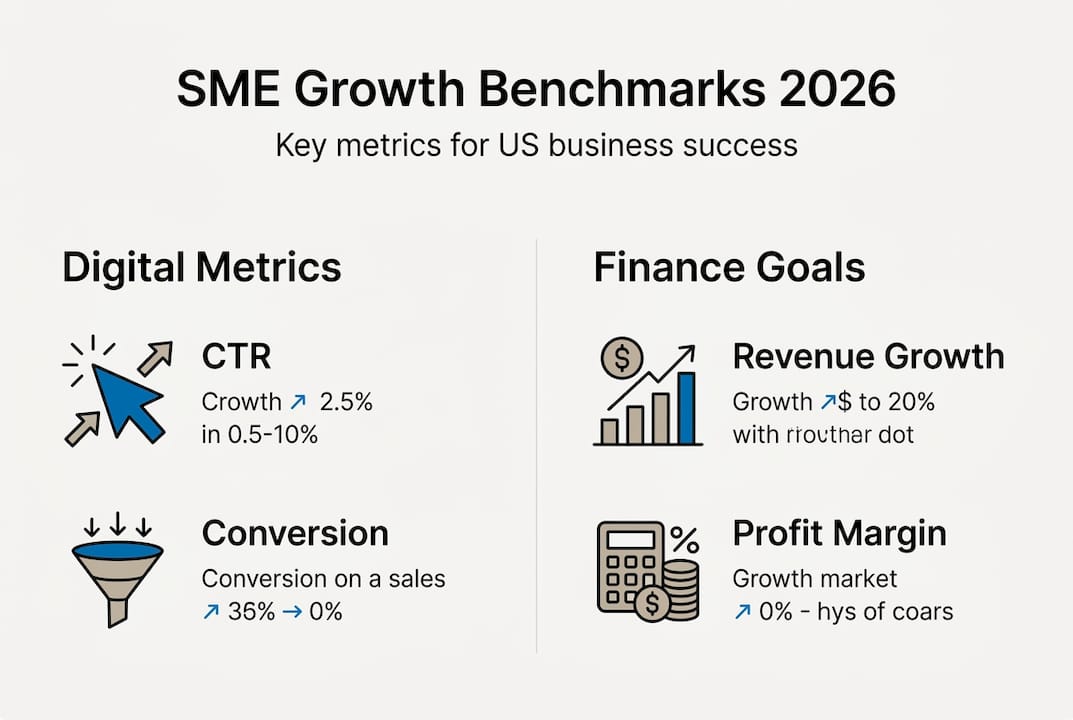
Knowing what to expect from your investment is just as important as knowing how much to spend. Here are key benchmarks to guide your planning:
| Channel | Benchmark metric | Target range |
|---|---|---|
| Google Ads | Click-through rate | 3.2% |
| Google Ads | Conversion rate | 2.8% |
| Paid advertising | ROAS (return on ad spend) | 2.5x to 3.8x |
| All channels | LTV to CAC ratio | Minimum 3:1 |
According to SMB marketing benchmarks, a minimum lifetime value to customer acquisition cost ratio of 3:1 is the threshold for sustainable marketing investment. If you are spending more to acquire a customer than that customer is worth over time, you are funding a leaking bucket.
Prioritise your highest-return tactics first:
- Email marketing consistently delivers the strongest ROI for SMBs and costs relatively little
- Organic social content builds trust over time and supports paid campaigns
- Google Ads work best when paired with a well-optimised landing page and clear offer
- Retargeting campaigns recapture warm leads who already know your brand
“The businesses that win in 2026 will not be those that spend the most on marketing. They will be those that measure the most carefully.”
For more on building marketing efforts that support long-term profitability, explore profit-first growth and sales profitability tips to sharpen your approach.
A fresh perspective: What most business growth guides miss in 2026
Here is something most growth guides will not tell you: not all growth is good growth. We see it repeatedly. A business owner hits record revenue, then wonders why they feel more stressed, not less. The answer is usually that they scaled before they were ready, and the cracks only showed once the volume increased.
The conventional wisdom says grow fast, grow big, and figure out the rest later. We disagree. Sustainable growth means knowing your numbers deeply, protecting your margins fiercely, and building a team that does not depend entirely on you. Scaling a broken model just breaks it faster.
AI is genuinely powerful, but it amplifies what already exists. If your customer data is poor or your sales process is unclear, AI will not fix that. It will just automate the confusion at speed.
The businesses that build real, lasting value in 2026 are those that resist the urge to chase every opportunity and instead focus on sustainable scalability. Slower, deliberate growth often produces stronger margins, healthier culture, and a business you can actually sell or step back from one day. That is the kind of growth worth building.
Take your business growth further with expert support
Knowing the strategies is one thing. Executing them consistently, under pressure, while running your business day to day, is another challenge entirely. That is where structured support makes a measurable difference.
At Summit SCALE®, our coaching frameworks are built specifically for SMB owners who want to grow profitably without burning out. Whether you are working on sales, team structure, or long-term valuation, we help you move from clarity to action faster. Explore why invest in coaching and discover how coaching in scaling business can accelerate your 2026 results. For a full overview of what is working right now, our profitable SMB growth strategies resource is a strong place to start.
Frequently asked questions
What is the most effective business growth strategy for US SMEs in 2026?
A balanced combination of digital marketing, AI-driven automation, and optimising core operations is recommended for sustainable growth in 2026. Matching the strategy to your current business stage is essential for meaningful results.
How much should I increase my marketing budget in 2026?
Most SMBs plan to raise their marketing budgets, often by 10 to 30%, to keep pace with inflation and digital competition. With 68% of SMBs planning increases, staying still is effectively falling behind.
What marketing benchmarks should I target in 2026?
Aim for a 3.2% click-through rate and 2.8% conversion rate on Google Ads, with a minimum LTV to CAC ratio of 3:1 to ensure your marketing investment is sustainable.
Is AI really worth implementing for small businesses?
AI delivers measurable productivity and sales benefits, but its impact depends on quality data and focused use cases. With overall SME adoption at 11.9%, early movers have a clear advantage if they apply it to the right problems.

