
TL;DR:
- Business valuation varies depending on context, assumptions, and the methods used, leading to different figures.
- Understanding this range helps owners make strategic decisions, improve profitability, and build more valuable businesses.
Your business does not have one single, fixed value. It never has. What surprises many business owners is that a buyer, a bank, a tax authority, and an investor could all look at the very same company and arrive at completely different numbers. That is not a flaw in the system. It is how business valuation actually works. Because valuation is context and assumption dependent, professionals triangulate multiple methods and reconcile differences into a defensible value range rather than relying on a single figure. Understanding this from the outset puts you miles ahead of most business owners.
Table of Contents
- What business valuation really means
- The most common business valuation methods explained
- Why different methods yield different values
- Applying business valuation insights to strategic growth
- A fresh perspective on business valuation: what most guides miss
- Unlock greater business value with expert support
- Frequently asked questions
Key Takeaways
| Point | Details |
|---|---|
| Valuation is context-driven | A business’s value depends on situation and assumptions, not a single fixed number. |
| Multiple methods matter | Professionals use more than one approach to produce a reliable range for your business’s value. |
| Discrepancies signal review | Large gaps between valuation methods mean it’s worth revisiting your data or core assumptions. |
| Valuation guides strategy | Understanding your business’s value helps you make better decisions for growth and profitability. |
| Expert help adds clarity | Support from a coach or mentor can help you use valuation as a tool for ongoing success. |
What business valuation really means
Business valuation is the process of estimating the economic worth of a business or its ownership interest. Put simply, it answers the question: what would someone with full information and no pressure be willing to pay for this business today?
But here is where it gets interesting. There is a meaningful difference between intrinsic value and price. Intrinsic value reflects what the business is genuinely worth based on its assets, earnings, and future prospects. Price is what a willing buyer actually pays, which is shaped by emotion, urgency, negotiating power, and market timing. The two are rarely identical, and that gap is where opportunity lives.
You might need a business valuation for any number of reasons:
- Selling your business: Knowing your defensible value prevents you from leaving money on the table or pricing yourself out of a deal.
- Buying another business: A proper valuation protects you from overpaying for someone else’s problems.
- Raising investment: Investors will value your business before writing a cheque. It helps to know the number before they do.
- Legal and tax requirements: Divorce proceedings, inheritance, shareholder disputes, and HMRC enquiries all call for formal valuations.
- Succession planning: Whether passing the business to family or management, you need a clear, credible figure.
- Strategic growth planning: This is the one most owners overlook, and it is arguably the most valuable reason of all.
That last point connects directly to the strategic steps to boost valuation that forward-thinking owners are already using to build businesses worth owning and selling.
Because valuation is context and assumption dependent, professionals commonly triangulate multiple methods and reconcile differences into a defensible value range rather than relying on a single technique.
Treat this as a liberating truth, not a frustrating one. A range gives you room to negotiate, room to grow, and room to make better decisions based on real data rather than a single arbitrary figure.
The most common business valuation methods explained
Now that you understand the purpose of business valuation, the next logical step is to see how business owners and professionals actually calculate value. There are three primary approaches, each grounded in a different philosophy about what makes a business worth something.
-
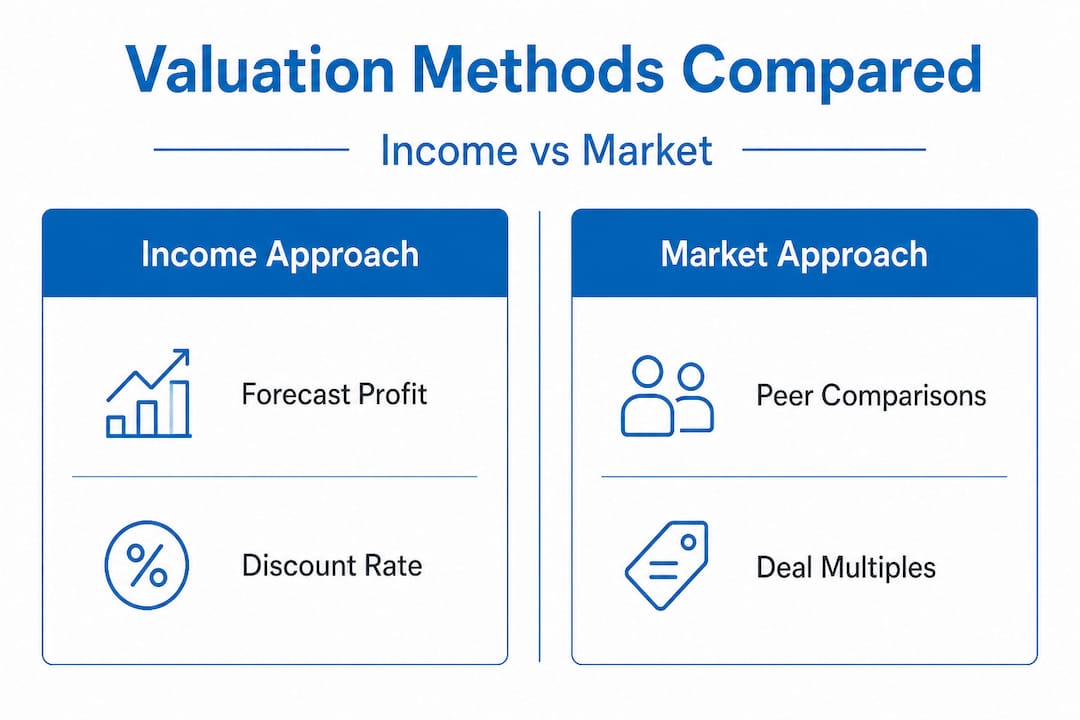
The income approach: This method focuses on what the business earns, or more precisely, what it is expected to earn in the future. The most common tool here is the Discounted Cash Flow (DCF) method, which projects future cash flows and then discounts them back to their present-day value using a rate that reflects risk. A simpler income-based tool is the capitalisation of earnings method, which divides a normalised profit figure by a capitalisation rate. This approach is brilliant for profitable, established businesses with predictable revenue.
-
The market approach: Here, the business is valued by comparing it to similar businesses that have recently sold. Think of it like valuing a house by looking at what comparable homes in the same street sold for. The challenge is finding genuinely comparable businesses. Sector, size, geography, and growth trajectory all matter. The market approach is particularly useful when there is rich transaction data available for your industry.
-
The asset approach: This method tallies up what the business owns, subtracts what it owes, and arrives at a net asset value. There are two main versions: going concern (which values assets at their current market value) and liquidation (which values them at a fire-sale price). The asset approach works well for holding companies, property-heavy businesses, or any firm where the balance sheet tells more of the story than the income statement.
| Method | Best suited for | Common drawbacks | Typical use cases |
|---|---|---|---|
| Income approach | Profitable, cash-generating businesses | Relies heavily on forecasting assumptions | Sale, investment, growth planning |
| Market approach | Businesses in active, comparable markets | Hard to find truly comparable sales data | Sale negotiations, benchmarking |
| Asset approach | Asset-heavy or low-profit businesses | Can undervalue intangible assets | Liquidation, balance sheet businesses |
Income, market, and asset outputs are often used together, and large gaps between methods can signal issues in normalisation, comparability, or risk assumptions. Understanding these profitability drivers is central to improving the income-based valuation of your business.
Most seasoned advisers will run at least two methods and compare the results. If they align, that consistency adds credibility to the valuation. If they diverge sharply, it is a signal worth investigating rather than ignoring. This is also precisely why profitability matters so profoundly. Stronger, more consistent earnings produce higher income-based valuations and attract better multiples in market comparisons.
Pro Tip: If two valuation methods produce figures that are more than 30 to 40 percent apart, do not average them and move on. That gap is telling you something meaningful about the risk profile, the earnings quality, or how cleanly the business compares to market peers. Investigate first, then reconcile.
Why different methods yield different values
Going further, business owners quickly notice that different valuation methods can yield different figures, which can cause concern or confusion. The truth is that divergence is normal, but understanding why it happens puts you in control.
The most common causes of valuation spread include:
- Differing assumptions: The income approach requires forecasts. Change the growth rate assumption by two percentage points and the value can shift by tens of thousands of pounds.
- Normalisation differences: Owners’ salaries, one-off costs, and related-party transactions all need adjusting to reveal true underlying earnings. Two advisers might normalise these figures differently.
- Market comparable quality: The market approach is only as reliable as the comparable data available. In thin markets with few recent transactions, comparables can be misleading.
- Risk perception: A buyer who sees concentrated revenue in one client will discount the business more aggressively than a seller who views that client as rock-solid.
Here is a practical illustration. Imagine a small manufacturing business with £500,000 in annual earnings. Depending on the method and assumptions used, the valuations might look like this:

| Valuation method | Estimated value | Key assumption |
|---|---|---|
| Income (DCF) | £2.1 million | Steady 5% growth, 15% discount rate |
| Market (comparable sales) | £1.6 million | Average sector multiple of 3.2x earnings |
| Asset (net asset value) | £900,000 | Assets valued at book value, limited goodwill |
That is a spread of over £1.2 million for the same business. Large gaps between methods can signal issues in normalisation, comparability, or risk assumptions. Rather than panicking, use that gap as a diagnostic.
When you are faced with a significant spread in valuations, here is what to do:
- Ask each adviser to walk you through their assumptions in plain language.
- Check whether earnings have been normalised consistently across all methods.
- Investigate whether the market comparables are genuinely similar businesses or just similar-sounding ones.
- Consider whether intangible assets like brand, team capability, or client relationships are being captured.
- Use the spread as a roadmap for improvement: narrow the gap by addressing the weaknesses each method is flagging.
Understanding how to increase your business valuation starts with understanding why different lenses produce different pictures. Once you know the levers, you can pull them with intention.
Applying business valuation insights to strategic growth
Once you understand the reasons for differing valuations, you are far better equipped to use this information as a strategic lever for growth rather than just a number for a transaction.
Here is a practical framework for turning valuation insights into forward momentum:
-
Establish your baseline. Commission or conduct an initial valuation using at least two methods. Do not do this only when you are thinking of selling. Do it now, so you have a foundation to build from and measure against.
-
Identify your value gaps. Compare what your income-based valuation says versus your asset-based or market-based figure. Where they diverge most sharply is where your effort should focus. Are your earnings inconsistent? Is your balance sheet carrying underperforming assets? Are you in a market where comparable businesses are selling at premium multiples you are not accessing?
-
Address the profitability drivers systematically. Revenue concentration, owner dependency, team capability, recurring revenue, and profit margins all directly affect how buyers, investors, and lenders perceive your business. Fixing these is not just good management. It is value creation.
-
Revisit your valuation annually. A business valuation is not a one-off certificate to file away. It is a living measure of your strategic progress. Reviewing it each year keeps your growth plan honest and your decision-making sharp.
-
Use your valuation to guide capital decisions. Should you invest in new equipment? Acquire a competitor? Hire a leadership team? Your valuation anchors these decisions in financial reality rather than gut instinct alone.
Because professionals triangulate multiple methods and reconcile differences into a range, you should expect and use that range rather than fixating on a single figure. That mindset shift alone changes how you make strategic decisions.
Pro Tip: Think of your business valuation as a dashboard, not a destination. It tells you where you are right now, which systems are strong, and which ones need attention. Download the business assessment tool to get a structured view of where your business stands and where the biggest growth opportunities lie. And if you want to learn from those who have navigated this journey firsthand, connecting with mentors for business growth can accelerate your path considerably.
A fresh perspective on business valuation: what most guides miss
Here is the honest truth that most valuation articles shy away from: chasing the perfect number is one of the most common and costly distractions for small and medium-sized business owners.
We have worked with many business owners who spent months debating which valuation figure was correct, when the real question they needed to answer was: what kind of business do I want to own in three years? That question is infinitely more powerful.
The obsession with precision often masks a deeper discomfort with uncertainty. But business is uncertain. Markets shift, key employees leave, clients churn, and economic cycles turn. No single valuation number, however precisely calculated, will give you immunity from those realities. What does give you resilience is a clear strategic intent and the discipline to act on it consistently.
Valuation is best understood not as a verdict on your business, but as an ongoing conversation. A conversation between your current reality and your future ambition. When you treat it that way, the divergence between methods becomes less threatening and more useful. Each method is a different perspective on the same question, and those perspectives combined create a richer picture than any single answer ever could.
There is also something deeper to consider. The single largest driver of business value is often the least discussed: owner mindset. A business built with intention, a clear succession pathway, documented systems, and a team that does not depend entirely on the owner is worth dramatically more than a technically similar business where everything runs through one person. That is not a financial metric. It is a leadership choice. Mastering leadership for valuation impact is one of the most direct ways to move the needle on what your business is genuinely worth.
Stop chasing the number. Start building the business that makes the number irrelevant to your personal freedom.
Unlock greater business value with expert support
Understanding business valuation methods is a powerful first step, but putting those insights into consistent practice is where most owners need support. The gap between knowing and doing is real, and it is costly.

At Summit SCALE®, we work with small and medium-sized business owners who are ready to move from confusion to clarity and from potential to measurable progress. Our coaching for business growth is designed to connect your valuation insights directly to the strategic decisions that drive profitability and long-term value. Whether you want to understand where the gaps are, strengthen your financial performance, or build a business that works without you at the centre of everything, we offer practical, tailored support. Explore how coaching’s impact on profitability can translate directly into a stronger, more valuable business. Book your free 15-minute assessment call today.
Frequently asked questions
What is the quickest way to estimate my business’s value?
A broker or online tool can give a rough estimate, but a more robust result uses income, market, and asset methods together. As professionals know, a defensible value range is always more reliable than a single figure.
Why do different experts give me different valuations?
Valuations differ because each expert brings different data sources, method preferences, and assumptions about risk. Large gaps between methods can signal issues in normalisation, comparability, or risk assessments that are worth investigating.
Do I need a formal valuation if I’m not selling my business?
Absolutely. A formal valuation is valuable for investment decisions, strategic planning, and improving overall profitability, not just for a sale. Because valuation is context dependent, revisiting it regularly helps you make smarter decisions at every stage.
Can understanding valuation methods help me grow my company?
Yes, and significantly so. Knowing which factors most influence your company’s value helps you direct your energy and investment more effectively. When you triangulate multiple methods, you gain a fuller picture of where your growth levers are and which ones to pull first.

