
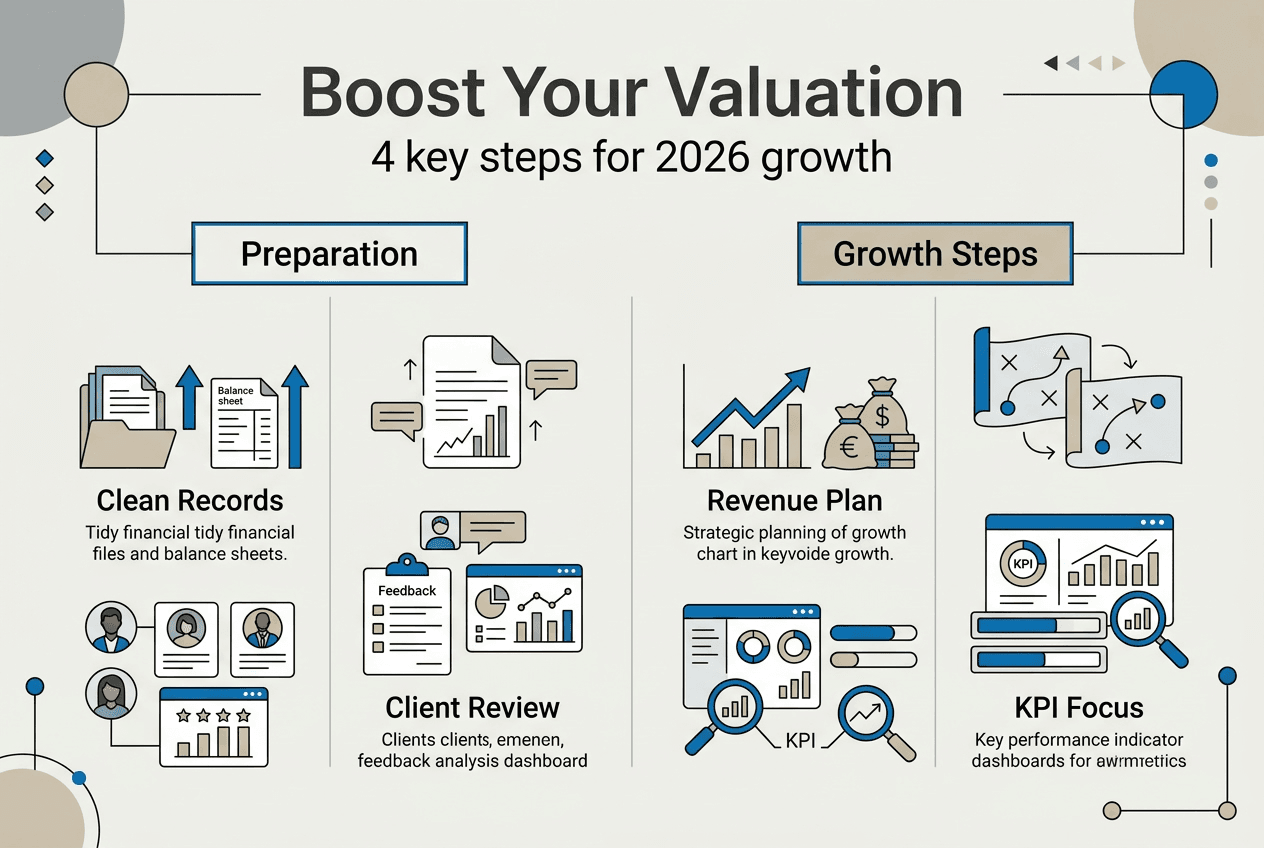
Many small to medium-sized business owners work tirelessly to grow their enterprises, yet struggle to maximise their business valuation when it matters most. Whether you’re preparing for a sale, seeking investment, or simply building long-term equity, understanding how to strategically enhance your business’s worth is essential. This comprehensive guide reveals practical, proven steps tailored for 2026 that will help you prepare, execute, and verify effective valuation-boosting strategies. You’ll discover how to strengthen financial health, optimise client relationships, and implement growth tactics that directly translate into measurable increases in your business value.
Table of Contents
- Understanding The Importance Of Business Valuation
- Preparing Your Business For Valuation Improvement
- Executing Strategic Steps To Boost Your Business Valuation
- Verifying And Sustaining Your Enhanced Business Valuation
- How Strategic Coaching Accelerates Your Business Valuation Growth
- How To Boost Business Valuation: Faq
Key takeaways
| Point | Details |
|---|---|
| Preparation is foundational | Clean financial records, strong client relationships, and operational efficiency set the stage for valuation growth. |
| Strategic execution drives results | Revenue diversification, margin improvement, and leadership development directly increase business worth. |
| Regular verification sustains value | Continuous monitoring through KPIs and periodic valuations ensures lasting attractiveness to buyers and investors. |
| Professional coaching accelerates outcomes | Expert guidance helps navigate complex strategies and overcome bottlenecks faster than solo efforts. |
Understanding the importance of business valuation
Business valuation represents the economic worth of your enterprise, calculated through various methodologies that assess assets, earnings potential, market position, and future prospects. For SME owners in 2026, understanding valuation is no longer optional. It influences every major decision, from securing growth capital to planning succession or negotiating partnerships. A robust valuation opens doors to better financing terms, attracts quality investors, and provides a clear benchmark for measuring strategic progress.
Several core factors determine how much your business is worth. Financial performance sits at the top, encompassing revenue consistency, profit margins, and cash flow stability. Your client base quality matters enormously, particularly recurring revenue streams and contract longevity. Growth potential, including market opportunities and scalability, signals future value to prospective buyers. Management strength and team capability demonstrate whether the business can thrive beyond the founder. Finally, operational efficiency and documented processes prove the business runs systematically rather than depending solely on individual heroics.
In 2026, valuation expectations for SMEs have evolved significantly. Buyers increasingly prioritise businesses with diversified revenue sources, strong digital infrastructure, and demonstrable resilience against market disruptions. Understanding key valuation drivers helps owners focus their efforts effectively. The post-pandemic landscape values flexibility, remote-capable operations, and sustainable growth models over pure revenue size.
Key valuation factors to prioritise include:
- Consistent revenue growth with predictable patterns
- Healthy profit margins exceeding industry benchmarks
- Diverse client base reducing concentration risk
- Scalable systems and documented processes
- Strong leadership team beyond the founder
Recognising these drivers allows you to target improvements where they’ll generate maximum valuation impact. Rather than spreading efforts thinly across every business area, concentrate on strengthening the specific elements that professional valuators and buyers scrutinise most closely.
Preparing your business for valuation improvement
Before implementing growth strategies, you must establish a solid foundation. Think of preparation as building the infrastructure that supports sustainable valuation increases. Without this groundwork, even brilliant strategies will struggle to deliver lasting results.
Your financial house must be impeccable. This means maintaining accurate, up-to-date accounting records that clearly demonstrate profitability trends. Clean books aren’t just about compliance; they signal professionalism and reduce buyer risk. Work with your accountant to improve profit margins through strategic cost management and pricing optimisation. Strengthening finances and client relationships are foundational to improving valuation. Consider implementing quarterly financial reviews to catch issues early and identify improvement opportunities before they become problems.

Your client portfolio deserves equal attention. Analyse your customer mix to identify concentration risks where losing one or two clients would significantly impact revenue. Strengthen relationships with key accounts through enhanced service delivery and regular communication. Review and upgrade contractual agreements to include longer terms, automatic renewals, or performance incentives that lock in recurring revenue. These measures reduce perceived risk and make your business more attractive.
Operational readiness separates mediocre businesses from highly valued ones. Document your core processes so they’re repeatable without your constant involvement. This demonstrates that the business operates as a system rather than depending entirely on you. Align your team around clear goals and ensure key personnel have defined roles with succession plans. Invest in technology that improves efficiency and provides data-driven insights into performance.
Pro Tip: Schedule quarterly financial audits, even informal ones, to prevent surprises during formal valuation assessments and maintain continuous improvement momentum.
Key preparation activities include:
- Conducting a comprehensive financial audit to identify gaps
- Documenting all standard operating procedures
- Diversifying your client base to reduce concentration
- Upgrading contracts to include favourable renewal terms
- Building a management team capable of operating independently
These preparatory steps create the stable platform necessary for executing high-impact valuation strategies. Rushing into growth tactics without this foundation often leads to unsustainable results that collapse under scrutiny. Taking time to prepare properly pays dividends when you’re ready to boost business profitability and implement advanced business development best practices.
Executing strategic steps to boost your business valuation
With preparation complete, you’re ready to implement specific strategies that directly increase your business valuation. These aren’t theoretical concepts but proven approaches that deliver measurable results when executed consistently.
Follow these priority strategies in sequence:
- Diversify revenue streams by developing new product lines, entering adjacent markets, or creating recurring revenue models that reduce income volatility.
- Enhance client retention through loyalty programmes, improved service delivery, and proactive communication that strengthens relationships and increases lifetime value.
- Improve profit margins by renegotiating supplier contracts, optimising pricing strategies, and eliminating operational inefficiencies that erode profitability.
- Develop leadership depth by hiring key managers, implementing succession planning, and creating systems that allow the business to thrive without founder involvement.
- Invest in technology infrastructure that automates routine tasks, provides real-time performance data, and positions your business as forward-thinking and scalable.
- Build intellectual property through proprietary processes, brand development, or unique methodologies that differentiate your business and create barriers to competition.
- Expand market presence strategically through targeted marketing, strategic partnerships, or geographic expansion that demonstrates clear growth trajectory.
Implementing proven growth and profitability strategies directly increases business valuation. Each strategy contributes differently based on your specific situation, industry, and resources. The comparison table below helps you evaluate which approaches suit your circumstances best.
| Strategy | Valuation Impact | Implementation Cost | Timeframe | Best For |
|---|---|---|---|---|
| Revenue diversification | High | Medium | 6-12 months | Businesses with concentration risk |
| Client retention programmes | High | Low | 3-6 months | Service-based businesses |
| Margin improvement | Very High | Low | 3-9 months | All business types |
| Leadership development | Very High | Medium | 12-24 months | Owner-dependent businesses |
| Technology investment | Medium | High | 6-18 months | Manual or legacy operations |
| IP development | Medium | Medium | 12-24 months | Businesses with unique processes |
Pro Tip: Focus on scalable strategies that add measurable value and operational flexibility, allowing you to demonstrate clear before-and-after metrics to potential buyers or investors.
The most successful valuation improvements come from combining multiple strategies rather than relying on a single approach. For example, improving margins whilst simultaneously strengthening client retention creates compounding effects that dramatically boost overall value. Similarly, developing leadership depth whilst investing in technology demonstrates both current efficiency and future scalability.
Consider exploring detailed business growth strategies examples to identify approaches that align with your specific industry and business model. Understanding how to scale your business growth ensures your valuation improvements translate into long-term enterprise value rather than temporary gains.
Execution requires discipline and consistency. Set clear milestones for each strategy, assign responsibility to specific team members, and establish regular review cycles to track progress. Document results meticulously, as this evidence becomes crucial during formal valuation assessments. Remember that buyers and investors value demonstrated results over promises, so building a track record of successful strategy implementation significantly enhances perceived value.
Verifying and sustaining your enhanced business valuation
Implementing strategies is only half the equation. Verifying their impact and sustaining improvements over time separates temporary gains from lasting valuation growth. This phase requires systematic monitoring, continuous adjustment, and cultural embedding of valuation-focused thinking.
Conduct formal valuation assessments at regular intervals, ideally annually or biannually. These professional evaluations provide objective measurements of progress and highlight areas needing additional attention. Whilst formal valuations involve cost, they deliver invaluable insights that guide strategic decisions and demonstrate credible value to stakeholders. Between formal assessments, track proxy indicators that correlate with valuation, such as revenue growth rates, profit margin trends, and client retention percentages.
Establish key performance indicators directly aligned to valuation drivers. Rather than tracking vanity metrics, focus on measures that professional valuators scrutinise. These might include customer acquisition cost, lifetime value ratios, revenue per employee, or working capital efficiency. Create dashboards that make these KPIs visible to leadership teams, fostering accountability and enabling rapid response when metrics drift off target.
Continuous improvement must become embedded in your operational culture. Regular valuation reviews and continuous improvement ensure sustainable business value. Encourage team members to identify process enhancements, cost savings, or service improvements that contribute to overall value. Implement systematic client feedback mechanisms that surface opportunities for strengthening relationships and reducing churn risk. Consider engaging a business coach who brings external perspective and holds you accountable to valuation goals.
Key monitoring and adjustment activities include:
- Quarterly KPI reviews with leadership team
- Annual professional valuation assessments
- Monthly client satisfaction surveys and feedback analysis
- Biannual strategy sessions to refine approaches
- Continuous documentation of process improvements and results
Sustaining high valuation requires vigilance against complacency. Markets evolve, competitors emerge, and buyer expectations shift. What impressed buyers in 2024 may be table stakes in 2026. Stay informed about industry trends, valuation methodology changes, and emerging best practices. Participate in peer networks or industry associations where you can benchmark your progress against similar businesses.
Integrate valuation thinking into major decisions. Before launching new initiatives, hiring key personnel, or making significant investments, evaluate the potential impact on business value. This discipline ensures resources flow toward activities that genuinely enhance worth rather than simply keeping you busy. Consider developing a formal business coaching workflow that systematically addresses valuation drivers through structured improvement cycles.
Remember that valuation is ultimately about reducing buyer risk whilst demonstrating future potential. Every verification activity should answer the question: does this make our business less risky and more attractive to potential buyers or investors? When you consistently answer yes, you’ve created a self-reinforcing cycle of valuation growth that compounds over time.
How strategic coaching accelerates your business valuation growth
Navigating valuation improvement alone can feel overwhelming, particularly when managing daily operations simultaneously. Strategic coaching provides the external expertise, accountability, and structured approach that accelerates results whilst reducing costly missteps. Professional coaches bring proven frameworks, industry insights, and objective perspective that help you identify blind spots and capitalise on overlooked opportunities.
At Summit SCALE, we specialise in helping SME owners like you implement systematic strategies that directly boost business valuation. Our personalised coaching addresses your unique challenges, whether that’s strengthening financial performance, building leadership depth, or creating scalable systems. We’ve guided countless business owners through the exact preparation, execution, and verification phases outlined in this guide, delivering measurable increases in enterprise value. Discover the benefits of coaching investment and explore profitable SMB growth strategies tailored to your situation. Ready to unlock your business’s full potential? Learn about our sustainable business growth workflow and take the first step toward transforming your business value in 2026.
How to boost business valuation: FAQ
What are the fastest ways to boost my business valuation?
The quickest valuation improvements typically come from improving profit margins through cost optimisation and strategic pricing adjustments. These changes can show results within three to six months and directly impact the bottom line that valuators scrutinise most. Strengthening client retention simultaneously reduces risk perception whilst demonstrating stable revenue streams.
How does improving client retention affect valuation?
Client retention directly reduces business risk, which is a primary valuation driver. Businesses with high retention rates demonstrate predictable revenue streams and lower customer acquisition costs, making them significantly more attractive to buyers. Increasing retention by even 5% can substantially boost lifetime customer value and overall enterprise worth.
When is the right time to get a professional business valuation?
Schedule your first professional valuation as soon as you’re serious about maximising business value, even if sale or exit is years away. This baseline assessment identifies specific improvement areas and allows you to track progress over time. Follow up with formal valuations annually or biannually to measure strategy effectiveness and adjust approaches accordingly.
What role does leadership coaching play in valuation growth?
Leadership coaching accelerates valuation growth by helping you develop the strategic thinking, team-building skills, and operational systems that buyers value most. Coaches provide accountability, proven frameworks, and external perspective that prevent costly mistakes whilst identifying high-impact opportunities you might otherwise miss. The guidance particularly helps owner-dependent businesses transition to management-led operations.
How often should I review my business valuation to maintain growth?
Conduct formal professional valuations annually or biannually to track meaningful progress. Between formal assessments, review valuation-related KPIs monthly or quarterly to ensure strategies remain on track. This balanced approach provides regular feedback without excessive cost whilst maintaining focus on continuous improvement. For comprehensive guidance, explore this detailed increase business valuation guide.

