
Running a business in the UK or Australia often means tackling tough decisions with limited time and even fewer trusted sounding boards. The journey can feel isolating, especially when growth stalls or new challenges pile up. For many business owners, finding a mentor who offers not just generic advice but truly personalised guidance becomes the turning point. In this article, you will discover how the right business mentorship provides tailored, practical support to bridge knowledge gaps, improve profitability, and foster long-term success.
Table of Contents
- Defining Business Mentorship and Its Core Value
- Types of Mentorship for Business Owners
- How Mentorship Drives Business Growth
- Essential Qualities in Effective Mentors
- Common Mentorship Pitfalls to Avoid
Key Takeaways
| Point | Details |
|---|---|
| Importance of Mentorship | Business mentorship enhances growth and navigates challenges, with over 80% of Fortune 500 companies employing structured programmes. |
| Types of Mentorship | Different models, including one-on-one, group, peer, virtual, and structured programmes, offer tailored support for various entrepreneurial needs. |
| Driving Business Growth | Engaging with mentors can lead to up to 35% revenue growth and improved organisational sustainability through strategic insights and knowledge transfer. |
| Choosing the Right Mentor | Select mentors with relevant experience, emotional intelligence, and a commitment to your professional development for optimal results. |
Defining Business Mentorship and Its Core Value
Business mentorship represents a strategic relationship between an experienced professional and an emerging entrepreneur, designed to accelerate growth and navigate complex business challenges. Research reveals mentorship’s critical role in supporting business development, with over 80 percent of Fortune 500 companies implementing structured mentoring programmes.
At its core, business mentorship provides personalised guidance that bridges critical knowledge gaps. The most effective mentorship relationships are characterised by five fundamental traits:
- Context-specific expertise in relevant business domains
- Genuine commitment to the mentee’s professional growth
- Strong interpersonal communication skills
- Pro-social orientation focused on collaborative success
- A developmental mindset that encourages continuous learning
Mentors bring substantial value by offering strategic insights drawn from their extensive professional experience. Unlike generic advice, these personalised recommendations help business owners make informed decisions, understand potential pitfalls, and develop robust strategies for sustainable growth. Structured guidance from experienced professionals can significantly accelerate learning curves and enhance innovation within organisations.
Pro tip: When seeking a mentor, prioritise professionals who demonstrate genuine interest in your specific business challenges and possess proven expertise in your industry.
Types of Mentorship for Business Owners
Business owners have access to diverse mentorship approaches, each offering unique advantages for professional growth and development. Research identifies multiple mentoring models designed to address specific entrepreneurial needs and challenges.
The primary types of business mentorship include:
- One-on-One Mentoring: Personalised guidance with a dedicated experienced professional
- Group Mentoring: Collaborative learning environment with multiple perspectives
- Peer Mentoring: Support from fellow entrepreneurs at similar business stages
- Virtual Mentoring: Technology-enabled relationships transcending geographical limitations
- Formal Structured Programmes: Organised mentorship with predefined goals and expectations
Each mentorship type provides distinct benefits. Entrepreneurship mentorship programs have evolved to become more inclusive, particularly supporting underrepresented entrepreneurs by increasing access to critical resources and fostering professional confidence. Contextual matching between mentor and mentee remains crucial, ensuring alignment of skills, industry experience, and personal communication styles.
Here is a comparative overview of business mentorship models and their best-use scenarios:
| Mentorship Model | Ideal For | Typical Format | Unique Benefit |
|---|---|---|---|
| One-on-One Mentoring | Tailored business challenges | Regular personal meetings | Deep, personalised guidance |
| Group Mentoring | Shared industry problems | Multi-mentee sessions | Diverse perspectives shared |
| Peer Mentoring | Collaborative skill development | Mutual sharing, informal | Empathy and solidarity |
| Virtual Mentoring | Overcoming geographic barriers | Online meetings or platforms | Flexible, global access |
| Structured Programmes | Long-term professional growth | Predefined curriculum | Goal tracking and accountability |
Successful mentorship transcends simple advice-giving. It involves creating a strategic partnership that challenges existing thinking, provides objective perspectives, and supports nuanced decision-making across complex business landscapes.
Pro tip: Select a mentorship model that aligns closely with your specific business goals, learning style, and current developmental stage.
How Mentorship Drives Business Growth
Longitudinal studies demonstrate mentorship’s transformative impact on business performance, revealing substantial growth potential for entrepreneurs who engage with experienced mentors. Businesses with structured mentorship programmes can experience up to 35% higher revenue growth and significantly improved sustainability across multiple operational domains.
The key mechanisms through which mentorship drives business growth include:
- Strategic Network Expansion: Access to mentor’s professional connections
- Knowledge Transfer: Insights from experienced industry professionals
- Risk Mitigation: Guidance in navigating complex business challenges
- Performance Acceleration: Targeted advice for operational improvement
- Confidence Building: Psychological support during critical decision-making
Global business leaders emphasise mentorship’s critical role in unlocking entrepreneurial potential. Mentors provide more than simple advice; they offer contextual wisdom that helps businesses adapt to changing market conditions, identify innovative opportunities, and develop resilient organisational strategies.
Beyond financial metrics, mentorship cultivates intangible yet crucial business capabilities. Entrepreneurs gain perspective, challenge their existing assumptions, and develop more nuanced approaches to leadership, ultimately creating more sustainable and adaptable business models.

Consider these distinct business outcomes linked to effective mentorship participation:
| Outcome Area | Potential Impact | Example Result |
|---|---|---|
| Revenue Growth | Up to 35% increase | Improved sales and profit margins |
| Organisational Innovation | Faster adoption of new strategies | More competitive product launches |
| Professional Confidence | Greater resilience in leadership | Improved decision-making under pressure |
| Operational Sustainability | Higher business survival rate | Lasting presence in competitive markets |
Pro tip: Seek mentors who have successfully navigated challenges similar to your current business stage and demonstrate a genuine commitment to your professional development.
Essential Qualities in Effective Mentors
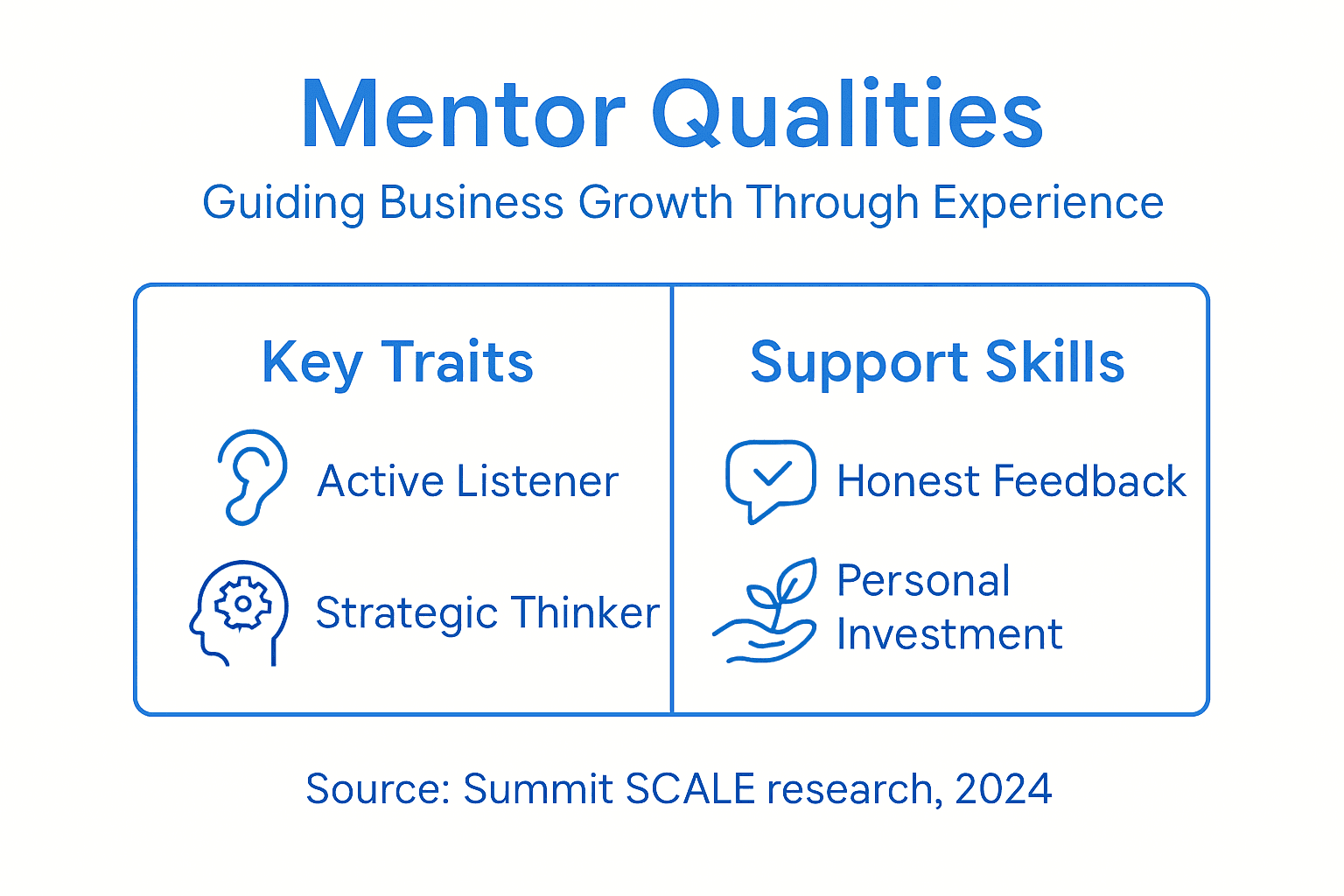
Research reveals critical characteristics of exceptional business mentors, highlighting the complex blend of skills required to truly guide entrepreneurial growth. Effective mentors are not simply experienced professionals, but strategic partners who bring transformative insights to their mentees’ business journeys.
The essential qualities of outstanding business mentors include:
- Emotional Intelligence: Ability to understand and navigate complex interpersonal dynamics
- Domain Expertise: Deep, practical knowledge in specific business contexts
- Communication Skills: Clear, constructive, and empathetic dialogue
- Ethical Integrity: Consistent commitment to professional and moral standards
- Growth Mindset: Continuous learning and adaptability
Professional mentoring research demonstrates that the most impactful mentors possess a nuanced ability to provide constructive feedback that challenges without discouraging. They create safe spaces for entrepreneurs to explore ideas, confront limitations, and develop robust problem-solving strategies.
Beyond technical skills, exceptional mentors cultivate a developmental relationship. They invest in their mentees’ holistic growth, recognising that business success intertwines personal development, strategic thinking, and emotional resilience.
Pro tip: When selecting a mentor, prioritise those who demonstrate genuine curiosity about your unique business challenges and show a track record of supporting entrepreneurial growth.
Common Mentorship Pitfalls to Avoid
Research highlights critical challenges in business mentorship that can derail potentially transformative relationships. Understanding these potential pitfalls is crucial for entrepreneurs seeking meaningful guidance and sustainable professional development.
The most common mentorship challenges include:
- Unclear Objectives: Lack of specific, measurable goals
- Poor Mentor-Mentee Matching: Misalignment of skills and expectations
- Inconsistent Communication: Irregular or superficial interactions
- Over-Dependence: Failing to develop independent problem-solving skills
- Undefined Boundaries: Blurred professional relationship lines
Mentorship relationships often falter due to unrealistic expectations that can create tension and disappointment. Successful mentorship requires a structured approach that balances guidance with the mentee’s autonomy, ensuring the relationship remains productive and mutually beneficial.
Entrepreneurs must approach mentorship as a collaborative partnership, not a one-sided dependency. This means actively participating, being open to constructive feedback, and taking responsibility for personal and professional growth while respecting the mentor’s time and expertise.
Pro tip: Establish clear, SMART goals and communication protocols with your mentor from the outset to create a structured, effective mentoring relationship.
Unlock Your Business Growth Potential with Expert Guidance
Many business owners face challenges such as unclear objectives, limited strategic insight, and difficulty navigating complex decisions. This article highlights the critical value of mentorship in overcoming these hurdles by providing context-specific expertise, accountability, and confidence building. If you relate to the need for personalised, strategic support that drives sales growth, team building, and long-term sustainability, then tailored business coaching can be the solution you need.
At Summit SCALE, we specialise in empowering entrepreneurs with coaching that transforms not only their businesses but their lives. Our services deliver focused performance optimisation aimed at increasing profitability and creating time freedom. Learn more about how our approach aligns with the proven benefits of mentorship by exploring our Business Coaching Archives – Summit Scale and insights from seasoned Business Coach Archives – Summit Scale. Discover how targeted coaching and mentoring unlock new pathways to success.
Ready to move forward and experience growth with a trusted professional partner?
Take the first step today and schedule a free 15-minute assessment call via Summit SCALE. Build a structured partnership that helps you tackle challenges, seize new opportunities, and accelerate your business journey with expert mentorship tailored to your unique goals.
Frequently Asked Questions
What is business mentorship?
Business mentorship is a strategic relationship between an experienced professional and an emerging entrepreneur, aimed at providing personalised guidance to navigate business challenges and accelerate growth.
How can mentorship impact business growth?
Mentorship can significantly enhance business performance by providing access to strategic insights, expanding professional networks, facilitating knowledge transfer, and building the entrepreneur’s confidence, potentially leading to higher revenue growth and improved sustainability.
What types of mentorship are available for business owners?
Business owners can choose from various mentorship models, including one-on-one mentoring, group mentoring, peer mentoring, virtual mentoring, and formal structured programmes, each with unique benefits tailored to specific business needs.
What qualities should I look for in a mentor?
Effective mentors typically possess emotional intelligence, domain expertise, strong communication skills, ethical integrity, and a growth mindset. These qualities help them provide constructive feedback and foster a supportive developmental relationship.
Recommended
- Why (Almost) Every Owner Needs a Coach | Summit SCALE®
- 10 Self-Development Ideas for Business Owners – Summit Scale
- The Business Owner’s Personal Growth Blueprint
- How To Become A Better Business Owner | Summit SCALE® Coaching
- Business Financial Literacy: Why It Matters for Kansas City Owners
- Introducing GrowthParty ! – Kukoo Creative UK

