
TL;DR:
- Business freedom depends on building documented systems that enable independent team execution.
- Effective workflows require clear roles, process documentation, and ongoing review for sustainability.
- Leadership development and trust are essential to let go and truly achieve business freedom.
You started your business to gain freedom. More time, more money, more control over your life. Yet somewhere along the way, the business started running you instead. You’re the first in and the last out. Every decision lands on your desk. Every problem needs your attention. Sound familiar? This guide lays out a structured, proven workflow to move you from constant firefighting to real, lasting freedom. You’ll learn not just the steps to follow, but how to avoid the mistakes that keep most owners stuck, and how to know when your business is genuinely working for you rather than the other way around.
Table of Contents
- What is business freedom and why does workflow matter?
- Get ready: The essentials for a workflow that delivers freedom
- Step-by-step: Designing a workflow for lasting business freedom
- Avoiding common pitfalls: Troubleshooting and sustaining your workflow
- Why most business workflow advice is incomplete
- Unlock real business freedom: Expert coaching to guide your workflow
- Frequently asked questions
Key Takeaways
| Point | Details |
|---|---|
| Business freedom defined | True business freedom is about building repeatable systems so you can step back without chaos. |
| Essential workflow elements | Clear documentation, delegated roles, and consistent systems are non-negotiable for owner independence. |
| Follow sequential steps | You can build freedom with a step-by-step workflow from mapping core processes to team handover. |
| Sustain and improve | Your workflow must be reviewed and improved regularly to ensure ongoing owner freedom and profitability. |
What is business freedom and why does workflow matter?
Business freedom is not about working less for the sake of it. It’s about having the personal optionality to step back from daily operations without your income or reputation suffering. You choose when to show up, not because the business demands it, but because you want to. That’s a fundamentally different relationship with your company.
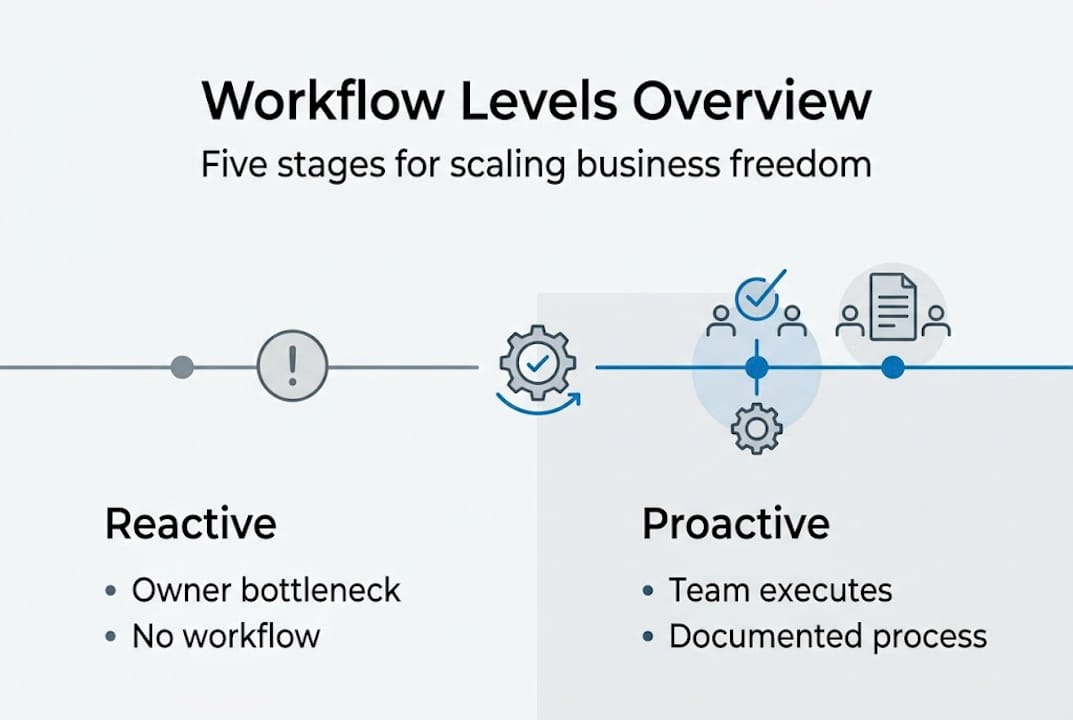
The problem is that most owners never build the systems needed to reach this point. Instead, they operate in reactive mode, responding to whatever is loudest rather than leading with intention. Without clear workflows, processes live inside the owner’s head, and the moment you step away, things fall apart.
Consider the contrast:
| Business without workflow | Business with workflow |
|---|---|
| Owner is the bottleneck | Team executes independently |
| Inconsistent results | Repeatable, predictable outcomes |
| Growth stalls without owner present | Growth continues in owner’s absence |
| Constant stress and overwork | Owner focuses on strategy and vision |
Workflows change everything. A documented process means your team knows exactly what to do, when to do it, and how to do it to your standard. Role clarity removes confusion. Systems create consistency. Together, they give you back your time.
A useful framework for understanding where you currently sit is the five levels of freedom: 1. Stabilise your finances; 2. Build consistent systems and pay; 3. Scale profitably; 4. Build personal wealth; 5. True optionality. Most owners are stuck at level one or two, not because they lack ambition, but because they’ve never built the workflow infrastructure that supports the climb.
If you’re wondering why scale a small business in the first place, the answer is simple: scaling without systems creates chaos, but scaling with systems creates freedom.
Key elements of an effective workflow include:
- Documented steps that anyone can follow without asking the owner
- Clear role assignments so accountability is never ambiguous
- Repeatable systems that produce consistent quality every single time
- Measurable outcomes so you can track whether the process is working
“Most business owners don’t have a business. They have a job. The difference is a system.” True freedom begins the moment your business can operate without you at the centre of every decision.
Get ready: The essentials for a workflow that delivers freedom
Before you start mapping processes and building systems, you need the right foundations in place. Jumping straight into workflow design without clarity on your mission, your leadership style, and your team roles is like building a house on sand. It looks good at first, and then it sinks.
The Rich Dad B-I Triangle identifies eight integrities, including mission, leadership, and team, that a systematised, freedom-generating business must have in place. These aren’t soft, feel-good concepts. They are the structural pillars your workflow will sit on.

Use this checklist to assess your readiness:
| Workflow essential | Why it matters | In place? |
|---|---|---|
| Clear business mission | Aligns team decisions with your vision | ✓ / ✗ |
| Defined leadership structure | Removes owner as sole decision-maker | ✓ / ✗ |
| Documented core processes | Enables consistent team execution | ✓ / ✗ |
| Delegated roles and responsibilities | Stops tasks defaulting back to owner | ✓ / ✗ |
| Documentation tools | Makes capturing processes fast and simple | ✓ / ✗ |
The tools you choose matter too. You don’t need to invest in expensive software to get started. A practical stack for most small businesses might include:
- A project management tool such as Trello, Asana, or ClickUp for task tracking
- A shared document system like Google Workspace or Notion for storing processes
- A communication platform such as Slack or Microsoft Teams for team alignment
- Simple video tools for recording walkthroughs of key tasks
If you want to go deeper on what scaling a business actually requires at each stage, it’s worth reviewing the full picture before investing time in tool selection. The right preparation will also unlock business scalability far more quickly than jumping straight to tactics.
Pro Tip: Start by documenting just the tasks you repeat every single week. Pick the top five recurring tasks and write out each step as if explaining it to someone on their very first day. This alone will reveal where you’re the bottleneck and where delegation is immediately possible.
Step-by-step: Designing a workflow for lasting business freedom
Once your foundations are set, here’s exactly how to build the workflow that shifts you toward genuine freedom. Follow these steps in order, and resist the urge to skip ahead.
-
Identify your core tasks. List every task you personally carry out in a typical week. Be thorough. Include the small things you do automatically without thinking, because those are often the most important to document.
-
Categorise by type. Sort your tasks into three buckets: tasks only you can do (true owner decisions), tasks someone else could do with training, and tasks that should already be delegated. Be honest with yourself here.
-
Map your process flows. For each task in the second bucket, map out every step involved. Use simple flowcharts or numbered lists. The goal is to document processes clearly enough that someone with no prior experience could replicate them accurately.
-
Assign clear ownership. Every documented process needs a named owner. Not a department, not a vague role, a specific person who is responsible for its execution and quality.
-
Build training resources. Convert your documented processes into training materials. Written guides work, but video walkthroughs are faster to create and easier for new team members to follow. Pair them with a simple checklist for daily reference.
-
Test and refine. Have a team member follow your documented process without your help. Watch where they get stuck. Those gaps are your next round of improvements. A process that hasn’t been tested isn’t ready to be relied upon.
-
Schedule regular reviews. Set a monthly or quarterly date to review each core workflow. Businesses evolve, and your processes must evolve with them. A workflow that worked six months ago may now be creating friction.
This step-by-step approach to scaling mirrors what high-growth businesses do differently from those that stay stuck. If you want a structured framework, our five-step process offers a practical path from where you are now to where you want to be.
Pro Tip: Use screen recording tools like Loom to capture exactly how you complete a task in real time. This creates an instant training video and a documentation draft in one go, with no extra effort.
Avoiding common pitfalls: Troubleshooting and sustaining your workflow
Building your workflow is the beginning, not the finish line. The owners who gain lasting freedom are not those who created the best initial process, but those who consistently maintained, improved, and trusted their systems over time.
Here are the most common mistakes that derail workflow implementation:
- Overcomplicating the process. If a workflow takes twenty steps to explain a simple task, it won’t be followed. Simplify first, then add detail only where it’s genuinely needed.
- Leaving the team out. Workflows built in isolation by the owner rarely reflect how work actually happens. Involve the people doing the tasks. Their input makes the process more accurate and builds buy-in.
- Skipping documentation entirely. “We’ll just remember it” is not a system. Undocumented processes disappear when staff change, memory fades, or the owner is unavailable.
- Never reviewing or updating. Static workflows become outdated. A process designed last year may no longer match your current tools, team, or customer expectations.
- Expecting instant results. Workflow implementation takes time to embed. Give your team the space to learn, make mistakes, and improve without jumping back in to take over.
Monitoring your workflows doesn’t have to be complex. A simple weekly check-in where team leads report on any friction points, combined with a monthly review of key performance indicators, is enough to catch problems early.
The progression from reactive to lasting freedom is not linear. There will be setbacks. Systems will break. Staff will leave. The difference between owners who achieve freedom and those who don’t is not that the former had perfect workflows. It’s that they kept improving.
“Freedom is not a destination you arrive at once. It’s a direction you keep choosing, one improved process at a time.”
For practical advice on sustainable scaling and how to avoid burnout while building your systems, and to understand how workflows connect to lasting growth and freedom at every stage of your journey, these resources are worth your time.
Why most business workflow advice is incomplete
Here’s the uncomfortable truth most guides won’t say: workflows alone will not set you free. We see this repeatedly with business owners who have beautifully documented processes, colour-coded flowcharts, and a full suite of project management tools, yet they’re still working sixty-hour weeks. Why? Because the workflow addressed the systems but not the leader.
Freedom requires you to genuinely let go. That means trusting your team to make decisions without your input, accepting that things will sometimes be done differently from how you’d do them, and resisting the pull to step back in the moment things feel uncertain. That is a leadership and culture challenge, not a process challenge.
The workflow’s real value is this: it creates the conditions for you to focus on what only you can do, the vision, the strategy, the relationships that shape your business’s future. Without that shift, the workflow simply becomes another management task on your to-do list. Knowing how to scale for freedom means pairing your systems with genuine leadership development. That’s what transforms a well-run operation into a business that truly works for you.
Unlock real business freedom: Expert coaching to guide your workflow
Building workflows that genuinely deliver freedom is entirely achievable, but it’s far easier with someone in your corner who has guided other business owners through the same journey.
At Summit SCALE®, we help you design and implement the right workflow tailored to your specific business, team, and growth goals. Our coaching accelerates your systematisation process and ensures you’re not just building processes, but building a business that supports your life. Whether you’re exploring why investing in coaching makes commercial sense, understanding the role of coaching for SMEs, or ready to explore types of business coaching available to you, we’re here to help. Book your free 15-minute assessment call today.
Frequently asked questions
What is a business workflow?
A business workflow is a documented set of processes and systems that allows your business to run smoothly and replicate success, ideally with minimal owner involvement. Effective workflows are written clearly enough that someone with no prior experience can follow and replicate them accurately.
How does workflow impact business owner freedom?
Workflows create consistency, reduce the daily pressure on owners, and are the foundation for scaling towards genuine business freedom. The progression from reactive to lasting freedom depends on having reliable systems your team can execute without your constant direction.
What’s the first step to create a workflow?
Start by listing your most repetitive weekly tasks and writing out exactly how each one is completed, step by step, as if explaining it to someone entirely new to the role.
Can workflows really help small business owners step back?
Yes, when properly implemented and paired with team leadership development, workflows enable owners to reduce their direct involvement and build a resilient, self-managing business that grows without them at the centre of every decision.

