
Nearly 90 percent of entrepreneurs list business freedom as their top priority when scaling beyond the startup stage. Whether you operate in an American metropolis or an Australian coastal community, understanding business freedom is crucial for those aiming for both success and personal autonomy. From British legal roots to modern performance coaching, this guide clarifies what business freedom truly means, why it matters, and how it empowers you to thrive on your own terms.
Table of Contents
- Defining Business Freedom And Its Purpose
- Types Of Business Freedom For Owners
- Core Elements: Time, Money, And Control
- Practical Steps To Achieve Business Freedom
- Common Pitfalls And How To Avoid Them
Key Takeaways
| Point | Details |
|---|---|
| Importance of Business Freedom | Business freedom allows entrepreneurs to operate with minimal governmental interference while fostering responsible practices. |
| Core Elements of Success | Success hinges on time, money, and control; mastering these elements empowers sustainable growth. |
| Strategic Financial Management | Building diversified revenue streams and establishing robust financial controls are vital for achieving entrepreneurial freedom. |
| Avoiding Common Pitfalls | Regularly assessing market assumptions, financial strategies, and adaptability helps mitigate risks and supports continued business viability. |
Defining Business Freedom And Its Purpose
Business freedom represents more than a legal concept; it is a dynamic framework enabling entrepreneurs to pursue economic opportunities while navigating complex regulatory environments. At its core, business freedom encompasses the liberty to establish, operate, and grow enterprises with minimal governmental interference while maintaining responsible practices.
Historically, business freedom has evolved significantly, particularly in the United States. Constitutional economic property rights762349) have transformed from absolute protections to a nuanced balance between entrepreneurial liberty and public welfare regulations. This shift reflects an understanding that unrestrained business activities can potentially harm broader societal interests, necessitating thoughtful governance.
Moreover, contemporary interpretations of business freedom extend beyond regulatory parameters. Purpose-driven entrepreneurship emphasises aligning business goals with societal commitments. Successful entrepreneurs recognise that true freedom involves creating value not just for shareholders, but for employees, communities, and stakeholders.
Business owners must understand that freedom is not about operating without constraints, but about strategically navigating complex ecosystems while maintaining ethical standards and pursuing meaningful growth.
Pro tip: Regularly assess your business’s alignment between regulatory compliance, personal vision, and broader societal impact to maintain authentic entrepreneurial freedom.
Types Of Business Freedom For Owners
Business freedom encompasses multiple interconnected dimensions that enable entrepreneurs to strategically navigate their professional landscapes. Economic freedom components762349) represent critical pillars that support business owners’ ability to operate, innovate, and expand their enterprises with minimal external constraints.
The primary types of business freedom include operational autonomy, financial management liberty, market access rights, and legal protection frameworks. Operational autonomy allows business owners to make independent strategic decisions about their organisational structure, workflow processes, and internal management approaches. Financial management liberty encompasses the freedom to allocate resources, invest capital, manage revenue streams, and make independent financial planning choices without excessive bureaucratic interference.
Market access rights represent another crucial dimension of business freedom, enabling entrepreneurs to engage in free market trade across diverse economic environments. This includes the ability to enter or exit markets, compete fairly, and pursue business opportunities without undue regulatory restrictions. Legal protection frameworks further support these freedoms by ensuring entrepreneurs can secure their intellectual property, enforce contractual agreements, and operate within a transparent regulatory environment that protects their fundamental business rights.
Ultimately, business freedom is not about complete deregulation, but about creating an ecosystem where entrepreneurs can pursue innovation, create value, and contribute meaningfully to economic development while maintaining responsible business practices.
Here’s an overview of the main types of business freedom and how each supports entrepreneurial success:
| Type of Freedom | Key Features | Example Benefit |
|---|---|---|
| Operational Autonomy | Independent decision-making | Agile adaptation to change |
| Financial Management | Unrestricted resource allocation | Sustainable business growth |
| Market Access | Enter and exit markets freely | Expanded revenue potential |
| Legal Protection | Secure intellectual property rights | Reduced legal vulnerabilities |
Pro tip: Regularly audit your business’s operational processes to identify and eliminate unnecessary bureaucratic constraints that might be limiting your entrepreneurial freedom.
Core Elements: Time, Money, And Control
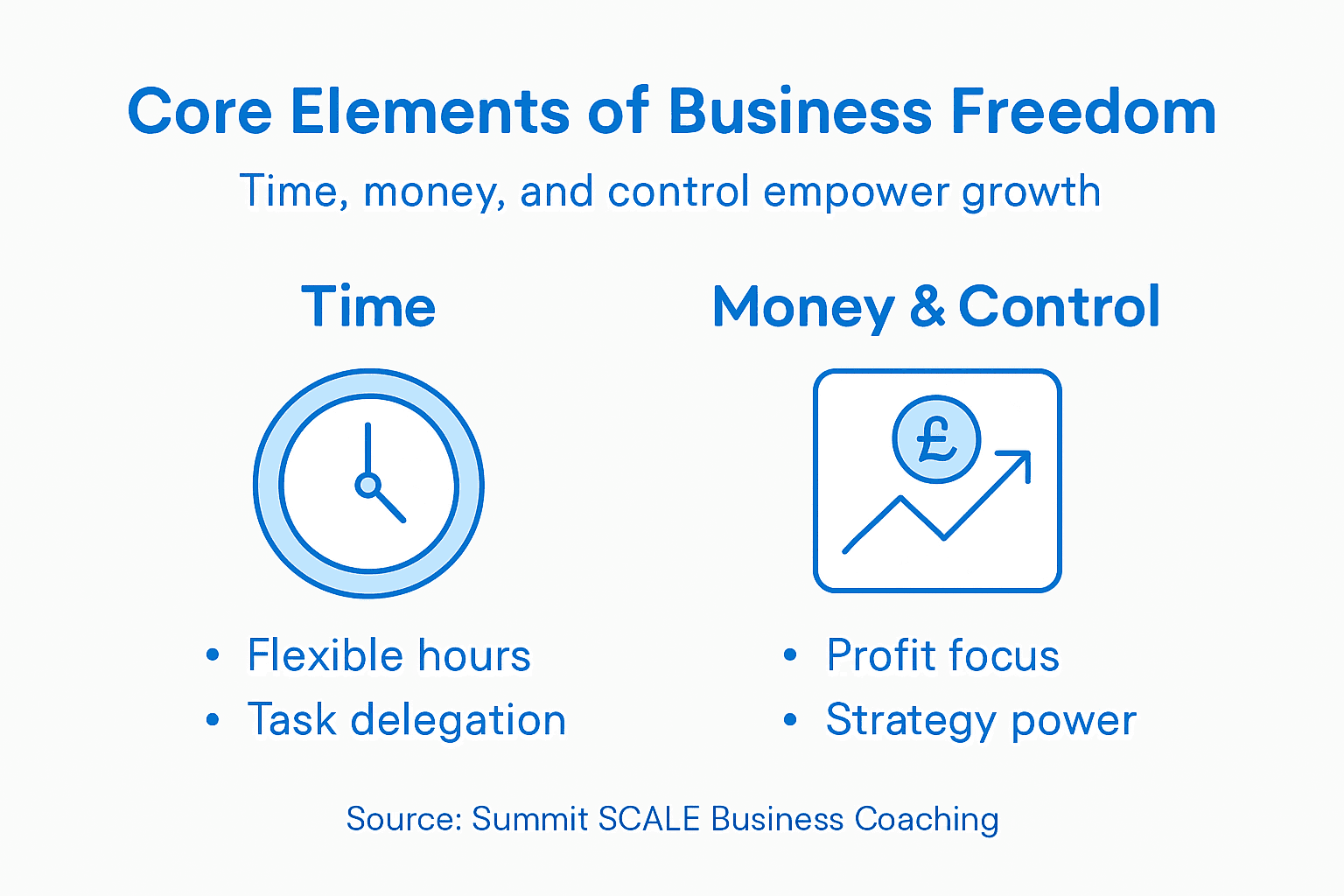
Business freedom fundamentally revolves around three interconnected core elements that determine an entrepreneur’s ability to thrive: time, money, and control. Drivers of business freedom demonstrate how these elements are intricately linked, creating a dynamic framework for entrepreneurial success.
Time freedom represents the ability to strategically allocate working hours, design flexible schedules, and prioritise high-value activities that drive business growth. This doesn’t merely mean working fewer hours, but working more effectively by focusing on tasks that generate maximum impact. Entrepreneurs who master time management can systematically reduce operational overhead, delegate non-critical responsibilities, and create space for strategic thinking and innovation.
Financial freedom encompasses more than simple profitability. It involves creating robust revenue streams, maintaining healthy cash flow, making strategic investments, and developing financial systems that provide predictability and stability. Successful business owners understand that financial freedom means building businesses that generate consistent income with minimal direct personal intervention, allowing for scalability and long-term wealth creation.

Control represents the entrepreneur’s capacity to make independent strategic decisions, shape organisational culture, and maintain autonomy over business direction. This element goes beyond mere operational control, extending to psychological freedom from external pressures, the ability to pivot when necessary, and maintaining alignment between personal vision and business objectives.
Pro tip: Conduct a quarterly audit of your time, financial, and strategic controls to identify potential inefficiencies and realign your business towards greater entrepreneurial freedom.
Practical Steps To Achieve Business Freedom
Achieving genuine business freedom requires a strategic and systematic approach that transcends traditional management techniques. Establishing clear governance frameworks provides entrepreneurs with a robust foundation for creating sustainable autonomy within their business ecosystems.
The first critical step involves developing comprehensive operational systems that reduce personal dependency. This means creating documented processes, standardised workflows, and training protocols that enable the business to function effectively without constant direct intervention. Entrepreneurs must design organisational structures that distribute responsibilities, implement performance metrics, and cultivate a culture of accountability that supports independent decision making across all levels of the organisation.
Financial strategy represents another fundamental pillar of business freedom. Successful business owners must focus on building diversified revenue streams, establishing robust financial controls, and developing scalable economic models that generate consistent returns with minimal ongoing management. This involves strategic investments, careful cash flow management, and creating financial buffers that provide stability and flexibility for future growth opportunities. Simplifying administrative procedures can further accelerate this process by reducing bureaucratic friction and enabling more agile business operations.
Ultimately, achieving business freedom demands a holistic approach that integrates strategic planning, systematic implementation, and continuous adaptation. Entrepreneurs must view their business as a dynamic organism capable of evolving independently while maintaining alignment with core vision and values.
Pro tip: Develop a quarterly review process that systematically evaluates your business’s operational independence and identifies potential areas for increased autonomy and reduced personal intervention.
Common Pitfalls And How To Avoid Them
Entrepreneurial journeys are fraught with potential obstacles that can derail even the most promising business ventures. Entrepreneurial challenges often stem from cognitive biases and strategic miscalculations that prevent business owners from achieving sustainable growth and operational freedom.
One of the most critical pitfalls is becoming excessively attached to a single business concept without rigorous market validation. Successful entrepreneurs understand the importance of maintaining flexibility and objectivity. This means continuously testing assumptions, gathering customer feedback, and being willing to pivot or modify business models when evidence suggests necessary changes. Developing a systematic approach to market research and maintaining emotional detachment from initial ideas can prevent significant strategic missteps.
Financial management represents another substantial area of potential failure. Many business owners underestimate their capital requirements, miscalculate cash flow projections, or fail to establish robust financial controls. Entrepreneurs must develop comprehensive financial strategies that include multiple revenue streams, contingency planning, and regular financial audits. This approach helps create financial resilience and reduces the risk of unexpected cash flow disruptions that could compromise business stability.
Perhaps the most insidious pitfall is resistance to continuous learning and adaptation. The business landscape evolves rapidly, and entrepreneurs who remain static quickly become obsolete. This requires cultivating a growth mindset, staying informed about industry trends, seeking mentorship, and being open to implementing new technologies and strategies that can enhance operational efficiency.
The following table summarises typical business pitfalls and how strategic action can address them:
| Common Pitfall | Underlying Cause | Preventive Strategy |
|---|---|---|
| Over-attachment to ideas | Lack of market validation | Continuous customer feedback |
| Poor financial management | Inadequate planning and controls | Regular financial audits and forecasting |
| Resistance to adaptation | Fear of change and stagnation | Ongoing learning and mentoring |
Pro tip: Implement a monthly learning and reflection session where you critically analyse your business performance, identifying potential blind spots and opportunities for strategic improvement.
Empower Your Journey to True Business Freedom Today
The article highlights the vital need for entrepreneurs to gain control over their time, money, and decision-making while avoiding common pitfalls such as rigid business models and poor financial planning. If you feel overwhelmed by operational demands or uncertain how to align your vision with sustainable growth, it is time to embrace a tailored approach that guides you through these challenges confidently. Concepts like operational autonomy and financial freedom are not just ideals but achievable realities when supported by expert coaching designed explicitly for ambitious business owners.
At Summit SCALE, we specialise in helping entrepreneurs unlock genuine business freedom through strategic coaching in areas including sales growth, team building, and cost control. Our proven methods foster not only increased profitability but also more personal time and control over your business direction. By integrating proven frameworks with your unique vision, you can overcome barriers that often limit growth and scalability.
Accelerate your path with professional guidance and transform your business into a thriving, autonomous enterprise that supports your lifestyle and goals.
Start your journey now by exploring our business coaching services to discover how to regain control and unlock growth.
Take action today. Book your free 15-minute assessment call at Summit SCALE and begin creating the business freedom you deserve.
Frequently Asked Questions
What is business freedom?
Business freedom is the ability for entrepreneurs to establish, operate, and grow their enterprises with minimal governmental interference while adhering to responsible practices. It involves aligning business goals with societal commitments and creating value for all stakeholders.
What are the types of business freedom?
The primary types of business freedom include operational autonomy, financial management liberty, market access rights, and legal protection frameworks. Each of these dimensions supports entrepreneurs in operating effectively and pursuing growth opportunities.
How can entrepreneurs achieve business freedom?
Entrepreneurs can achieve business freedom by developing operational systems that reduce dependency, implementing robust financial strategies, and creating organisational structures that foster independent decision-making and accountability.
What common pitfalls should entrepreneurs avoid to ensure business freedom?
Common pitfalls include becoming excessively attached to a single business idea without market validation, poor financial management, and resistance to continuous learning. To avoid these, entrepreneurs should seek customer feedback, maintain comprehensive financial controls, and embrace a growth mindset.

