
TL;DR:
- Meaningful sales growth involves improving unit sales, pricing, customer acquisition, and retention rather than simply increasing revenue.
- UK and Australian SMEs demonstrate cautious but steady growth, emphasizing profit and cash management alongside revenue expansion.
More sales should mean more success. That idea feels obvious, almost instinctive. Yet many small and medium-sized business owners in the UK and Australia are discovering that rising revenue can mask real dangers, from shrinking margins to cash flow crises that appear without warning. UK SMEs show cautious momentum as revenues and profits rise, yet business owners remain wary about hiring and investment. This guide cuts through the noise. We will help you understand what meaningful sales growth actually looks like, which levers you truly control, and how to grow in a way that builds lasting profit rather than fragile momentum.
Table of Contents
- What does sales growth mean for your business?
- The four levers of profitable sales growth
- Profit, cash and sustainable momentum: Avoiding the revenue trap
- Balancing ambition: Lessons from the UK and Australia
- A smarter way to focus on sales growth: Our perspective
- How expert guidance can accelerate your sales growth journey
- Frequently asked questions
Key Takeaways
| Point | Details |
|---|---|
| Sales growth framework | Strategically using the four growth levers gives SME owners real control over outcomes. |
| Profit focus matters | Growth should always be tied to profit and cash flow rather than just increasing revenue. |
| Balanced ambition wins | Learning from UK and Australian SME experience shows agile, resilient firms do best. |
| Expert advice pays off | Engaging expert guidance can fast-track the journey from sales ideas to profitable results. |
What does sales growth mean for your business?
With misconceptions addressed, let’s clarify what sales growth really means for your business.
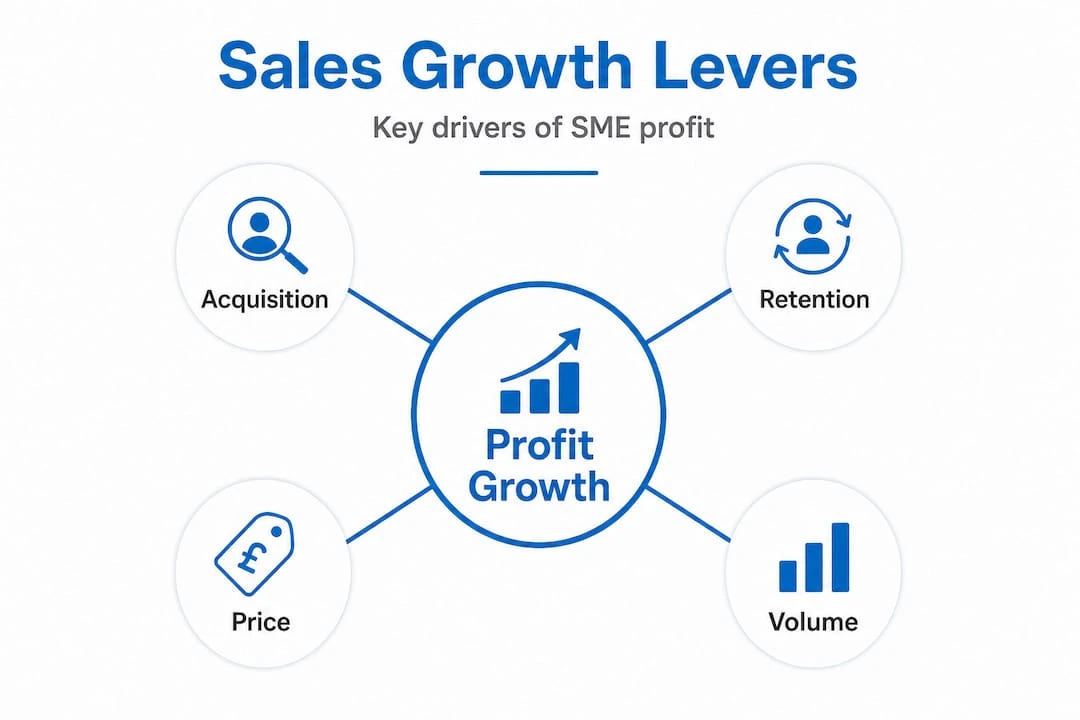
Sales growth is not simply a bigger number at the top of your income statement. In practice, it means increasing the value your business generates through a combination of four dimensions: more units sold, higher prices achieved, more customers won, and more repeat business retained. Each of these dimensions tells a different story about the health of your enterprise.
Think of it this way. If your revenue grew by 10% last year purely because you discounted heavily to shift stock, that is very different from growing 10% because loyal customers bought more at full price. One erodes your future, the other builds it.
Recent data brings this into sharp focus. UK SMEs recorded real revenues up 3.3% year-on-year, with profits rising a stronger 6.2% and headcount growing modestly. Across the water, Australian small business sales rose 7.2% in Q1 2026. Both markets show growth, but both also show caution. That combination is not a contradiction. It is wisdom.
| Market | Revenue/sales growth | Profit growth | Headcount trend |
|---|---|---|---|
| UK SMEs (2026) | +3.3% year-on-year | +6.2% year-on-year | Modestly positive |
| Australian SMEs (Q1 2026) | +7.2% year-on-year | Not separately reported | Cautious |
“Purposeful growth is the kind that makes your business stronger, not just bigger. The numbers on the scoreboard matter less than the margin behind them.”
If you want to build a sales growth strategy that holds up under pressure, start by defining what growth means for your specific business model, your customers, and your market conditions. Rapid growth for its own sake is a treadmill. Purposeful growth is a staircase.
The four levers of profitable sales growth
Understanding growth is one thing; knowing how to achieve it is another. Let’s get practical with the four key levers you actually control.

Every sales result your business produces is a product of four levers. You can pull them individually or in combination, but understanding which lever to pull first is where business owners gain a genuine edge. As sales growth research consistently shows, growth is driven by price, volume, acquisition, and retention, and the smartest operators choose their lever based on data, not gut instinct.
Here is what each lever means in plain English:
- Acquisition means winning new customers. It is the most expensive lever to pull because it requires marketing spend, sales time, and often a longer payback period.
- Retention means keeping the customers you already have and encouraging them to buy again. This is typically the most cost-efficient lever, yet it is the most neglected.
- Price means charging more for what you already sell. Even a 5% price increase, if your volume holds, can transform your profit margin.
- Volume means selling more units or services to existing customers. Cross-selling, upselling, and bundling all live here.
| Growth challenge | Best lever to pull | Why it works |
|---|---|---|
| Struggling to find new customers | Acquisition | Widens your customer base |
| High churn rate | Retention | Reduces costly replacement cycle |
| Margins shrinking | Price | Recovers margin without increasing costs |
| Underutilised existing customers | Volume | Grows revenue from proven relationships |
The role that each of these levers plays in overall profitability is significant. Most SME owners instinctively reach for acquisition because it feels like “real” growth. But acquisition is expensive. A client who costs you £500 to acquire and buys once is far less valuable than a loyal client who needs no advertising and buys three times a year.
Pro Tip: Never pull just one lever without measuring the impact on your profit margin. Driving high volume at a low price might look impressive in revenue terms but could quietly destroy your business from the inside out. Always connect your lever activity to your bottom line.
Profit, cash and sustainable momentum: Avoiding the revenue trap
Now, with practical levers in hand, it is vital to consider how sales growth interacts with profit and cash, a connection that is key to true success.
Here is an uncomfortable truth. Plenty of businesses have gone under while their sales were rising. This is not a rare story. It is a pattern, and it has a name: the revenue trap. You chase bigger numbers, but the costs of chasing them outpace the returns. SMEs face margin pressure from rising costs and slow payments even as they record sales growth, which is why connecting revenue to profit is not optional. It is survival.
“Revenue without profit is momentum without progress.”
There are three pitfalls that pull SME owners into the revenue trap more often than any others:
-
Underpricing to win business. Many owners drop prices to secure clients, telling themselves they will raise prices later. Later rarely comes. You end up with a full order book and an empty bank account. Pricing confidence is not arrogance. It is financial responsibility.
-
Poor debtor management. You invoice a client, they pay 60 or 90 days later, and in the meantime you have already paid your team and your suppliers. This gap between earned revenue and received cash is where growing businesses quietly run out of oxygen. Strong collections processes are as important as strong sales processes.
-
Overexpansion ahead of cash. You win a big contract and hire five people to service it. The contract delivers, but slowly, and the payroll hits every fortnight regardless. Scaling your capacity before your cash supports it is one of the fastest routes to insolvency, even during a period of growth.
Learning to align profitability with growth is the discipline that separates thriving businesses from those that grow into trouble. You can also draw on practical consulting insights for SMEs to strengthen your financial decision-making process.
Pro Tip: Before launching any sales push, pressure-test your cash flow projections. Ask yourself: if we hit our sales target but clients pay 45 days late, can we still meet all our obligations? If the answer is uncertain, fix the cash model before you scale the sales activity.
Balancing ambition: Lessons from the UK and Australia
To turn these principles into action, let’s look at what recent UK and Australian SME experience truly teaches about balanced growth.
The data emerging from both markets in 2026 paints a picture that is worth studying carefully. UK SMEs show that productivity improvements are essential to transforming top-line revenue gains into resilient, lasting performance. Growing revenue without improving how efficiently that revenue is produced leads to fragile results. Australian SMEs, meanwhile, are being advised to pressure test cash and manage cost uncertainty even as sales rise strongly.
The statistic worth printing and pinning to your wall: Australian SMEs grew sales by 7.2% in Q1 2026. UK SMEs grew revenue by 3.3% and profit by 6.2% in the same period. The UK number is slower on the top line but faster on the bottom line. That is not underperformance. That is quality over quantity in action.
What do the most resilient businesses in both markets have in common? Here are the practical patterns that matter most:
- They reinvest wisely. Profit is not the finish line. It is fuel. The best-performing SMEs reinvest a portion of profit into improving systems, capability, and customer experience rather than withdrawing everything or hoarding cash without purpose.
- They keep costs visible. Growing businesses often let cost structures drift. Regular, honest cost audits prevent the creep that erodes margin quietly over time. Knowing your numbers is not a finance task. It is a leadership task.
- They prioritise talent carefully. Hiring ahead of revenue is a common mistake. The smarter approach is to hire just behind demand, bring people in as the growth validates the need, and invest in retaining those who deliver results.
- They treat cash as king. Profit on paper and cash in the bank are two different things. Healthy businesses track both obsessively and make decisions based on cash reality, not accounting estimates.
A useful read for building these foundations is our SME profitability guide, which connects the dots between sales activity and financial resilience. Understanding why sales growth is critical also helps you communicate the priorities clearly within your leadership team.
The lesson from both markets is the same: avoid binary thinking. Sales growth is not something you pursue recklessly or abandon fearfully. You pursue it with discipline, eyes open, and a clear view of what your numbers are telling you.
A smarter way to focus on sales growth: Our perspective
All these factors lead to a smarter, more diagnostic approach to sales growth. Here is our take, shaped by years of working closely with SME owners across a wide range of industries and market conditions.
The conventional wisdom says: grow your sales and everything else will follow. We have seen enough businesses to know that this is not just incomplete, it is sometimes dangerous. More sales can mean more complexity, more cost, more exposure, and more pressure on a team that was already stretched. Without the right focus, growth can become the problem rather than the solution.
What we observe consistently in the businesses that succeed is not a relentless pursuit of more. It is a disciplined focus on which lever matters most right now, for this business, in this market, at this stage. That is what we call leverage mapping. It is the practice of diagnosing your growth position before you commit energy and resource to any particular direction.
“The business owner who knows which lever to pull next will always outperform the one who simply works harder on all of them at once.”
Here is the uncomfortable insight: most SME owners are growth-ready in terms of ambition but diagnosis-poor in terms of clarity. They know they want more revenue. They are less certain whether that means winning new clients, raising prices, or simply doing a better job of retaining the clients they already have. That uncertainty costs them time, money, and momentum.
Patient investment in the right lever, supported by real data and honest financial review, is what separates sustainable performers from those who grow fast and then stall. If you want lasting business success, the diagnosis has to come before the action. Hustle without direction is just noise.
How expert guidance can accelerate your sales growth journey
If you are ready to put these strategies into action, quality guidance can make the difference between another year of good intentions and genuine, measurable progress.
Understanding the four levers, avoiding the revenue trap, and building profit-first growth habits are all achievable. But most SME owners are managing operations, leading teams, and serving clients simultaneously. Finding the time and objectivity to apply these frameworks consistently is genuinely difficult. That is where structured coaching changes everything.
At Summit SCALE, we work with business owners to bring clarity, accountability, and a diagnostic approach to their sales growth strategy. Our coaching helps you identify which lever to pull first, build the financial discipline to protect your margins, and create the momentum that compounds over time. You can explore our sales growth strategies or learn more about why so many SME owners choose to invest in coaching as the fastest route from knowing to doing. Discover the role of coaching in delivering the kind of focused, systemised growth that holds up under pressure. The next step is a free 15-minute assessment call. It costs nothing and could reframe everything.
Frequently asked questions
What is the main benefit of focusing on sales growth for my SME?
Sales growth provides more resources for reinvestment, helps buffer against market shocks, and supports long-term profitability when managed correctly. As UK SME data shows, quality growth where profits rise faster than revenue builds genuine resilience.
Which sales growth lever should I focus on first?
Start with the lever, whether price, volume, acquisition, or retention, that your current numbers show is weakest and aligns with your market conditions. Leverage mapping allows you to tailor your sales approach to your own data rather than following generic advice.
Can rapid sales growth harm my SME?
Yes. If sales outpace profit or cash flow, growth can strain resources, squeeze margins, and risk insolvency. As research confirms, “revenue without profit” is momentum without progress, and fast growth can genuinely destabilise an otherwise healthy SME.
How do I know if my sales growth is sustainable?
Monitor profit margins consistently, track recurring customer rates, audit your cost structure regularly, and pressure-test cash flow projections before each growth phase. Australian SMEs are specifically advised to test cash flow and margins during growth periods to ensure the growth is robust rather than fragile.

