
TL;DR:
- Time freedom is the power to choose how you spend your days on your own terms, beyond work-life balance. It involves designing your life proactively, expanding discretionary time, and maintaining emotional readiness, not just reducing hours. Achieving it requires intentional scheduling, boundary setting, and rebuilding self-trust, regardless of income level or business size.
Time freedom is one of those concepts that sounds simple until you try to define it. Most people assume it means working fewer hours, taking more holidays, or finally having enough money to slow down. But what is time freedom, really? It is the power to decide how you spend your days, months, and years on your own terms, without a schedule that owns you. It goes far beyond work-life balance and sits in a different category from financial freedom entirely. This article breaks down what time freedom genuinely means, why so many high earners still lack it, and how you can start building it deliberately.
Table of Contents
- Key takeaways
- What time freedom really means
- Frameworks for achieving time freedom
- The challenges most people overlook
- Practical ways to cultivate time freedom
- My perspective on why time freedom changes everything
- Ready to build your time freedom?
- FAQ
Key takeaways
| Point | Details |
|---|---|
| Time freedom is not fewer hours | It is about choosing what you do and when, not simply reducing your workload. |
| It differs from work-life balance | Work-life balance manages daily conflicts; time freedom designs life across months and years. |
| Intentional scheduling is the foundation | Proactively separating business, client, and personal time protects your autonomy. |
| Psychological readiness matters | Unstructured time can surface hidden stress, so emotional planning is just as important as diary management. |
| Anyone can start now | Time freedom begins with intentionality, not a certain income level or business size. |
What time freedom really means
Let us clear something up straight away. Time freedom does not mean you stop working. It means you stop being owned by your work.
Time freedom is lived on a broad timescale. Work-life balance asks whether you left the office on time today. Time freedom asks how you want to live this month, this year, and across your lifetime. That is a fundamentally different question, and it demands a fundamentally different answer.
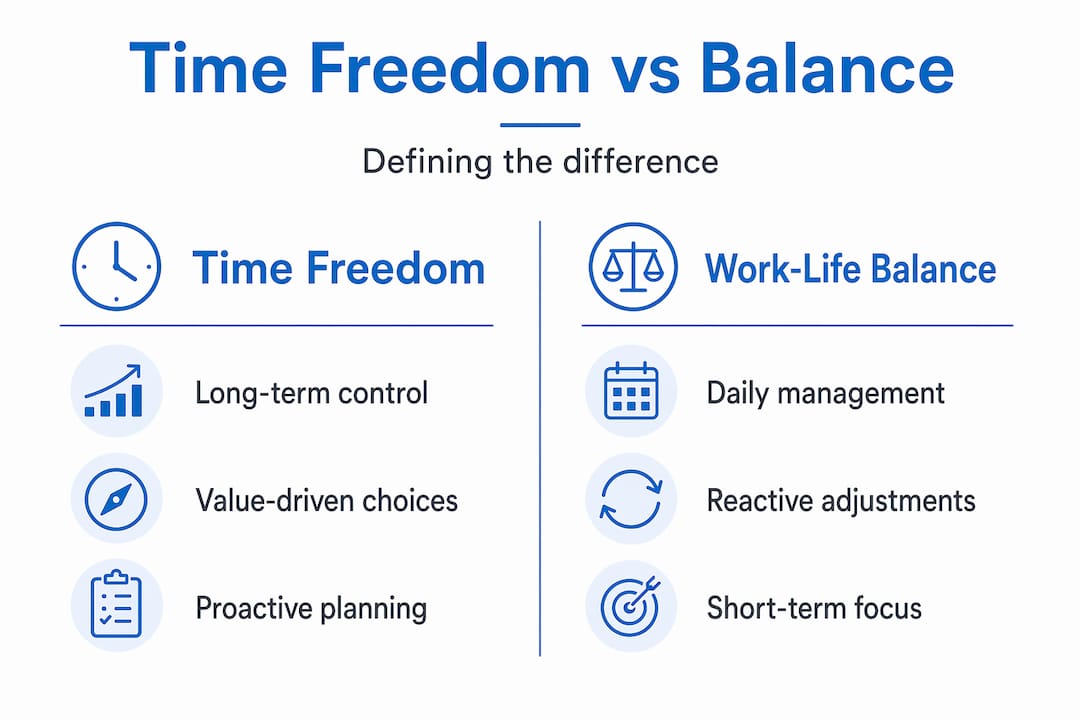
Think of it this way. Work-life balance is reactive. You manage the tension between competing demands as they arrive. Time freedom is proactive. You design the structure of your life before the demands show up, so you are never simply reacting to what the week throws at you.
There is also a concept worth understanding here: discretionary time. Discretionary time refers to time that is genuinely free from paid work, unpaid care responsibilities, and the basic necessities of personal care. It is not the same as leisure. It reflects the actual choices and constraints shaping your schedule. True time freedom means expanding your discretionary time and using it with intention, not just filling it with something else.
How does this differ from financial freedom? Financial freedom means you have enough money to cover your costs without needing to work. But you can be financially free and still have zero time freedom. If your diary is booked six weeks in advance, if you need a month’s notice before you can take a day off, if every personal decision requires fitting around your obligations, money has not freed you at all.
“Time freedom is not about having more time. It is about having the right to decide what that time is for.”
Here is what the time freedom lifestyle actually looks like in practice:
- You choose your working hours around your energy and priorities, not around a fixed rota.
- You can say yes to an unexpected opportunity or no to a draining commitment without needing permission.
- You plan life in seasons, not just weeks, which means life design over months replaces short-term fire-fighting.
- Your calendar reflects your values, not just your obligations.
Frameworks for achieving time freedom
Understanding what time freedom means is one thing. Knowing how to build it is another. The good news is that there are clear frameworks you can apply right now, regardless of where you are starting from.
One of the most useful is the 4 Freedoms Framework, which sequences personal autonomy into four stages: income freedom, time freedom, choice freedom, and purpose freedom. The insight here is sequencing. Sequencing the freedoms means you earn enough first, then deliberately redesign your time, before expanding into bigger life choices. Skipping the sequence is where most people go wrong. They try to chase purpose before they have sorted their time, and everything collapses back into chaos.
Within that framework, here are the core steps for how to achieve time freedom in practice:
- Audit your current calendar honestly. Look at the last four weeks. How much of your time was genuinely chosen versus simply filled? You cannot redesign what you have not first examined.
- Separate your time into three clear zones. Productive work time, business or career development time, and personal restoration time each need their own protected place in your schedule. A proactive calendar structure stops the reactive spiral of simply surviving each week.
- Work at your peak hours. Schedule your most demanding tasks during the hours when your focus is sharpest. This is not a luxury. It is how you get more done in less time, which is the foundation of choosing when you work rather than defaulting to convention.
- Automate and delegate the rest. Administrative tasks that eat your hours but do not require your specific expertise should either be automated or handed off. Executive assistant support and workflow automation are two practical routes. You can also look at workflow efficiency examples to identify what in your business is ripe for delegation.
- Practise calendar honesty. This means scheduling buffer time for preparation, rest, and transitions, not just appointments. Buffer zones rebuild self-trust and make saying no far easier because the structure protects you instead of you having to fight for it.
Pro Tip: Block your personal restoration time first, before any professional commitments go into the diary. If it is not in the calendar, it will not happen.
The deeper principle underneath all of this is that time freedom means selecting high-value activities and arranging your schedule around them, rather than filling hours and hoping something meaningful fits in. That shift in orientation changes everything.
The challenges most people overlook
Here is where the conversation gets honest. Building time freedom is not just a scheduling problem. It is a psychological one too.
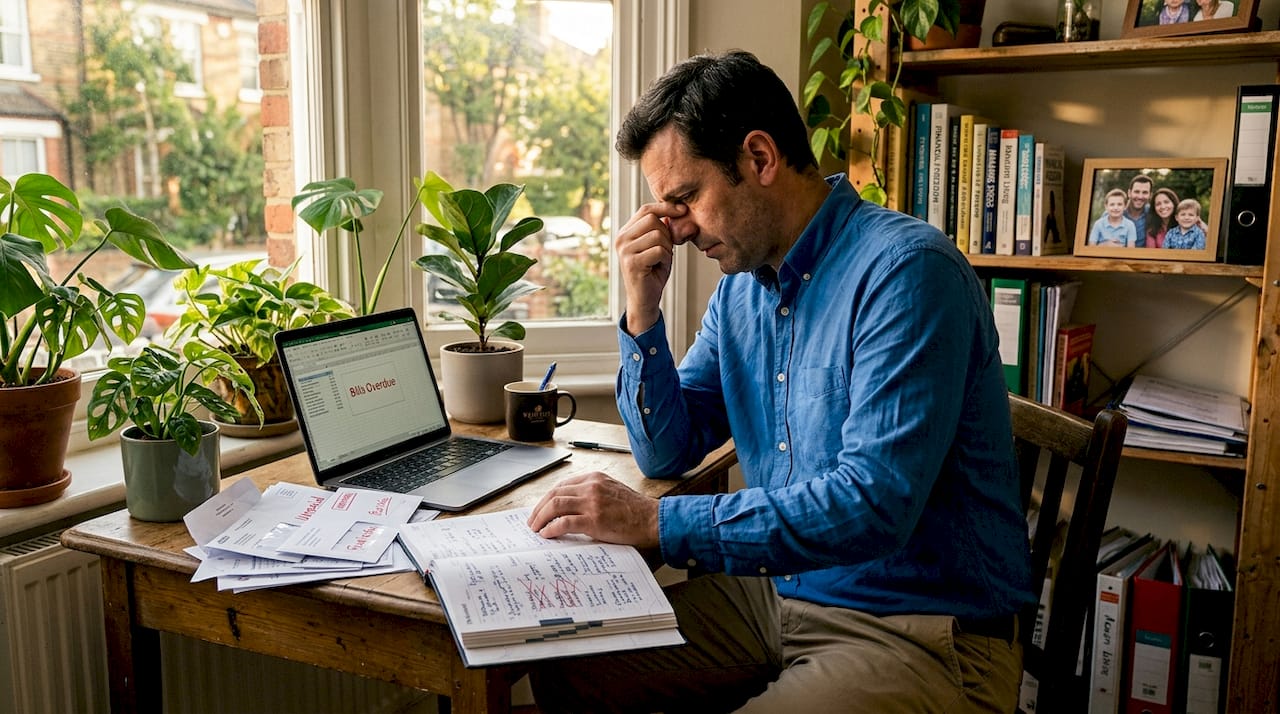
Most people assume that if they just cleared their diary, they would finally feel rested and free. Research tells a different story. Unstructured time can expose what busyness was covering all along: anxiety, restlessness, unresolved emotional weight. The stillness reveals what the noise was hiding. That is not a reason to avoid time freedom. It is a reason to approach it with both eyes open.
There are several pitfalls that derail even the most motivated people:
- Being well-paid but scheduled. You can earn an excellent income and still have no autonomy over your time. Many professionals sit in this trap for years, mistaking income growth for life improvement.
- Needing excessive advance notice before taking personal time. If you cannot respond to a family situation, a health need, or a simple spontaneous trip without weeks of planning, you are scheduled, not free.
- Ignoring emotional readiness. Gaining time freedom without psychological and emotional planning is like opening a pressure valve too fast. You need to prepare for what the space will surface.
- Treating time freedom as a destination. It is not something you arrive at and then maintain effortlessly. It requires ongoing, active management.
“The goal is not an empty calendar. The goal is a calendar that tells the honest story of what you value.”
Context also shapes the experience of time freedom significantly. 76% of retirees report good life balance compared to 57% of unemployed people, even though both groups have considerable unstructured time. The difference is not the hours available. It is the sense of purpose, choice, and identity attached to how those hours are used.
Practical ways to cultivate time freedom
Knowing the theory is useful. Knowing what to do on Monday morning is better. Here are concrete, tested ways to start finding time freedom in your actual life.
- Prioritise with ruthlessness, not guilt. Make a short list of the three things that genuinely move your life and work forward. Everything else gets questioned before it gets your time. Prioritising selectively is one of the four foundational habits of people who genuinely own their schedule.
- Introduce quarterly life planning. Daily and weekly productivity planning is not enough. Planning on quarterly horizons lets you align your commitments with the seasons and chapters of your life, rather than just managing the next deadline. Ask yourself at the start of each quarter what season you are in and what that season requires of your time.
- Set hard boundaries around non-negotiables. Whether it is school pick-ups, exercise, or creative thinking time, these need to be in your diary with the same weight as a client meeting. The moment personal time becomes optional, it disappears.
- Use technology to reclaim hours, not fill them. Automating repetitive tasks frees up cognitive bandwidth for decisions that actually require you. The goal is discretionary time, not just a shorter to-do list.
- Test your flexibility regularly. Genuine time freedom means you can respond to life quickly. True time freedom includes rapid schedule pivots, like a spontaneous day off or an unexpected family need, without the world falling apart. If you cannot do that, you have identified exactly where to focus your next effort.
Pro Tip: Try the “time freedom audit” every quarter. Ask yourself: how many decisions about my time did I make proactively this month versus reactively? The ratio tells you everything.
Good time management for business growth is not about squeezing more into your hours. It is about protecting the hours that belong to you in the first place. The importance of time freedom grows the more you recognise how limited and irreplaceable your time actually is. You can always earn more money. You cannot earn more time.
My perspective on why time freedom changes everything
I have worked with many business owners and professionals who reached a level of income they once only dreamed of, and still felt trapped. That pattern taught me something that no framework fully captures: time freedom is an act of self-respect before it is a strategy.
What I have seen repeatedly is that people confuse busyness with progress. They keep their calendars full because a full calendar feels productive. But when I ask them to look honestly at the last month and count the hours they actually chose, the number is almost always smaller than they expected. That moment of recognition is the beginning of real change.
In my experience, the hardest part of finding time freedom is not the scheduling. It is rebuilding trust with yourself. If you have spent years letting every urgent request override your personal priorities, your own needs stop feeling legitimate. Rebuilding that trust means keeping commitments to yourself, starting small and consistently, until your schedule reflects who you actually are rather than who everyone else needs you to be.
I also want to push back on the idea that time freedom is only for the successful or the wealthy. I have seen people on modest incomes design genuinely autonomous lives because they were intentional, and I have seen high earners with beautiful businesses who could not take a long weekend without it costing them a week’s recovery. The difference is always intentionality, not income. Business freedom for owners begins the moment you decide your time belongs to you.
— Shane
Ready to build your time freedom?
If this article has made you realise that your schedule is running your life rather than serving it, you are not alone. That is exactly the pattern Summitscale was built to help business owners break. Through structured business coaching, Summitscale works with entrepreneurs and SME owners to redesign their businesses around the life they actually want, using proven frameworks for delegation, boundary setting, and strategic planning. Whether you are just beginning to think about time freedom or you have been chasing it for years without quite landing it, a coaching approach for growth built around your specific situation makes all the difference. Book a free 15-minute assessment call and start reclaiming your time today.
FAQ
What does time freedom mean?
Time freedom means having genuine control over how you spend your time across daily, monthly, and yearly decisions, choosing what you do, when you do it, and why, rather than being driven by external demands or a fixed schedule.
How is time freedom different from work-life balance?
Work-life balance focuses on managing competing demands in the short term, hour by hour. Time freedom is broader. It involves designing how you want to live across longer periods, making it a life design concept rather than a daily management tool.
Can you have time freedom without financial freedom?
Yes, though it is more challenging. Time freedom is primarily about intentionality and structure, not income level. People with modest resources can build genuine autonomy through disciplined prioritisation, boundary setting, and deliberate scheduling.
What are some practical time freedom examples?
Being able to take a spontaneous day off without weeks of planning, working during your peak energy hours, spending school holidays fully present with family, and saying no to low-value commitments are all real examples of what a time freedom lifestyle looks like in practice.
Why does time freedom matter for business owners?
Business owners often sacrifice time freedom in pursuit of income growth, ending up well-paid but controlled by their own businesses. Reclaiming time freedom is what transforms a business from a high-paying job into a genuine asset that serves your life.

