
Managing a business often means juggling endless tasks while chasing the freedom you imagined at the start. Many American owners quickly find that real business autonomy is far more complex than simply working fewer hours or seeing bigger profits. Setting the record straight on business freedom helps you avoid costly misconceptions and create a business structure that genuinely supports your personal and professional goals, with guidance on the pitfalls and practical pathways towards lasting independence.
Table of Contents
- Business Freedom Defined And Misconceptions
- Types Of Business Freedom For Owners
- Core Elements: Time, Money, Control
- Role Of Coaching In Achieving Autonomy
- Practical Risks And Common Pitfalls
- Comparisons With Traditional Business Models
Key Takeaways
| Point | Details |
|---|---|
| Understanding Business Freedom | It involves strategic autonomy, emphasising the creation of sustainable frameworks that align business objectives with personal well-being. |
| Misconceptions of Freedom | Many entrepreneurs confuse business freedom with less work or immediate financial independence, overlooking the need for accountability and strategic planning. |
| Core Dimensions of Freedom | Business freedom encompasses time, financial, and control freedom, which must be intentionally designed for holistic success. |
| Importance of Coaching | Effective coaching facilitates personal and organisational transformation, empowering entrepreneurs to achieve true autonomy in their business practices. |
Business freedom defined and misconceptions
Business freedom represents far more than simply owning an enterprise. It encompasses the strategic autonomy to make pivotal decisions that align with your professional vision while maintaining personal wellbeing. Business autonomy goes beyond operational control – it means creating a sustainable framework where your enterprise serves your life goals, not vice versa.
Misconceptions about business freedom are widespread. Many entrepreneurs mistakenly believe it means working less or achieving instant financial independence. In reality, comprehensive legal perspectives on business liberty762349_EN.pdf) reveal a nuanced landscape of regulated entrepreneurial rights and responsibilities.
Key misconceptions about business freedom include:
- Believing freedom means zero accountability
- Assuming total control equals business freedom
- Thinking profitability automatically generates personal liberty
- Expecting immediate lifestyle transformation
True business freedom requires strategic planning, disciplined execution, and a holistic understanding of personal and professional integration. It demands intentional design of systems, processes, and leadership approaches that create sustainable operational independence.
Pro tip: Conduct a quarterly review of your business structures to ensure they consistently support your personal freedom objectives and adapt to changing circumstances.
Types of business freedom for owners
Business freedom is not a monolithic concept but a multifaceted framework comprising distinct dimensions that collectively empower entrepreneurs. Comparative legal analysis reveals762349_EN.pdf) complex layers of entrepreneurial liberty that extend beyond simplistic interpretations.
Operational Freedom represents the core ability to make independent strategic decisions about your enterprise’s direction, structure, and management. This includes:
- Selecting your business model
- Designing internal processes
- Choosing technological infrastructure
- Determining workforce composition
- Setting organisational culture
Financial Freedom encompasses more nuanced elements than mere profitability. It involves:
- Creating predictable revenue streams
- Building sustainable cash flow mechanisms
- Developing robust financial planning strategies
- Minimising unnecessary operational expenses
- Establishing multiple income channels
Another critical dimension is Lifestyle Freedom, which transforms business ownership from a constraint into a personal empowerment tool. This freedom allows entrepreneurs to design work environments and schedules that align with personal values, family commitments, and individual well-being.

Pro tip: Conduct a comprehensive quarterly audit of your business’s operational, financial, and lifestyle freedom metrics to identify potential improvement areas and maintain strategic flexibility.
Core elements: time, money, control
Business freedom fundamentally revolves around three interconnected dimensions: time, money, and control. Temporal preferences shape entrepreneurial autonomy in ways that extend far beyond traditional financial metrics.
Time Freedom represents the ability to allocate personal and professional hours strategically. This dimension involves:
- Designing flexible work schedules
- Prioritising high-value activities
- Eliminating low-impact tasks
- Creating systems that operate without constant personal intervention
- Developing delegation strategies
Financial Freedom encompasses more than revenue generation. It includes:
- Creating predictable income streams
- Minimising financial volatility
- Building robust financial reserves
- Developing multiple revenue channels
- Implementing strategic cost management
Control Freedom is about maintaining decision-making authority while building scalable systems. Entrepreneurs achieve this by:
- Establishing clear organisational structures
- Implementing effective leadership frameworks
- Creating transparent performance metrics
- Developing robust operational processes
- Maintaining strategic flexibility
Business freedom isn’t about working less, but about working more intentionally across time, money, and control dimensions.
Pro tip: Develop a quarterly scorecard that tracks your progress across time, money, and control freedom metrics to ensure continuous strategic alignment.
Role of coaching in achieving autonomy
Coaching leadership transforms business autonomy by providing strategic guidance that transcends traditional management approaches. Coaches serve as critical catalysts in helping entrepreneurs reimagine their operational frameworks and personal leadership potential.
Strategic Coaching Dimensions that drive business autonomy include:
- Developing personalised performance roadmaps
- Identifying hidden operational bottlenecks
- Challenging limiting belief systems
- Creating accountability mechanisms
- Enhancing decision-making capabilities
Psychological Enablement is another crucial aspect of coaching. By fostering:
- Increased self-awareness
- Emotional intelligence development
- Confidence-building strategies
- Resilience training
- Stress management techniques
Organisational Transformation emerges through coaching by systematically addressing complex challenges. Research demonstrates that effective coaching creates environments where autonomy becomes a natural organisational outcome rather than an imposed directive.
Coaching is not about telling entrepreneurs what to do, but empowering them to discover their most effective path to business freedom.
Pro tip: Invest in a coach who specialises in your specific industry and has demonstrable experience in scaling businesses to ensure targeted, actionable guidance.
Practical risks and common pitfalls
Legal interpretations can significantly undermine business freedom, creating complex challenges for entrepreneurs seeking operational autonomy. Understanding potential risks becomes crucial in maintaining sustainable business independence.
Regulatory Compliance Risks include:
- Misinterpreting complex legal frameworks
- Overlooking sector-specific regulatory requirements
- Failing to update compliance protocols
- Insufficient documentation of business practices
- Inadequate risk management strategies
Ethical Pitfalls entrepreneurs must navigate carefully:
- Potential conflicts of interest
- Unintentional misrepresentation
- Discriminatory hiring or operational practices
- Financial impropriety
- Compromising transparency
Ethical business practices demand consistent vigilance and proactive management. Business freedom requires a delicate balance between operational independence and responsible governance.
Below is a summary of key risks and proactive strategies to safeguard business autonomy:
| Risk Area | Main Challenge | Proactive Strategy |
|---|---|---|
| Legal Compliance | Navigating complex regulations | Continuous legal review |
| Ethical Standards | Maintaining public trust | Regular ethics training |
| Operational Risks | Over-reliance on one individual | Build redundant systems |
| Financial Security | Unstable income sources | Diversify revenue streams |
Business autonomy is not about circumventing rules, but creating sustainable frameworks that respect legal and ethical boundaries.
Pro tip: Conduct a quarterly comprehensive audit of your business practices, focusing on legal compliance, ethical standards, and potential operational risks.
Comparisons with traditional business models
Sustainable business practices transcend traditional profit models, representing a profound shift in entrepreneurial thinking. Modern business freedom challenges long-established paradigms of organisational management and value creation.
Traditional Model Characteristics typically include:
- Singular focus on financial performance
- Hierarchical decision-making structures
- Short-term profit orientation
- Minimal stakeholder engagement
- Rigid operational frameworks
Modern Business Freedom Model fundamentally differs by emphasising:
- Holistic value creation
- Adaptive and flexible structures
- Long-term sustainability
- Comprehensive stakeholder consideration
- Integrated personal and professional goals
Contemporary business frameworks demonstrate that success is no longer measured exclusively through financial metrics. Entrepreneurs now recognise the importance of balancing economic objectives with personal fulfilment and societal contributions.
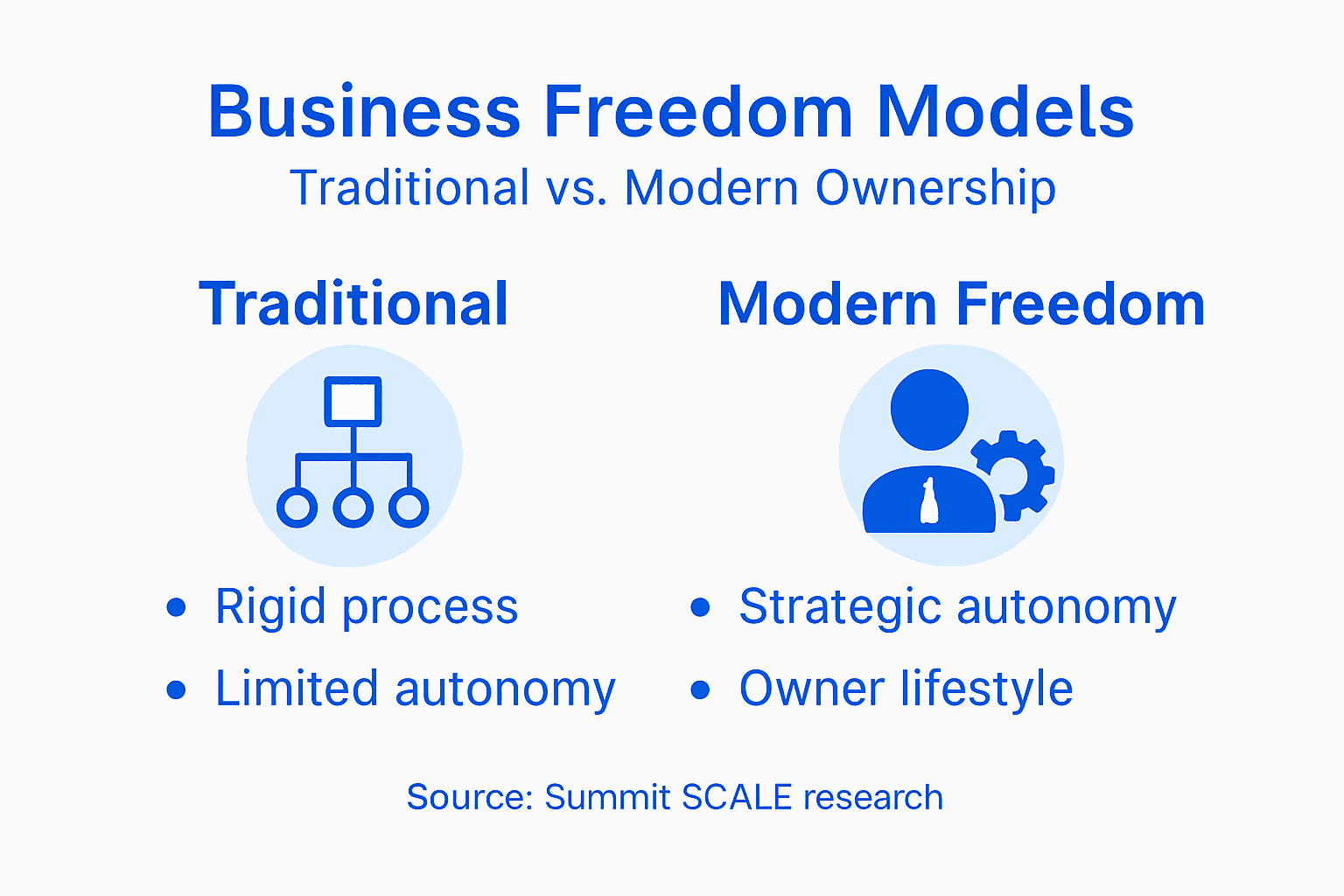
Here is a concise comparison of traditional business models and modern business freedom approaches:
| Aspect | Traditional Model | Modern Business Freedom Model |
|---|---|---|
| Decision-making | Top-down hierarchy | Distributed and collaborative |
| Organisational Focus | Profit maximisation | Balanced value creation |
| Stakeholder Approach | Limited to shareholders | Includes staff and community |
| Structure Flexibility | Rigid procedures | Agile, adaptable systems |
| Personal Well-being | Often secondary | Integrated with goals |
Business freedom means transforming from a profit-extraction model to a value-creation ecosystem.
Pro tip: Regularly assess your business model against both traditional and modern frameworks to identify opportunities for strategic evolution and increased autonomy.
Unlock True Business Freedom with Expert Coaching
If you are striving to gain operational, financial, and lifestyle freedom in your business, understanding these core elements is the first step. The journey to sustainable autonomy requires more than just working harder — it demands intentional strategies, well-designed business systems, and confident leadership. By addressing common pitfalls such as legal compliance and ineffective control mechanisms, you can transform your business into a growth engine that supports your personal goals.
Discover how tailored coaching from Summit SCALE can guide you through refining your business systems and ownership strategies. Our expert-led approach focuses on practical steps for sales growth, cost control, and building scalable teams — all designed to give you more time and financial freedom. Visit our Business Systems Archives – Summit Scale and Business Ownership Archives – Summit Scale to explore resources that align with mastering autonomy. Ready to take control and elevate your business life balance? Connect with us at Summit SCALE now and schedule your free 15-minute assessment call to start your transformation today.
Frequently Asked Questions
What is business freedom?
Business freedom refers to the autonomy entrepreneurs have to make strategic decisions that align with their vision and well-being. It includes operational, financial, and lifestyle freedoms, empowering owners to create a business that supports their life goals.
How can I achieve financial freedom in my business?
Achieving financial freedom involves creating predictable revenue streams, developing robust financial planning strategies, and minimising unnecessary operational expenses. Establishing multiple income channels is also crucial for enhancing financial stability.
What are the key misconceptions about business freedom?
Common misconceptions include the belief that business freedom means no accountability, that total control equates to freedom, and that profitability automatically leads to personal liberty. True business freedom requires strategic planning and a balanced approach to personal and professional integration.
How does coaching contribute to achieving business autonomy?
Coaching provides strategic guidance that helps entrepreneurs develop personalised performance roadmaps, identify operational bottlenecks, and enhance decision-making capabilities. It empowers business owners to discover effective paths to autonomy and fosters a culture of continuous improvement.

