
TL;DR:
- Profitability improvement involves managing operational efficiency, pricing, and capital as a system to prevent margin erosion. Conduct a detailed diagnostic of productive units, and prioritize operational efficiency for immediate margin gains before focusing on pricing and capital management. Monthly reviews of margins and working capital are essential to sustain improvements and prevent untimely margin collapse.
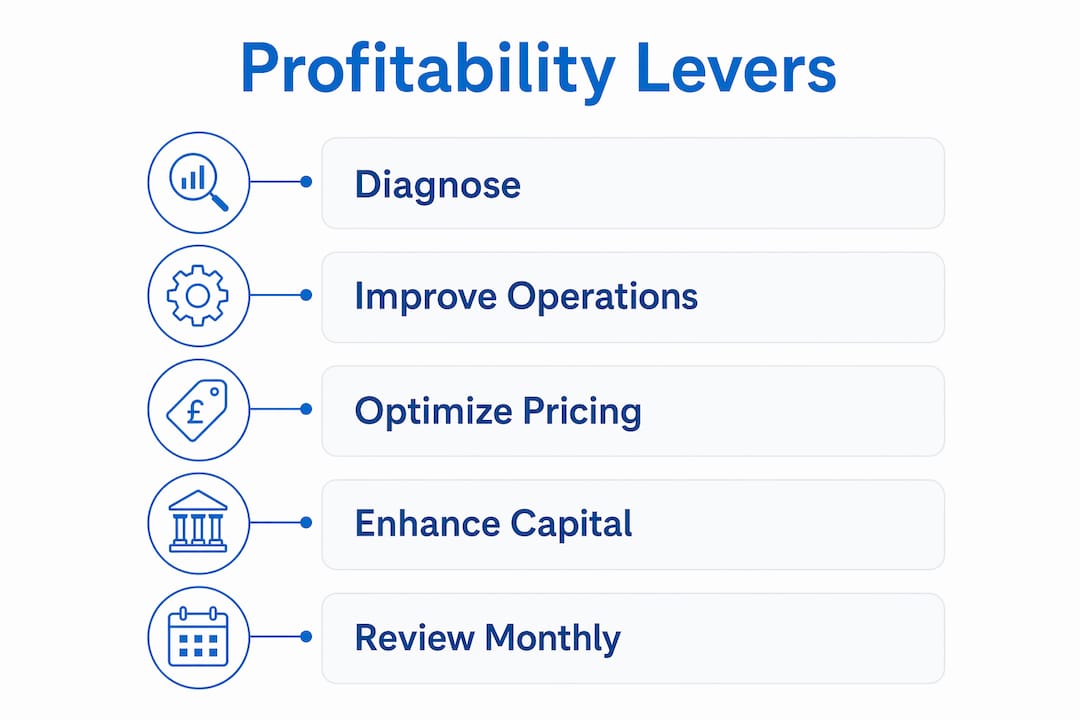
Profitability improvement is the process of systematically enhancing your business margins through three interconnected levers: operational efficiency, pricing discipline, and capital management. Most business owners treat these as separate initiatives, but the real power lies in running them as a compound system. Hidden costs like discounts and untracked expenses can erode margins by 20 to 30% if left unexamined. This guide gives you a clear, step-by-step framework to diagnose where your profit is leaking, fix it deliberately, and sustain the gains through a monthly review routine.
How to identify your profitability improvement levers
Before you change anything, you need to know where your margins are actually breaking down. This diagnostic step is the foundation of any credible business profitability guide, and skipping it is the single most common mistake SMB owners make.
Start by separating your business into its productive units. A productive unit is the smallest meaningful slice of your business: a product line, a customer segment, a service type, or a delivery route. Profitability analysis at the unit level reveals the real profit drivers and prevents costly misjudgements that come from looking only at total revenue or blended margins.
Once you have your units mapped, assess each one across three dimensions:
- Operational performance: Are there visible delays, rework, or excess labour hours in delivering this product or service?
- Pricing position: Is the price you charge reflecting the value you deliver, or has it drifted downward through informal discounts and concessions?
- Capital consumption: How much cash is tied up in inventory, unpaid invoices, or underused assets to support this unit?
Use EBITDA (earnings before interest, tax, depreciation, and amortisation) as your primary profitability metric at the business level, and Return on Net Operating Assets (RNOA) to assess how efficiently your capital is working. These two metrics together tell you whether you are generating profit and whether you are doing so efficiently.
Pro Tip: Rank your productive units by gross margin percentage, not gross margin pounds. A high-revenue product with a thin margin is often consuming more resources than it returns. Clarity on this ranking tells you exactly where to focus first.

How does operational efficiency drive profit margins?
Over 50% of a typical middle-market company’s margin improvement is achievable through operational efficiency fixes alone. That figure is significant because it means you do not need to raise prices or restructure your balance sheet to see meaningful results. Operations is where you build the confidence and the cash to tackle the other levers.
Here is a practical sequence for improving operational efficiency:
- Map your key delivery processes. Write down every step involved in delivering your core product or service, from order to payment. This exercise alone typically surfaces three to five activities that add cost but no customer value.
- Identify waste categories. Common culprits include waiting time between process steps, rework caused by unclear handovers, excess stock held “just in case,” and unnecessary approvals that slow delivery.
- Eliminate before you automate. Fix the process first, then consider technology. Automating a broken process only makes the problem faster. Tools like Xero, MYOB, or purpose-built workflow platforms are most effective when the underlying process is already clean.
- Reduce your cost-to-serve. Calculate what it actually costs to deliver each unit of your product or service. Then ask which steps could be simplified, batched, or removed without affecting the customer experience.
- Set a governance cadence. Assign ownership of each key process to a specific person. Review operational metrics monthly alongside your financial results.
The table below shows the typical impact of combining operational improvements with pricing and capital changes:
| Lever | Improvement applied | Profit impact |
|---|---|---|
| Operations | 15% efficiency gain | Significant margin uplift |
| Pricing | 5% realisation increase | Highest per-unit impact |
| Capital efficiency | 20% reduction in trapped capital | Frees cash for reinvestment |
| Combined (compounding) | All three applied together | Over 40% combined profit boost |
Pro Tip: Avoid over-engineering your processes. Operations improvements focused on visible, tangible waste yield the fastest results and build team confidence. Save the complex restructuring for later, once the quick wins are banked.
What pricing strategies protect and grow your margins?
Pricing is the most powerful lever available to you. A 1% increase in pricing realisation can translate into an 8% increase in operating profit. No cost reduction programme comes close to that ratio. Yet most SMB owners underuse this lever because they fear losing customers, or because pricing decisions have never been made with discipline.
Value-based pricing is the standard the most profitable businesses use. It means setting your price based on the value your product or service delivers to the customer, not on your costs plus a margin. To apply it, you need to understand what problem you solve, what it costs the customer if that problem goes unsolved, and what alternatives they have.
The comparison below shows the difference between cost-plus and value-based approaches:
| Approach | Basis for price | Margin outcome | Risk |
|---|---|---|---|
| Cost-plus pricing | Costs incurred plus fixed margin | Predictable but often leaves money on the table | Margin shrinks as costs rise |
| Value-based pricing | Value delivered to the customer | Higher margins where value is clear | Requires strong customer insight |
Beyond the pricing model itself, margin leakage through informal discounts is a serious and often invisible problem. Cost smearing and untracked discounts distort your true profitability picture and can push individual customer relationships into loss-making territory without anyone realising it. Introduce a formal discount approval process. Any concession above a defined threshold should require sign-off from a senior decision-maker.
Segment your customers and products by pocket margin, which is the margin remaining after all direct costs, discounts, freight, and support time are accounted for. You will almost certainly find that 20% of your customers generate 80% of your real profit. Protect those relationships fiercely, and reconsider the terms on which you serve the rest.
How does capital efficiency unlock cash and support growth?
Capital efficiency as a profitability lever means optimising your working capital and asset utilisation to free cash that is currently trapped in your business. That freed cash reduces your reliance on debt, lowers interest costs, and gives you funds to reinvest in growth. Many SMB owners focus entirely on the income statement and miss this lever entirely.
Working capital has three components, each of which you can improve deliberately:
- Accounts receivable. Shorten your payment terms where possible. Send invoices immediately upon delivery, not at the end of the month. Introduce a structured follow-up process for overdue accounts. Even reducing your average debtor days by ten days can release significant cash in a business turning over £1 million or more.
- Inventory. Carry only what you need to meet realistic demand. Excess inventory ties up cash, increases storage costs, and creates write-off risk. Use your sales data to set minimum and maximum stock levels by product, and review these quarterly.
- Accounts payable. Negotiate extended payment terms with suppliers where your relationship allows it. Paying in 45 days instead of 30 days on a £500,000 annual spend frees roughly £20,000 in cash at any given time.
Pro Tip: Track your Cash Conversion Cycle (the number of days it takes to turn your investment in inventory and receivables back into cash) monthly. A shortening cycle is a direct signal that your capital efficiency is improving. You can read more about sustainable profitability approaches that combine capital and operational discipline.
Ignoring balance sheet management limits the sustainability of profit improvements even when your EBITDA is growing. Capital efficiency compounds with your operational and pricing gains to create the kind of cash-generative business that can fund its own growth.
Why monthly profitability reviews prevent margin collapse
Margins can deteriorate months before annual reviews detect the problem. By the time a year-end review surfaces a margin issue, the damage is already done and the corrective action required is far more disruptive. Monthly reviews are the governance mechanism that keeps your profitability improvement steps on track.
A monthly review does not need to be complex. It needs to be consistent. Cover these areas each month:
- Revenue by segment: Is growth coming from your most profitable customers and products, or from low-margin volume?
- Gross margin by unit: Are margins holding, improving, or eroding? Which units are moving in the wrong direction?
- Working capital position: Are debtor days, stock levels, and creditor days moving in the right direction?
- Pricing exceptions: How many discounts were approved this month, and at what total cost to margin?
“Building a monthly profitability review into your management routine is not an administrative task. It is the discipline that separates businesses that grow sustainably from those that chase revenue and wonder why the bank account never reflects it.”
The most common mistakes SMB owners make are chasing revenue without tracking margin, cutting costs in isolation without addressing pricing or capital, and treating profitability improvement as a one-off project rather than an ongoing discipline. Monthly segmented profitability reviews with targeted follow-ups prevent margin collapse and embed accountability across your management team. For a deeper look at why this discipline matters, explore why prioritising profitability unlocks both growth and stability.
Key takeaways
Profitability improvement requires operational efficiency, pricing discipline, and capital management to work together as a compound system, not as isolated fixes.
| Point | Details |
|---|---|
| Diagnose before acting | Map productive units and assess each across operations, pricing, and capital before making changes. |
| Operations first | Over 50% of margin improvement potential sits in operational efficiency, making it the right starting point. |
| Pricing is the highest-leverage lever | A 1% pricing gain can deliver an 8% operating profit increase, outperforming cost cuts every time. |
| Capital efficiency frees cash | Reducing debtor days, right-sizing inventory, and extending payables unlocks cash without borrowing. |
| Monthly reviews sustain gains | Reviewing margins monthly catches deterioration early and keeps all three levers aligned. |
Shane’s view: why the system matters more than any single lever
I have worked with SMB owners who have spent years cutting costs and wondering why their margins never seem to improve. The reason is almost always the same. They are pulling one lever in isolation while the other two work against them. They trim operational costs, but their pricing has drifted downward through informal discounts. Or they raise prices, but their working capital is so poorly managed that the extra cash disappears into slow-paying debtors and excess stock.
The insight that changes everything is this: profitability improvement is a system of levers that must be managed together. Operational improvements build the confidence and the margin to tackle pricing. Pricing gains free the cash to invest in better processes. Capital efficiency amplifies both. When you run all three deliberately, the compounding effect is real and it is faster than most owners expect.
My advice is to start with the diagnostic. Spend two weeks mapping your productive units and ranking them by pocket margin. What you find will tell you exactly where to focus. Then build the monthly review habit before you do anything else. Discipline in measurement is what separates a one-off improvement from a lasting shift in how your business performs.
— Shane
Ready to put this into practice?
Understanding the three levers of profitability is one thing. Applying them consistently in a real business, with real pressures on your time and attention, is another challenge entirely. That is where structured coaching makes the difference.

Summitscale works with SMB owners to implement exactly this kind of compound profitability system, from the initial diagnostic through to pricing discipline, operational improvements, and monthly review governance. If you are ready to move from knowing what to do to actually doing it, explore how coaching drives profitability for business owners like you. You can also discover why investing in coaching is one of the highest-return decisions an SMB owner can make. Book your free 15-minute assessment call with Summitscale and start building a more profitable business today.
FAQ
What is a profitability improvement guide?
A profitability improvement guide is a structured framework for identifying and addressing the operational, pricing, and capital efficiency factors that determine your business margins. It provides step-by-step strategies to diagnose margin leakage and apply targeted fixes that compound over time.
Which profitability lever has the greatest impact?
Pricing is the single most powerful lever. A 1% increase in pricing realisation can produce an 8% increase in operating profit, which significantly outperforms equivalent gains from cost reduction or volume growth.
How often should I review my business profitability?
Monthly reviews are the recommended standard. Margins can deteriorate for months before annual reviews detect the problem, meaning that by the time you see it in a year-end report, the damage is already significant and harder to reverse.
What is working capital and why does it affect profitability?
Working capital is the cash tied up in your accounts receivable, inventory, and accounts payable cycle. Poorly managed working capital drains cash even when your income statement looks healthy, limiting your ability to invest in growth and increasing your reliance on debt.
Where should an SMB owner start with profit enhancement strategies?
Start with a unit-level diagnostic. Map your products, customers, or services by pocket margin to identify where profit is being made and where it is being lost. This clarity tells you which lever to pull first and prevents wasted effort on low-impact changes.

