
TL;DR:
- SMEs in 2026 must focus on targeted AI adoption to drive growth in marketing, customer service, and operations.
- Economic pressures demand proactive financial planning, cost management, and revenue diversification for resilience.
- Building internal skills in AI literacy, adaptability, and digital communication is crucial for staying competitive.
Most small business owners expect gradual change. What they are actually facing in 2026 is a step change, and the gap between those who act and those who wait is widening fast. AI and GenAI adoption is no longer a future consideration for SMEs; it is the defining business development trend right now. Alongside economic pressures, shifting government policy, and rising skills demands, the landscape has never been more complex or more full of opportunity. This guide cuts through the noise and gives you a clear, practical view of the trends that matter most and, crucially, how to act on them.
Table of Contents
- The rise of AI and generative AI in SME growth
- Adapting to new business realities: Economic pressures and opportunities
- Building capabilities: Skills development and organisational readiness
- Government policy shifts and support programmes for SMEs
- A smarter path to growth: Hard-won lessons for 2026
- Take your SME further with expert support
- Frequently asked questions
Key Takeaways
| Point | Details |
|---|---|
| AI drives growth | AI and generative AI are powering new efficiencies and opportunities for SMEs in 2026. |
| Economic shifts matter | Navigating current economic pressures is essential for SME resilience and success. |
| Upskilling is vital | Developing AI, data, and adaptive skills will set growing SMEs apart from competitors. |
| Government support helps | Leveraging new support programmes and policies accelerates SME growth and innovation. |
The rise of AI and generative AI in SME growth
If you have been watching AI from the sidelines, now is the time to step onto the pitch. Generative AI (GenAI) refers to tools that can create content, automate responses, and analyse data, think of platforms like ChatGPT or Gemini, and they are rapidly becoming standard kit for growth-focused SMEs.
The numbers are striking. 64% of UK small business leaders see new technology, particularly AI, as key to growth, and 57% are actively building AI skills within their teams. This is not a trend confined to large corporations. It is happening at the SME level, right now.
So where does AI actually make a difference for your business development?
- Marketing and content creation: GenAI tools can produce first drafts of emails, social posts, and proposals in minutes, freeing your team for higher-value work.
- Customer service: AI-powered chatbots handle routine enquiries around the clock, improving response times without increasing headcount.
- Sales outreach: Automated, personalised email sequences mean your pipeline keeps moving even when your team is focused elsewhere.
- Operations: AI can flag inefficiencies, forecast demand, and surface insights from your data that would otherwise go unnoticed.
| AI use case | Business benefit | Difficulty to implement |
|---|---|---|
| Content generation | Faster marketing output | Low |
| Customer chatbots | 24/7 support coverage | Medium |
| Sales automation | Higher pipeline activity | Medium |
| Data analytics | Smarter decision-making | Medium to high |
The temptation is to try everything at once. Resist it. The SMEs gaining the most traction are those focusing on business coaching trends and choosing one or two AI applications that directly touch revenue, then building confidence from there.
Pro Tip: Before investing in any AI tool, map out which part of your sales or operations process costs the most time. Start there. Pair the tool with team training so adoption sticks, and track results after 60 days. Small wins compound quickly, and your team’s confidence will grow alongside your results. Explore sales growth tips to see how AI fits into a broader revenue strategy.
Adapting to new business realities: Economic pressures and opportunities
AI is a powerful lever, but it operates inside a broader economic context that you cannot afford to ignore. The picture in 2026 is uneven, and understanding where you stand geographically matters enormously.
In the UK, the mood is cautious. The FSB Small Business Index hit -71 in Q4 2025, the lowest reading since the pandemic. Rising employer National Insurance contributions, energy costs, and wage pressures are forcing many owners into difficult decisions. In the US, the outlook is comparatively more optimistic, with SMEs showing greater confidence in leveraging new market opportunities, though inflation and interest rate sensitivity remain real concerns.
“The businesses that survive economic turbulence are not always the strongest. They are the most adaptable.” This is not just a motivational line; it is a pattern we see consistently in high-performing SMEs.
| Factor | UK SMEs | US SMEs |
|---|---|---|
| Business confidence | Low (FSB Index -71) | Moderate to high |
| Key pressure | Taxation and labour costs | Inflation and interest rates |
| Primary opportunity | Digital adoption and export | AI integration and market growth |
| Government support | DBT SME action plan active | SBA programmes and grants |
Here are four numbered steps to strengthen your financial resilience right now:
- Audit your cost base quarterly. Identify fixed costs that can be renegotiated or reduced without compromising quality.
- Stress-test your cash flow. Model what happens to your business if revenue drops 20% for three months. Build a buffer accordingly.
- Diversify your revenue streams. Reliance on one client or one product is a vulnerability. A second income stream, even a small one, changes your risk profile entirely.
- Build your support network. Peer groups, mentors, and coaches give you access to perspectives and solutions you would not find alone.
If you are based in the US, exploring growth strategies for US SMEs can help you align your planning with the specific opportunities your market presents.
Building capabilities: Skills development and organisational readiness
External pressures are real, but your internal capabilities determine how well you respond to them. The SMEs pulling ahead in 2026 are investing in their people, not just their tools.
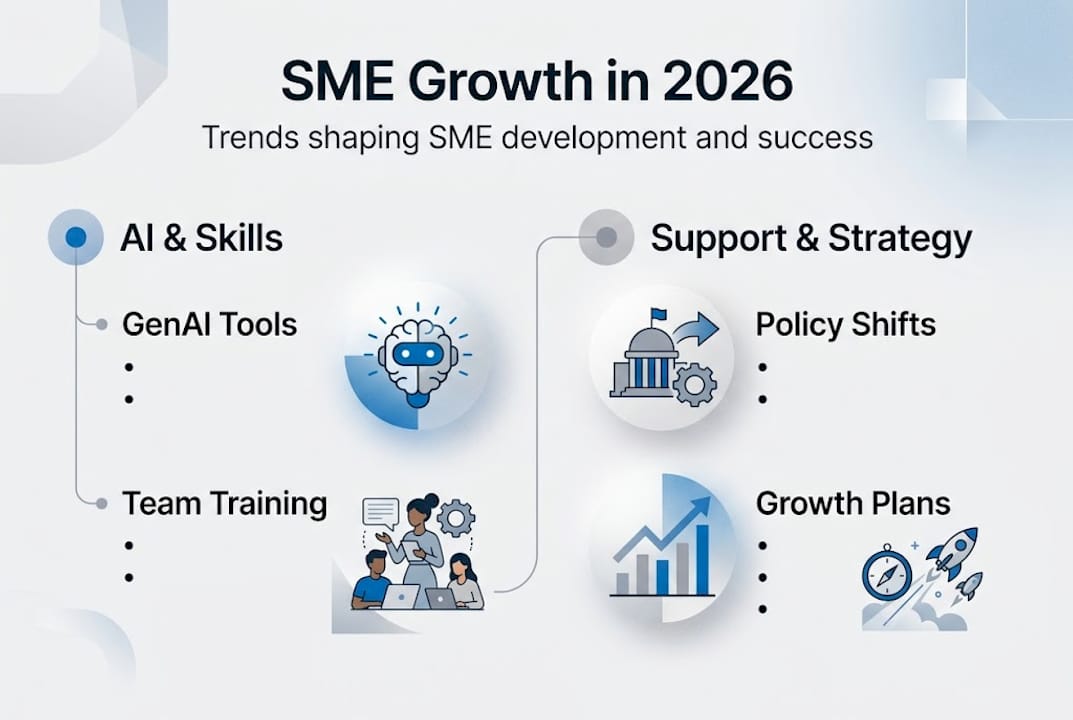
57% of UK SMEs are actively building AI skills to secure growth. That statistic should prompt a question: is your team among them?
The critical skills for 2026 go beyond technical know-how. Here is what matters most:
- AI and data literacy: Understanding how to use AI tools effectively and interpret the data they produce.
- Adaptability: The ability to shift priorities quickly as market conditions change.
- Digital communication: Confident use of collaboration platforms, CRM systems, and digital marketing tools.
- Financial acumen: A working understanding of margins, cash flow, and profitability, not just revenue.
- Critical thinking: Knowing when to trust an AI output and when to question it.
The good news is that building these skills does not require a large training budget. Pragmatic AI deployment starts with assessing your team’s current readiness, identifying the biggest gaps, and then filling them with targeted, practical learning.
Regular AI literacy sessions, even 30 minutes a fortnight, create a culture of curiosity and confidence. Teams that understand the tools they use adopt them more effectively and flag problems earlier.
Pro Tip: Cross-training does not have to be expensive. Platforms like Coursera, LinkedIn Learning, and Google’s free AI courses offer high-quality content for minimal cost. Pair online learning with internal workshops where team members teach each other what they have learnt. This reinforces knowledge and builds a shared language around AI literacy training across your organisation.
Government policy shifts and support programmes for SMEs
Once your team is developing new capabilities, the next question is: what external support can accelerate your progress? The answer, particularly in the UK, is more substantial than many business owners realise.
The UK DBT SME action plan 2025 to 2028 acknowledges that SMEs represent 99.85% of all UK businesses and account for three-fifths of employment. The plan sets ambitious targets for direct SME spend and support, including the Business Growth Service, which consolidates existing support into a more accessible format.
| Programme | Who it serves | Key benefit |
|---|---|---|
| UK Business Growth Service | UK SMEs | Consolidated advice and funding access |
| DBT SME action plan | UK SMEs | Procurement, digital, and export support |
| US Small Business Administration (SBA) | US SMEs | Loans, grants, and mentoring programmes |
| Innovate UK grants | UK tech-focused SMEs | R&D and innovation funding |
For US business owners, the SBA continues to offer a range of loan programmes, free counselling through SCORE, and sector-specific grants. The key is knowing where to look and applying early, as many programmes are oversubscribed.
Here is how to make the most of available support:
- Research what is available in your region. National programmes are a starting point, but local enterprise partnerships and chambers of commerce often have additional funding.
- Apply before you need it. Funding applications take time. Start the process when your business is stable, not when you are under pressure.
- Track your return on investment. If you receive support, measure the impact. This strengthens future applications and keeps your strategy grounded.
- Engage with peer networks. Other business owners in similar sectors often know about programmes you have not yet discovered.
Exploring business growth strategies for SMEs alongside available government support gives you a fuller picture of what is possible. And if you want a structured path to putting it all together, reviewing proven SME growth steps is a strong place to start.
A smarter path to growth: Hard-won lessons for 2026
Here is something most trend articles will not tell you: chasing every new development is one of the fastest ways to stall your growth. We see it regularly. A business owner reads about AI, automation, and government grants, then tries to act on all of it simultaneously, and ends up overwhelmed and no further forward.
The SMEs that grow consistently are not the ones doing the most. They are the ones doing the right things with focus and discipline. The biggest gains come from incremental, well-supported adoption, not grand gestures or wholesale transformation.
Measure everything. If an AI tool, a new hire, or a government-backed programme is not moving the needle within 90 days, reassess. Iteration is not failure; it is intelligence.
Pragmatic leaders who invest in the role of SME coaching alongside their operational changes tend to implement trends more effectively because they have a sounding board, accountability, and a clear framework. The trends in this article are real and significant. But your ability to act on them with clarity and confidence is what will ultimately determine your results in 2026.
Take your SME further with expert support
Navigating AI adoption, economic uncertainty, skills development, and government policy all at once is a significant challenge. But you do not have to figure it out alone.
At Summit SCALE, we work with small and medium-sized business owners to turn strategic clarity into measurable growth. Whether you are looking to understand how business coaching for growth can sharpen your decision-making, explore how coaching and profitability connect in practical terms, or follow a structured path through our SME growth strategies, we are here to help. Book your free 15-minute assessment call today and take the first confident step towards the growth your business is capable of.
Frequently asked questions
What is the most important business development trend for SMEs in 2026?
AI and GenAI adoption is the defining trend for SME growth in 2026, particularly in marketing, customer service, and operations. SMEs that begin with focused, revenue-impacting AI projects are seeing the fastest returns.
How are economic pressures affecting UK and US SMEs in 2026?
UK SMEs are navigating significant cost pressures, with the FSB Index at -71 in Q4 2025, while US SMEs are showing comparatively stronger confidence. Both markets reward adaptability and proactive financial planning above all else.
How can small business owners build AI skills for their teams?
Start with free or low-cost online platforms and focus on pragmatic AI deployment that applies directly to real business challenges. Short, regular learning sessions build lasting capability without disrupting daily operations.
What government support is available for SMEs in 2026?
The UK DBT SME action plan and Business Growth Service offer structured funding and advice, while US business owners can access SBA loans, SCORE mentoring, and sector-specific grants. Research early and apply before pressure mounts.

