
TL;DR:
- Understanding profit levers is essential before scaling to improve margins effectively.
- Setting clear profit targets and KPIs helps maintain focus and measure progress.
- Building systems and reallocating resources toward high-margin opportunities drives sustainable profit growth.
Revenue is climbing, yet your bank account tells a different story. Sound familiar? Many small and medium-sized business owners experience this exact frustration: the business grows on paper, but profits refuse to follow. The gap between turnover and actual take-home value is where most scaling efforts quietly collapse. This guide cuts through the noise and gives you a practical, step-by-step framework for scaling profits sustainably. Drawing on proven coaching principles and data-backed strategies, you will discover how to move from revenue-chasing to margin-building, and finally create a business that rewards your effort properly.
Table of Contents
- Diagnose before you scale: know your profit levers
- Set clear, measurable objectives for profit scaling
- Implement systems and controls: make profit scaling repeatable
- Reallocate resources and double down on high-margin opportunities
- Why margin-first always beats revenue-only growth
- Accelerate your profit scaling with professional coaching
- Frequently asked questions
Key Takeaways
| Point | Details |
|---|---|
| Margin-first approach | Prioritise margin improvement over revenue to drive sustainable profit growth. |
| Analytics-led cost control | Use data, not gut feeling, to guide spend and achieve measurable results. |
| Resource reallocation | Invest more in high-margin products and clients for greater profit gains. |
| Systems for repeatable scaling | Implement structured processes and monitoring to make profit gains consistent. |
Diagnose before you scale: know your profit levers
With the right context set, the first step in scaling profits is understanding what actually drives or drags down your current profit numbers. Before you invest in growth, you need clarity on where your money is going and which parts of your business are genuinely earning their keep.
Think of this diagnostic phase as turning the mirror around. Most business owners focus outward, chasing new customers and bigger contracts. But the most revealing information often sits right inside your existing numbers. Your profit levers are the specific factors that, when adjusted, directly move your bottom line. These typically fall into three categories: margin per product or service, your product and service mix, and customer segment profitability.
The key diagnostic metrics you need to track
Start by pulling these three core figures for each product, service line, and customer segment:
| Metric | What it measures | Why it matters |
|---|---|---|
| Gross margin (%) | Revenue minus cost of goods sold | Reveals raw profitability per offer |
| Net margin (%) | Profit after all operating costs | Shows real business health |
| Customer acquisition cost (CAC) | Total spend to win one customer | Identifies efficiency of growth spend |
Many SME owners are surprised to discover that their busiest product line or their largest client is actually their least profitable. That is not failure. That is intelligence. Once you see it clearly, you can act on it.
Data analytics does not need to be complicated. Simple tools like Xero, QuickBooks, or even a well-structured spreadsheet can reveal digital growth strategies that you might be missing. The goal is to segment your data so you can see margin at the product, client, and channel level rather than as one blended average.
Understanding your profitability drivers is the foundation of every effective scaling decision. Here is a simple diagnostic process to follow:
- Pull your revenue and cost data by product line and customer segment for the last 12 months.
- Calculate gross margin and net margin for each segment.
- Calculate CAC for each acquisition channel you use.
- Rank each segment from most to least profitable.
- Identify the bottom 20% of profitability drains and question whether they belong in your future.
Once you have completed this exercise, you will likely find two or three clear opportunities to improve margin without adding a single new customer.
Pro Tip: Avoid making scaling decisions based only on top-line growth. Build a margin-first operating rhythm by measuring, diagnosing by segment, and then acting with precision.
Explore practical profit strategies that complement your diagnostic findings and accelerate this process considerably.
Set clear, measurable objectives for profit scaling
Now that you know what to measure, it is vital to move beyond analysis paralysis and set ambitious but realistic profit goals. Clarity is a superpower in business. Without specific profit targets, your team optimises for activity rather than outcomes, and you end up busy without being profitable.

Setting profit objectives is different from setting revenue targets. Revenue targets tell your team how much to sell. Profit objectives tell your business how to perform. The distinction matters enormously.
Defining your profit targets
Your profit objectives should include at least two levels:
- Absolute profit target: A specific pound value you want to retain after all costs. For example, £150,000 net profit by the end of Q4.
- Margin target: A percentage figure you want to achieve. For example, increasing net margin from 12% to 18% within 12 months.
Both matter. An absolute figure gives your team a concrete number to chase. A margin percentage keeps you honest about whether growth is actually efficient.
Supporting KPIs that keep you on track
Profit targets alone are not enough. You need supporting key performance indicators (KPIs) that signal whether you are on course or drifting. Understanding what scaling means for your business will help you select the right KPIs for your stage of growth.
| Approach | What it looks like | Risk level |
|---|---|---|
| Broad cost-cutting | Reduce all spend by 10% across the board | High: damages delivery quality and morale |
| Analytics-led cost control | Identify specific spend inefficiencies using data | Low: preserves value while reducing waste |
Analytics-led governance focuses on spend visibility, forecasting, and compliance rather than simply slashing budgets. This approach sustains growth while tightening margins, which is exactly what profit scaling requires.
Consider tracking these supporting KPIs:
- Spend per revenue pound: How much does it cost you to generate £1 of revenue?
- Forecast accuracy: Are your financial projections within 10% of actuals each quarter?
- Scope creep rate: How often do projects run over budget or time?
- Overhead as a percentage of revenue: Is this ratio improving as you scale?
When you set these KPIs alongside your profit targets, you create a navigational system for your business. Every decision your team makes can be tested against a simple question: does this move us closer to our margin goal?
One more thought here. Goals without accountability tend to drift. Build a monthly review rhythm where you assess progress against your profit targets and adjust your approach. Resilience in business comes from course-correcting early, not from hoping the numbers will fix themselves.
Implement systems and controls: make profit scaling repeatable
To truly scale your profits, objectives and insights must inform your core business processes and technology. Knowing your numbers and setting targets are necessary, but they are not sufficient. The business that scales profitably is the one that makes good financial behaviour automatic.
Think of systems as the guardrails on a mountain road. They do not replace your judgement, but they stop costly accidents from happening when attention slips. Implementing the right controls transforms profit scaling from a heroic one-off effort into a reliable, repeatable outcome.
A step-by-step approach to implementing spend governance
- Map your spend categories: Break down all business expenditure into clear categories such as staffing, marketing, operations, technology, and professional services.
- Assign budget owners: Every spending category should have one person accountable for staying within budget and reporting variances.
- Set approval thresholds: Define the spend level at which a purchase requires approval. This creates a natural checkpoint before money leaves the business.
- Automate your reporting: Use tools like Xero, Sage, or Fathom to generate weekly or fortnightly margin reports without manual effort.
- Review and act monthly: Hold a standing finance review where the data drives decisions rather than gut feeling.
You can also reduce operational costs by identifying tasks that do not require your core team’s attention and exploring cost-effective alternatives.
“Cost control involves monitoring spend, guiding purchasing, and using data so each pound contributes to measurable outcomes.”
This quote captures the essence of what effective systems look like in practice. It is not about being restrictive. It is about being intentional. Every pound your business spends should be working towards a defined outcome, whether that is delivering a great service, attracting quality clients, or building long-term capability.
Managing cost management for profits effectively also requires your team to understand the why behind the controls. When your team members understand how their purchasing decisions affect the business’s profitability, they become partners in the mission rather than passive followers of rules. Train your team on the key metrics, share the profit goals with them, and celebrate margin improvements as a collective win.
Pro Tip: Automate at least three of your financial reporting processes this quarter. You will free up hours of manual work and dramatically improve the accuracy and speed of your decision-making.
For long-term success, focus on sustainable scaling that builds strong systems without burning out your team or your resources. Sustainability is not a constraint. It is a competitive advantage.
Reallocate resources and double down on high-margin opportunities
With systems in place, focus shifts to making bold decisions about where your time and resources are best spent. This is where many business owners feel the most resistance. Reallocating resources often means letting go of work, clients, or services that feel comfortable, even when the data reveals they are quietly draining your business.
The discipline to focus is one of the most underrated drivers of profit growth. Your most valuable asset as a business owner is not your capital. It is your concentrated attention and energy.
Applying the 80/20 rule to profit growth
The Pareto Principle, often called the 80/20 rule, suggests that roughly 80% of your profits typically come from 20% of your clients, services, or activities. This pattern holds true across industries, and it is remarkably consistent once you look for it in your own data.
Here is how to put it into practice:
- Identify your top 20% of clients by net profit contribution, not just by revenue. These are your true growth partners.
- Examine your service or product mix and identify which offers generate the best margin with the least complexity.
- Review your operational activities and ask which 20% are creating 80% of your delivery value.
- Consider what sits outside the top tier. Can it be simplified, delegated, priced up, or removed entirely?
Embracing scaling for freedom means building a business that generates strong profit without requiring your constant involvement in every decision.
A practical example: a consultancy firm with eight service lines discovers through margin analysis that three of those lines generate 75% of all net profit. The remaining five lines create revenue but consume disproportionate team time and overhead. By gradually sunsetting the two lowest-margin lines and reinvesting that capacity into the top three, the firm improves its overall net margin by 6 percentage points within two years without adding headcount.
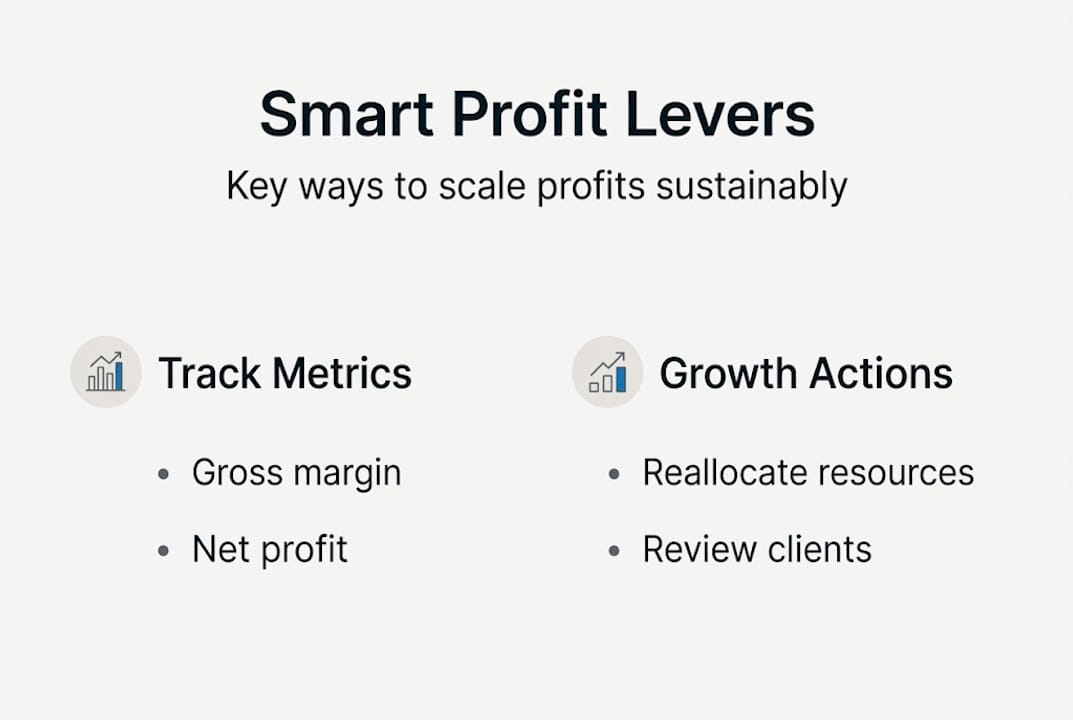
You can also apply this thinking to suppliers, partnerships, and marketing channels. Business process outsourcing for scale is one way to efficiently redirect internal resources toward high-margin activities while keeping operational costs lean.
Key resource reallocation strategies to consider:
- Redirect your marketing budget toward the channels that attract your most profitable clients.
- Invest in tools or automation that reduce the time cost of delivering your highest-margin services.
- Offer premium pricing or value-added tiers to clients in your most profitable segments.
- Free up leadership time from low-value tasks so it can focus on strategic, high-return activities.
As a margin-first operating rhythm takes hold, your resource allocation becomes more deliberate with every passing quarter. You stop chasing volume and start building value.
Why margin-first always beats revenue-only growth
Here is the uncomfortable truth that most business growth advice glosses over: a bigger turnover does not automatically mean a better business. We have worked with business owners who doubled their revenue over three years and were genuinely worse off at the end of it. More staff, more complexity, more stress, and somehow, less profit.
The culprit is almost always the same: cost structures that quietly expanded alongside revenue, a product mix that diluted margin over time, and a habit of measuring success in sales rather than in pounds retained.
The businesses that genuinely thrive over the long term are those that treat margin as the primary metric of health. A margin-first mentality ensures each pound earned contributes more meaningfully to business value than chasing top-line numbers alone.
What makes this genuinely hard is that revenue growth feels good. It is visible, it is exciting, and it is easy to share with your team. Margin improvement is quieter. But it is the difference between a business that funds your life and one that consumes it.
The cost leaks that eat margin are often invisible until you look for them deliberately: scope creep on client projects, under-priced legacy contracts never reviewed, subscriptions nobody cancelled, and team time absorbed by unprofitable work. Adopting a margin-first mindset means making lasting business growth the goal, rather than impressive-looking revenue lines that do not survive a closer look.
Accelerate your profit scaling with professional coaching
Putting these strategies into practice takes more than good intentions. It takes accountability, expertise, and a clear plan tailored to your specific business.

At Summit SCALE, we specialise in helping small and medium-sized business owners identify the blind spots that suppress profits and implement the systems that make sustainable growth repeatable. Our coaching brings genuine accountability to your profit targets, ensuring that the insights from your diagnostics translate into real, measurable results. Explore the coaching benefits for profit that business owners consistently report after working with a structured coaching programme. Learn how coaching and profitability connect in practice, and discover profitable growth strategies built specifically for SMEs ready to scale with confidence. Book your free 15-minute assessment call today.
Frequently asked questions
What is the most common mistake when scaling profits?
Relying on revenue growth alone without tracking margin improvements often leads to stagnant or reduced profits. The most effective businesses build margin-first rhythms rather than chasing top-line numbers.
How do you control costs without hurting growth?
Analytics-led governance enables targeted savings by guiding spend decisions with data rather than applying broad cuts that damage delivery or morale.
When should SMEs invest in professional coaching?
Coaching makes the biggest impact when scaling stalls or profit plateaus, helping you identify and address bottlenecks before they become entrenched habits or structural problems.
What KPIs are best for tracking profit scaling?
The core KPIs to monitor are gross margin, net margin, cost of customer acquisition, and spend efficiency ratios, reviewed consistently on a monthly basis for maximum clarity.

