
TL;DR:
- Strong leadership development significantly improves business performance metrics and employee engagement.
- Investing in coaching and mentoring drives faster decision-making and reduces staff turnover.
- Start leadership growth early with informal methods to maximize long-term business success.
Your product might be excellent. Your market timing might be perfect. Yet if your business has plateaued, the most likely culprit is not your strategy or your pricing. It is your leadership. Many small and medium-sized businesses stall not because of external forces, but because leadership capability has not kept pace with growth ambitions. Research consistently shows that companies investing in leadership see up to 25% improvement in organisational performance. This guide will clarify what leadership development truly means, outline the measurable business benefits, and give you practical steps to start building stronger leaders right now.
Table of Contents
- What is leadership development and why does it matter?
- Key benefits of investing in leadership development
- How leadership development drives team performance and business growth
- Practical strategies for implementing leadership development
- Why most SMEs underinvest and what they miss
- Accelerate your business growth through proven leadership development
- Frequently asked questions
Key Takeaways
| Point | Details |
|---|---|
| Leadership drives SME growth | Investing in leadership development directly improves business performance and team outcomes. |
| Tangible business benefits | Enhanced leaders lead to higher revenue, lower turnover, and increased innovation in SMEs. |
| Practical steps available | SMEs can start leadership development with accessible strategies, not just costly formal programmes. |
| Start small, scale impact | Even simple investments in coaching or mentoring can deliver measurable results over time. |
What is leadership development and why does it matter?
Leadership development is a structured, ongoing process designed to strengthen a leader’s skills, self-awareness, and strategic effectiveness. It is not a one-off workshop or an annual appraisal tick-box. It is a deliberate investment in the human capability that drives everything else in your business.
In large corporations, leadership responsibilities are spread across layers of management. In an SME, your leaders wear many hats. They set culture, manage performance, handle clients, and make decisions that ripple through the entire organisation. When leadership is strong, the whole business moves forward with clarity and confidence. When it stagnates, teams disengage, talent walks out the door, and growth quietly grinds to a halt.
This is why effective leadership coaching is not a luxury reserved for big corporates. It is a strategic necessity for any SME serious about sustained growth.
The data backs this up clearly. Consider what structured leadership investment delivers across key business metrics:
| Business outcome | Impact of leadership development |
|---|---|
| Organisational performance | Up to 25% improvement |
| Employee engagement | Significantly higher scores |
| Staff retention | Reduced turnover rates |
| Profit margins | Measurable uplift over 12 months |
| Decision-making speed | Faster, more confident execution |
“The best leaders are great teachers. They create clarity, build capability in others, and foster environments where people do their best work.” — Harvard Business Review
Leadership development also improves organisational agility and talent retention, two factors that directly determine whether your business can adapt and grow in a competitive market. When your leaders grow, your business grows with them. When they stagnate, your business will never outgrow them.
Key benefits of investing in leadership development
With a clear definition in hand, let us explore the real-world pay-offs business leaders can expect when they make leadership development a priority.
The benefits are not abstract. They show up in your revenue, your team’s daily performance, and your ability to attract and keep great people. Here is what strong leadership investment delivers:
- Enhanced decision-making: Leaders who receive coaching make faster, better-informed decisions under pressure.
- Improved team engagement and retention: Engaged teams are more productive and far less likely to leave.
- Succession planning: Developing internal leaders reduces dependency on any single person, including you.
- Greater innovation: Psychologically safe, well-led teams generate more ideas and act on them.
- Stronger stakeholder confidence: Investors, clients, and partners trust businesses with visible leadership depth.
The revenue impact is striking. Firms with robust leadership development report 37% higher revenue per employee compared to those without structured programmes. That is not a marginal gain. That is a transformational competitive advantage.
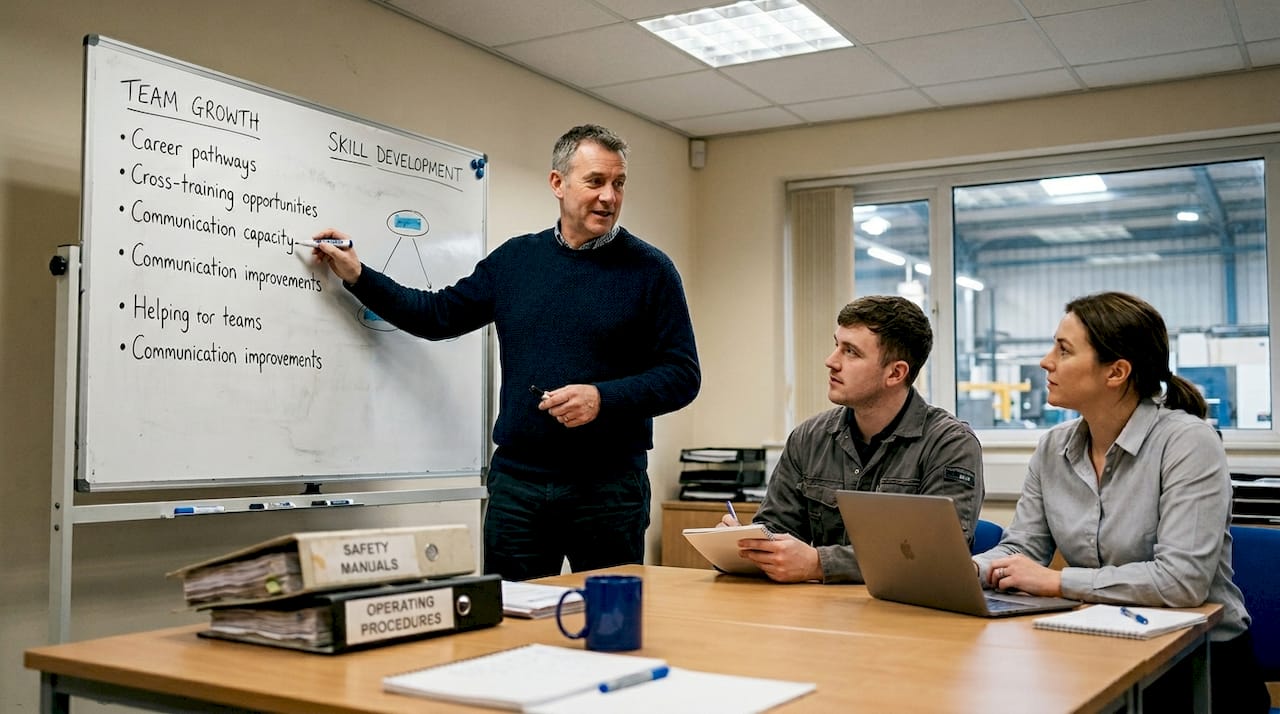
Consider a practical example. A manufacturing SME with 45 employees invested in structured leadership coaching for growth over 12 months. Within that period, staff turnover dropped by 30%, productivity rose measurably, and the owner was able to step back from daily operations for the first time in seven years. The coaching paid for itself many times over.
Pro Tip: You do not need to fund a full leadership programme from day one. Start with coaching for your top two or three leaders. Retain those people, reduce recruitment costs, and reinvest the savings into the next layer of development. The returns compound quickly.
Leadership development is not a cost centre. It is one of the highest-return investments available to an SME owner who is serious about building a business that runs without them.
How leadership development drives team performance and business growth
Understanding the benefits, it is crucial to see how leadership development moves the needle on day-to-day and bottom-line business outcomes.
Leaders shape culture, and culture drives performance. When a leader clarifies vision, removes obstacles, and holds the team accountable with consistency and care, results follow. The mechanism is not complicated, but it requires discipline to sustain.
Effective leaders directly impact team productivity, engagement, and turnover rates. Gallup’s research shows that the quality of leadership is the single biggest driver of employee engagement, which in turn determines output, quality, and retention.
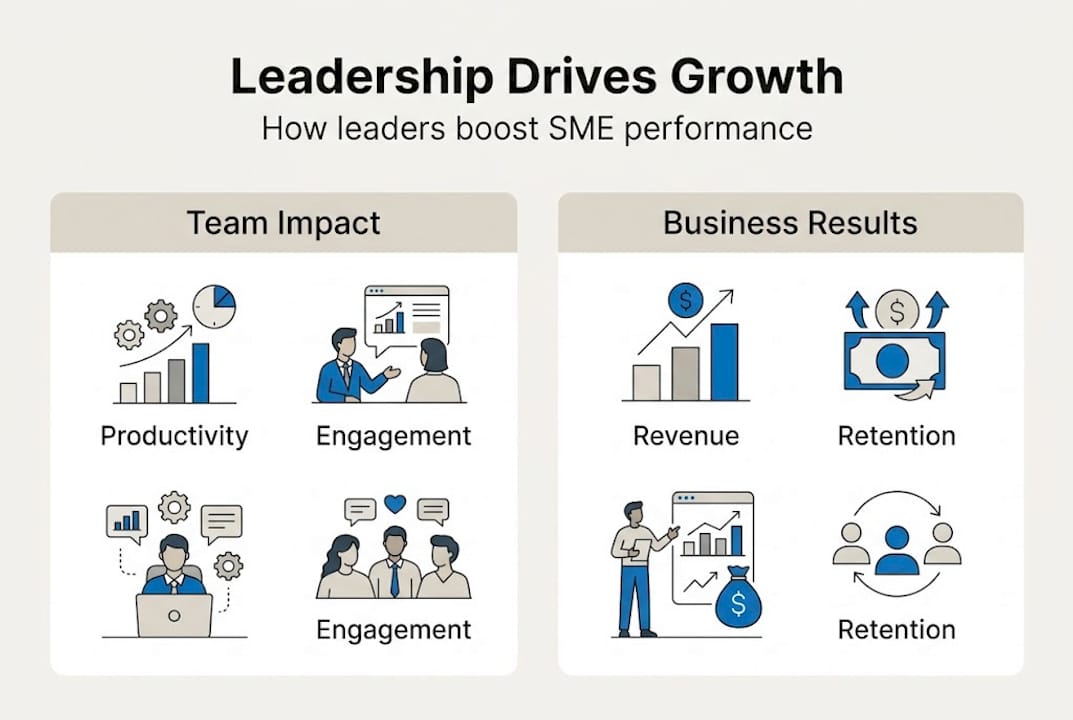
Here is how the picture changes with and without leadership development:
| Business metric | Before leadership development | After leadership development |
|---|---|---|
| Staff turnover | High, often above 25% annually | Reduced by 20 to 40% |
| Team engagement score | Low to moderate | Significantly improved |
| Profit margins | Flat or declining | Measurable growth |
| Innovation rate | Reactive, minimal | Proactive, consistent |
| Owner dependency | Very high | Reduced, scalable |
To connect your leadership coaching process to concrete business KPIs, follow these steps:
- Establish your baseline. Measure current engagement scores, turnover rates, and profit margins before any intervention.
- Define your leadership outcomes. Decide what good leadership looks like in your specific context, not just generic competencies.
- Implement development activities. Coaching, feedback cycles, peer learning, and stretch assignments all count.
- Review progress at 90-day intervals. Short review cycles keep momentum and allow course corrections.
- Link results to business data. Compare your KPIs at each review point to quantify the return on your investment.
This structured approach turns leadership development from a vague aspiration into a measurable business driver. Better leadership means better execution, lower staff churn, and a culture where innovation becomes the norm rather than the exception.
Practical strategies for implementing leadership development
So, how can you put leadership development into practice within your business, even on a modest budget?
The good news is that you do not need a large training budget or a dedicated HR team to start. What you need is intention, consistency, and a willingness to invest in the people who drive your results. Here are practical strategies that work for SMEs:
- Identify leadership potential early. Look for team members who influence others, take initiative, and think beyond their own role.
- Blend formal and informal learning. Combine structured coaching with on-the-job stretch assignments and peer discussions.
- Build peer learning networks. Encourage your leaders to connect with others outside the business through industry groups or mastermind circles.
- Use structured coaching. A professional coach brings objectivity and proven frameworks that internal mentors often cannot provide.
- Create a feedback culture. Regular, honest feedback is the fastest accelerator of leadership growth.
Pro Tip: Do not wait until you can afford a formal programme. Start with mentoring, job shadowing, or microlearning resources available online. Ongoing coaching and feedback are the most impactful elements of any leadership development programme, and both can begin immediately at low cost.
Exploring coaching and development strategies tailored to your business stage is a smart starting point. You might also benefit from understanding the types of business coaching available, so you can match the right approach to your specific leadership gaps.
Sustaining leadership investment over time is what separates businesses that grow from those that plateau. Build development into your calendar, not just your budget. Make it a rhythm, not a reaction.
Why most SMEs underinvest and what they miss
Bringing these insights together, it is worth challenging the prevailing mindset around leadership budgets in small and medium-sized businesses.
Most SME owners see leadership training as a nice-to-have. Something to consider when things settle down, when cash flow improves, or when the team is bigger. But here is the uncomfortable truth: those conditions rarely arrive on their own. They are created by better leadership.
The real risk of underinvestment is not the money you spend. It is the opportunity you forfeit. Disengaged teams, declining innovation, stagnant revenue, and an owner who cannot step back are all symptoms of a leadership gap. They are not bad luck. They are predictable outcomes of neglect.
In our experience working with SME owners across multiple industries, the businesses that grow fastest are not always the ones with the best products. They are the ones whose leaders invest early, iterate consistently, and treat their own development as a business asset. Boosting growth through leadership is not a slogan. It is a pattern we see repeated in every high-performing SME we work with.
Purposeful, sustained investment in leadership is not optional if you want a business that scales. It is the foundation everything else is built on.
Accelerate your business growth through proven leadership development
Leadership development is most effective when guided by expert frameworks and a coach who understands the realities of running an SME. Reading about it is a powerful first step. Acting on it is where the growth happens.
At Summit SCALE®, we specialise in coaching and leadership development tailored specifically to small and medium-sized business owners. Whether you are looking to understand why invest in coaching or you are ready to explore our structured leadership coaching process, we are here to help you build a business and a team that performs without you carrying it all alone. Book your free 15-minute assessment call today and take the first step towards real, measurable growth.
Frequently asked questions
How quickly can SMEs see results from leadership development?
Businesses often see measurable improvements in team engagement or productivity within 3 to 6 months of initiating leadership development, with ROI within 6 months achievable through focused coaching and feedback.
Do small businesses need formal leadership development programmes?
Formal programmes can help, but SMEs often succeed with informal approaches like mentoring, peer learning, or structured coaching, since ongoing coaching and feedback deliver strong results even without a formal structure.
Is leadership development relevant in a flat or small team structure?
Absolutely. Strong leadership drives clarity, motivation, and sustained growth regardless of team size, as good leadership value is not diminished by a smaller headcount.
How do I measure the ROI of leadership development?
Track employee engagement scores, turnover rates, and profit margins before and after development initiatives, then link leadership to KPIs at regular review intervals for clear evidence of return on investment.

