
TL;DR:
- Proper cost control is an ongoing management system, not just cost-cutting or visibility. It prevents overspending through embedded processes, approval workflows, and regular audits to protect margins and fuel growth. Building disciplined cost systems enhances profitability, resilience, and long-term scalability for SMEs.
Most business owners think cost control means cutting expenses. It does not. That misconception is exactly why so many well-run businesses quietly bleed profit year after year. Understanding why control business costs properly, as a continuous discipline rather than a reactive slash-and-burn exercise, is one of the most powerful levers you have for protecting margins, freeing up cash, and building a business that can genuinely scale. This article will show you what real cost control looks like, why it matters more than most owners realise, and how to build it into the fabric of your operations.
Table of Contents
- Key takeaways
- Why cost control is more than cutting back
- The impact of cost discipline on profitability
- Hidden pitfalls that drain SME profits
- Practical strategies to build cost control systems
- Cost control and long-term business growth
- My honest take on cost control for SMEs
- Take control of your costs with Summitscale
- FAQ
Key takeaways
| Point | Details |
|---|---|
| Cost control is not cost-cutting | True control is a continuous management system, not a one-off response to financial pressure. |
| Visibility alone is insufficient | Seeing where money goes is not the same as preventing overspend before it happens. |
| Small leaks cause big damage | Untracked, decentralised spending quietly erodes margins over months and years. |
| Discipline drives reinvestment | Controlled costs free up cash that can be directed towards growth and resilience. |
| Structure beats reaction | Approval workflows and centralised oversight prevent overspend rather than simply reporting it. |
Why cost control is more than cutting back
Here is the question worth sitting with: are you actually controlling your costs, or are you just watching them? These are two very different things, and confusing them is one of the most common and costly mistakes in business management.
Cost control, properly defined, is the ongoing process of monitoring, managing, and preventing expenditure from exceeding what your business has committed to spend. It is not the same as cost-cutting, which is a reactive response to financial pressure. And it is not the same as cost visibility, which is simply having a dashboard or report that tells you what you have already spent.
Visibility tools like dashboards are valuable, but they are insufficient on their own. Effective cost control requires proactive, embedded governance with authority over decisions and spend commitments before money leaves the business. Think of it this way: a speedometer tells you how fast you are going, but it does not stop you speeding. The brakes do that. Visibility is your speedometer. Control is the brakes.
The deeper issue is structural. Many overspending problems are not caused by poor financial reporting. They are caused by early operational decisions on purchasing, vendor agreements, and process design that quietly lock in high costs long before any report surfaces the problem. Embedding cost as a design constraint from the start prevents the kind of structural inefficiencies that are expensive and disruptive to fix later.
- Reactive cost-cutting responds to financial pain after overspend has occurred
- Cost visibility reports where money has gone, without preventing future leakage
- True cost control prevents overspend through embedded systems, approval workflows, and accountability
Pro Tip: If your cost management process begins after the invoice arrives, you do not have cost control. You have cost recording. True control happens upstream, at the point where spending decisions are made.
The impact of cost discipline on profitability
Why does cost control matter so deeply to your bottom line? Because costs are sticky. When your business grows, expenses rise quickly to match. When growth slows or reverses, those costs do not fall at the same rate. Operating costs exhibit cost stickiness, which means episodic cost-cutting rarely sustains margin improvement without a continuous underlying discipline.
Consider the mathematics of a modest 5% operating cost reduction on a business with tight margins. That saving flows almost entirely to profit because revenue has not changed. For a business turning over £500,000 with a 15% net margin, a 5% reduction in operating costs could represent a 30% or greater increase in net profit. That is the kind of leverage that transforms a business. And it does not require a single new customer.
“Cost control is not just about cutting expenses. It is a continuous optimisation process that fuels growth.” Signal Journal
The evidence supports this strongly. Most cost-cutting initiatives fail to deliver lasting profitability improvements when they are not backed by operational change. Cutting without changing the underlying system is like bailing water from a leaking boat without finding the hole.
74% of financial leaders now view cost control as a strategic management tool, not just a finance function. That shift in mindset is significant. When cost discipline is embedded in operations, the benefits compound over time:
- Improved cash flow and reduced reliance on credit or overdraft facilities
- Greater capacity to reinvest in growth, talent, and technology
- Stronger resilience during economic downturns or revenue dips
- Clearer financial clarity that supports better decision-making
- Higher business valuation when it comes time to exit or attract investment
The role of cost control in growth is not peripheral. It is central.
Hidden pitfalls that drain SME profits
Small and medium-sized businesses face a particular set of cost challenges that larger organisations can absorb more easily. The culprit is often not one large, obvious expense. It is death by a thousand cuts.
Unstructured spending leads to reactive purchases and a quiet erosion of profit margins over time. When purchasing decisions are made by multiple people without clear authority or process, small and untracked expenses accumulate into significant overspending. A £50 software subscription here, an unbudgeted supplier order there, a service renewal nobody reviewed. Individually, each seems trivial. Collectively, they can represent thousands of pounds in annual waste.
The specific traps to watch for include:
- Decentralised purchasing with no central oversight or approval process
- Automatic renewals on contracts or subscriptions that no longer deliver value
- Vendor relationships managed informally, with no regular renegotiation or benchmarking
- Reactive buying driven by urgency rather than planning, which inflates prices paid
- No spending policy, meaning each decision is made on instinct rather than a defined framework
The absence of structure is itself a cost. When there is no defined process, dispersed purchasing causes unnoticed small expenses that erode profits steadily and silently.
Pro Tip: A single monthly review of recurring subscriptions and vendor contracts often uncovers 3 to 8 per cent in immediately recoverable costs for businesses that have never done one before.
Practical strategies to build cost control systems
Knowing why you need cost control is one thing. Building the system that delivers it is another. The good news is that effective cost management strategies do not require complex infrastructure. They require clarity, commitment, and a handful of well-designed processes.
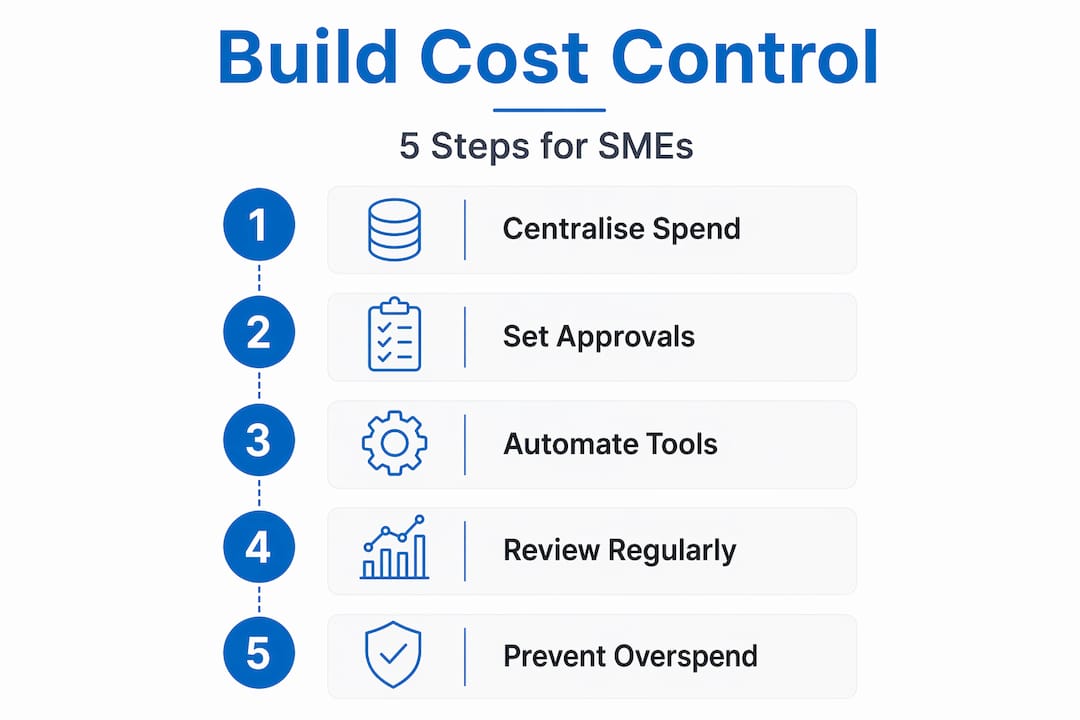
Start by centralising your spending activity. Every purchase, regardless of size, should flow through a defined process with visibility at the centre. This does not mean bureaucracy. It means knowing what is being spent, by whom, and whether it was planned.

Next, establish approval workflows. Define who can approve spending at each level, and create clear policies for unplanned purchases. This single change prevents the majority of reactive overspend before it happens. Centralised purchasing and clear approval workflows are among the most impactful structural changes an SME can implement.
Technology matters here too. Automation and real-time monitoring tools allow you to intervene proactively and prevent spending leaks before they occur. Cloud-based expense tracking platforms can flag anomalies, alert managers to budget thresholds, and produce reports that actually drive decisions rather than just record history.
| Approach | Episodic cost-cutting | Continuous cost discipline |
|---|---|---|
| Trigger | Financial crisis or pressure | Built into daily operations |
| Focus | Reducing headline numbers | Managing every spend decision |
| Duration | Short-term, temporary | Ongoing and self-reinforcing |
| Impact on margins | Brief improvement, then erosion | Sustained and compounding |
| Cultural effect | Fear and uncertainty | Confidence and financial clarity |
| Risk | Cuts valuable capacity | Eliminates waste, not capability |
Periodic audits also play a key role. A quarterly review of your cost base against budget, broken down by category and team, surfaces inefficiencies before they compound. Pair this with an annual vendor review and you create a system that continuously tightens spending without requiring constant management attention.
Cost control and long-term business growth
Here is the bigger picture. Why control operating costs consistently, year on year, even when the business is performing well? Because cost discipline is what creates the conditions for growth. It is not separate from your growth strategy. It is the engine that powers it.
Sustained cost discipline supports reinvestment, scalability, and higher business valuation. When your cost base is lean and well-managed, every pound of additional revenue generates a greater return. You have the cash to hire, to invest in systems, to pursue new markets. You are not perpetually catching up or responding to financial surprises.
Cost discipline also protects your business during the inevitable economic cycles. Businesses with strong cost structures absorb downturns better and recover faster. They are not forced into damaging cuts that strip out capacity precisely when they need to compete hard for recovery. The importance of cost control extends well beyond the finance function. It is a foundational discipline that touches every part of how your business operates, competes, and grows.
- Freed capital funds growth without requiring external debt or dilution
- Predictable cost structures make revenue projections more reliable and confidence higher
- Lean operations attract stronger valuations from buyers and investors
- A culture of financial discipline filters through to better decisions at every level
The businesses that scale well are rarely the ones with the highest revenue. They are the ones with the most disciplined relationship between what they earn and what they spend.
My honest take on cost control for SMEs
In my experience working with SME owners, the most common pattern I see is this: a business reaches a point of financial pressure, cuts costs sharply, recovers, then slowly lets those costs creep back. Six months later, the same pressure returns. The cycle repeats, and with each iteration, the owner feels more exhausted and less confident.
What I have learned is that this cycle is not a discipline problem. It is a systems problem. Most owners are not careless with money. They simply have no structure that prevents costs from drifting upward over time. When I work with a client to build that structure, including clear visibility, defined approval pathways, and regular audit rhythms, the transformation is not just financial. It is psychological. Knowing your numbers and trusting your processes gives you a kind of clarity and confidence that you simply cannot manufacture any other way.
My strong view is that cost control should be treated as a strategic constraint, not a finance task. When you build it into how your business makes decisions, not just how it reports results, you stop reacting and start leading. That shift, from reactive to disciplined, is one of the most liberating things I have seen a business owner experience.
— Shane
Take control of your costs with Summitscale

If this article has made you think differently about how your business manages costs, the next step is to build a structure that works for your specific operation. At Summitscale, we work directly with SME owners and managers to create the financial discipline, clarity, and confidence that drives real profitability. Our coaching programmes go beyond theory to help you implement the systems that prevent overspend, protect margins, and free up cash for growth. If you are ready to stop reacting and start leading your finances, explore coaching for business profitability or discover how coaching supports SME growth at every stage.
FAQ
What does it mean to control business costs?
Controlling business costs means actively managing all spending through defined systems, approval processes, and regular oversight, rather than simply recording expenses after they occur. It is a continuous discipline, not a one-off response to financial pressure.
Why is cost control vital for small businesses?
For small businesses, margins are tighter and the impact of overspend is felt faster. Without structured cost management, small untracked expenses accumulate into significant profit erosion, making financial resilience and growth far harder to achieve.
How does cost control differ from cost-cutting?
Cost-cutting is a reactive reduction in spending triggered by financial pressure, while cost control is a proactive, ongoing system that prevents overspend before it happens. Research shows that episodic cost-cutting rarely delivers lasting margin improvement without underlying operational change.
What are the biggest causes of overspending in SMEs?
The main causes include decentralised purchasing, unreviewed automatic renewals, informal vendor relationships, and the absence of a clear spending policy. A lack of centralised accountability is one of the most significant drivers of overspending in small and medium-sized businesses.
How does cost control support business growth?
Disciplined cost management frees up cash that can be reinvested in people, systems, and new opportunities. It also creates more predictable financial performance and supports a stronger business valuation, making it a direct contributor to long-term scalability and competitiveness.

