
TL;DR:
- Building a sales team creates predictable pipeline management and scalable revenue.
- Technology like AI CRM systems significantly boosts sales efficiency and ROI.
- Start small, ensure product-market fit, and build systems before expanding your sales team.
Most small business owners wear the sales hat longer than they should. You close deals, chase leads, follow up with clients, and somehow manage everything else at the same time. It feels efficient, but it is actually a ceiling. High-performing sales teams outperform peers by more than 50% in productivity metrics, not because they hire superstars, but because they build systems. This article walks you through exactly why a structured sales team transforms your business, when to build one, what tools to use, and how to avoid the costly mistakes that trip up so many ambitious owners.
Table of Contents
- Why sales teams trump solo selling for growth
- Core benefits of building a dedicated sales team
- When not to build a sales team: Common pitfalls
- Technology’s critical role: How digital tools amplify sales team impact
- The uncomfortable truth: Why most SMBs get sales team building wrong
- How Summit SCALE® Coaching can accelerate your sales team journey
- Frequently asked questions
Key Takeaways
| Point | Details |
|---|---|
| Teams drive growth | Structured sales teams outperform solo selling and enable business scale. |
| ROI proves the case | SMBs see more than 300% ROI over 3 years when investing in sales teams backed by CRM. |
| Timing matters | Avoid building a sales team before achieving product-market fit or scalable demand. |
| Tech multiplies results | AI and CRM tools significantly increase sales team efficiency and return on investment. |
| Start smart, not big | Begin with essentials and flexible resources to prevent costly mistakes—grow as proof accumulates. |
Why sales teams trump solo selling for growth
Let’s be honest about what solo selling really looks like at scale. You are the top performer, the product expert, and the trusted face your clients want to see. That is not a sales strategy. That is a bottleneck wearing a suit.
As your business grows, the complexity of selling grows with it. You need consistent pipeline activity, regular follow-ups, multi-channel outreach, and reliable forecasting. One person simply cannot cover all of that and run the business simultaneously. The moment you take a holiday, get ill, or focus on operations, your revenue pipeline dries up. That is a fragile place to operate from.
A structured sales team changes everything. Consider what a well-built team delivers that a solo effort cannot:
- Consistent pipeline management across multiple leads and stages at once
- Specialised roles so some reps focus on prospecting while others handle closing
- Customer coverage that does not drop when one person is unavailable
- Repeatable processes that get better over time rather than relying on individual memory or instinct
- Scalable capacity that grows with your revenue targets
“The goal is not to find a superstar salesperson. The goal is to build a system that makes every salesperson perform like one.”
This mindset shift is fundamental. Understanding sales growth importance means recognising that growth requires infrastructure, not just effort. A solo seller maxes out. A team compounds.
Research consistently backs this up. Teams built on clear processes and measurable systems, rather than heroic individual performances, outperform peers by 50%+ in key productivity metrics. That is not a marginal improvement. That is a structural advantage. And when you pair it with smart profitability drivers at the business level, the financial impact becomes genuinely transformative.
The question is no longer whether you need a sales team. It is whether you can afford to keep going without one.
Core benefits of building a dedicated sales team
Once you accept that a team outperforms a solo approach, the next step is understanding the specific, measurable benefits that come with building one. These are not abstract concepts. They show up directly in your revenue, your resilience, and your freedom as a business owner.

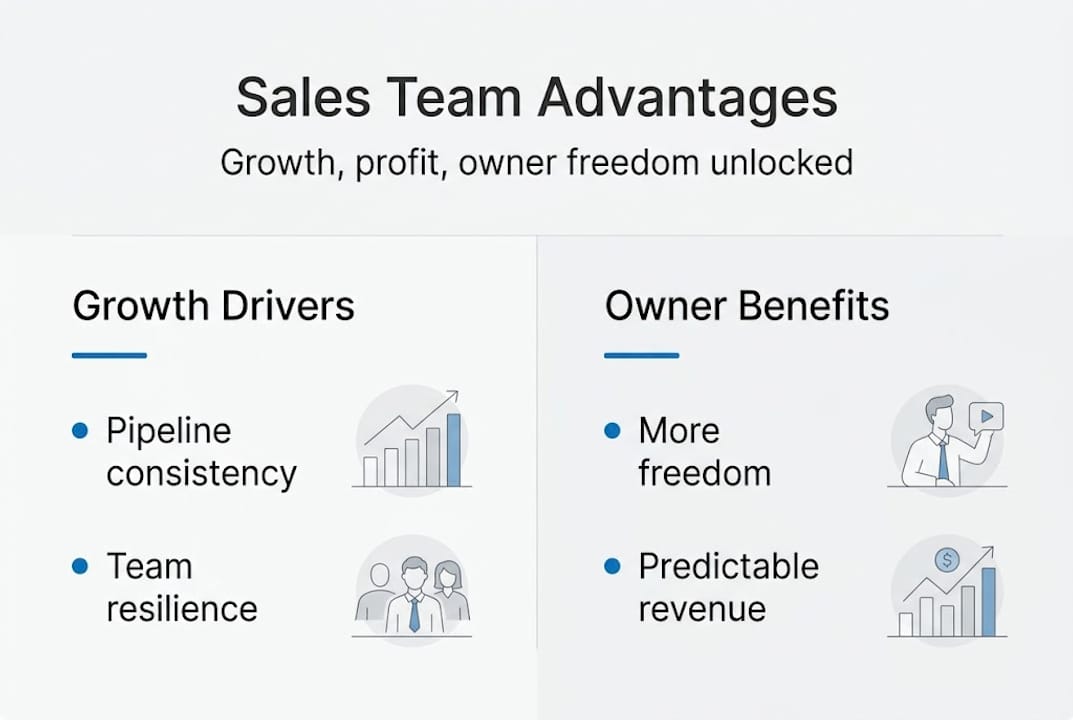
A repeatable revenue engine. A sales team that follows a defined process creates predictable results. You move from hoping clients ring you to having a structured engine that generates new business continuously. That predictability transforms your ability to plan, invest, and grow with confidence.
Faster customer acquisition. Teams can split responsibilities so leads are nurtured efficiently. A dedicated business development rep handles outreach, a closer handles proposals, and an account manager builds long-term relationships. Each person becomes excellent at their specific role rather than average at all three.
Resilience against disruption. If one team member leaves, your sales process continues. You are not starting from scratch because the knowledge, scripts, and systems live in the business, not in one person’s head.
Owner freedom. This one matters enormously. When your business has a functioning sales team, you step back from the front line. You lead, coach, and strategise rather than cold call. That is the shift from owner-operator to business owner that most entrepreneurs dream about.
Here is a snapshot of what the data shows about team-led sales outcomes:
| Benefit | Solo selling | Team-based selling |
|---|---|---|
| Pipeline consistency | Irregular | Structured and predictable |
| Recovery from staff changes | High risk | Resilient with documented process |
| Revenue scalability | Limited by owner hours | Scales with team size |
| CRM ROI over 3 years | Minimal | 303% for SMBs |
That CRM figure is worth pausing on. SMB businesses that invest in the right customer relationship management tools alongside their sales teams achieve an average of 303% return on investment over three years. That means the technology that supports your team pays for itself several times over.
Pro Tip: Before you hire your first dedicated salesperson, document your current sales process in full. Every step, every script, every follow-up sequence. This becomes the foundation your new team builds on, rather than learning from scratch.
Explore proven sales growth strategies to understand how team structures translate into bottom-line results, and review real-world sales strategy examples to see how other SMBs have made the shift successfully.
When not to build a sales team: Common pitfalls
Here is where most articles fall short. They sell you on the benefits without warning you about the situations where building a sales team too early, or in the wrong way, can set your business back significantly.
The most important lesson? Avoid premature scaling before you have product-market fit. Product-market fit means your offering genuinely solves a problem your target customers are willing to pay for consistently. Without that, a sales team will burn through budget generating leads that do not convert, leaving you with wages to pay and no results to show.
Signs your business is not yet ready for a full sales team:
- Your close rate is inconsistent or you cannot explain why deals are won or lost
- You do not have a documented sales process that someone else could follow
- Your product or service offering changes frequently in response to early customer feedback
- You are still refining your target customer profile
- Monthly revenue is irregular or you lack the cash flow to sustain salesperson wages during a ramp-up period
Solo selling also breaks down in a different context, complex B2B (business-to-business) deals involving multiple decision-makers. When a sale requires buy-in from a procurement team, a finance director, and a senior manager simultaneously, one person cannot manage all those relationships effectively. This is actually a signal that you need a structured team approach, not that you should keep going alone.
Here is a useful comparison to guide your decision:
| Scenario | Best approach |
|---|---|
| Early-stage, refining the offer | Solo selling or fractional sales support |
| Proven offer, growing demand | Build a small, structured team |
| Complex B2B, multiple stakeholders | Team approach with specialist roles |
| Resource-constrained but ready to test | Fractional or AI-assisted sales tools |
Fractional sales support (where you bring in part-time or contract sales professionals) is a smart, low-risk way to test whether a team model works for your business before committing to permanent hires. AI-assisted tools offer another avenue, automating parts of prospecting and lead qualification without the full cost of a dedicated hire.
Use the sales growth checklist to assess your readiness honestly, and explore practical sales growth tips for low-risk ways to start building capacity. It is also worth learning from branding mistakes UK SMEs make, since a confused brand message undermines even the best sales team effort before it begins.
Pro Tip: If you are unsure whether you have product-market fit, ask yourself this: do you regularly receive unsolicited referrals, and do existing clients renew or buy again without heavy persuasion? If yes, you likely have enough fit to start building a team.
Technology’s critical role: How digital tools amplify sales team impact
You could build a sales team and equip them with nothing more than a spreadsheet and a telephone. Some businesses still do. But the gap between a digitally-enabled team and one operating without the right tools is enormous, and growing.
The average sales tech stack costs around $187 per representative per month in 2025 and 2026. That sounds like a cost. In reality, it is an investment with measurable returns. AI-powered CRM systems deliver an average of 287% ROI, and businesses whose sales technology scores above 80 on AI capability benchmarks achieve 2.8 times higher return on investment than those using basic or outdated tools.
Let that sink in. A well-chosen AI CRM is not just slightly better than a generic solution. It is nearly three times more effective.
Here is how the numbers break down:
| Tool type | Average monthly cost per rep | Typical ROI |
|---|---|---|
| Basic CRM (no AI) | Lower upfront | Limited scalability |
| AI-enabled CRM | ~$187 per rep per month | 287% ROI |
| Full AI-integrated stack | Higher investment | 2.8x ROI vs basic tools |
What does this mean in practice for a small or medium-sized business? Even a lean team of two or three salespeople, properly supported by an AI CRM, can punch well above their weight. The technology handles lead scoring (ranking leads by their likelihood to convert), automated follow-up sequences, and pipeline reporting. Your team focuses on the human work: building relationships, handling objections, and closing deals.
The key benefits of integrating the right tech into your sales team include:
- Automated lead tracking so no prospect falls through the cracks
- AI-driven insights that highlight which deals need attention and which are likely to close
- Real-time reporting that gives you visibility into team performance without micromanaging
- Faster onboarding for new team members who follow system-guided workflows
- Consistent customer experience regardless of which team member handles the account
For detailed guidance on the best technology choices for your stage of growth, explore these sales growth tech tips tailored specifically for business leaders looking to accelerate results.
The bottom line is simple. Technology does not replace your team. It makes every member of your team significantly more productive, more consistent, and more valuable to your business.
The uncomfortable truth: Why most SMBs get sales team building wrong
Here is something most guides will not tell you. The biggest reason sales teams fail in small and medium-sized businesses has nothing to do with the quality of the people hired. It has everything to do with the approach taken before a single person is brought on board.
Many business owners look at a competitor or a larger firm, admire their sales operation, and try to replicate it. Copying a strategy designed for a business with different resources, a different customer base, and years of process refinement is not inspiration. It is a shortcut to wasted money. Your context is unique. Your team needs to be built around your customers, your offer, and your current capacity.
The second trap is the star salesperson myth. You hire someone with an impressive track record, assume they will bring their magic with them, and wait for results. Sometimes it works. More often, you discover that their success was tied to the systems, reputation, and lead flow of their previous employer. Without the right infrastructure around them, even talented people struggle.
What actually works is less glamorous but far more reliable. Start small. Hire one person, ideally someone coachable and disciplined rather than someone with a flashy CV. Build a simple, documented process together. Test it. Adjust it. Then scale what works.
Understanding sustained sales growth means accepting that the compounding effect of consistent, process-driven selling always beats the boom-and-bust cycle of relying on individual brilliance.
The owners who build the most durable sales teams are not the ones who hired fastest. They are the ones who built deliberately, measured honestly, and kept improving. That approach takes patience, but it builds something that genuinely runs without you needing to be in the room every day.
How Summit SCALE® Coaching can accelerate your sales team journey
Building a sales team that truly delivers, without wasting time, money, or momentum, is one of the most rewarding steps you can take as a business owner. But it works best with the right guidance at each stage.
At Summit SCALE®, we work with small and medium-sized business owners who are ready to move beyond the solo selling ceiling and build genuine sales capacity. Whether you are just starting to explore the idea or ready to scale a team you already have, our sales growth strategy guide gives you a practical framework to follow. Discover why investing in coaching delivers measurable returns, and explore how coaching for SME growth supports every stage of building and leading high-performing teams. Book your free 15-minute assessment call today and take the first clear step forward.
Frequently asked questions
How do I know if my business is ready for a sales team?
You are ready if you have clear demand, defined target customers, and need capacity or consistency to grow beyond what you alone can serve. If your offer is still evolving, avoid premature scaling until you have confirmed product-market fit.
What is the typical ROI from building a sales team?
SMB sales teams supported by CRM regularly achieve well over 300% return on investment over three years. Specifically, SMB CRM investments deliver an average 303% ROI over that period, making technology enablement a core part of the business case.
Can AI or automation replace all my sales reps?
AI tools significantly boost ROI and efficiency but work best alongside human teams, not as a total replacement. AI-enabled CRM systems achieve 287% ROI and free your team to focus on relationship-building rather than administrative tasks.
What’s the first step before I hire salespeople?
Define your ideal customer, refine your sales process, and ensure you have product-market fit before scaling your team. Rushing to hire before these foundations are in place is one of the most common reasons early sales teams fail.
How can I avoid costly mistakes when building my sales team?
Start small, invest in systems, and test with flexible or part-time approaches before fully committing to a permanent structure. Fractional and AI-assisted options let you validate your model without incurring fixed costs until you have proof it works.

