
TL;DR:
- Owner freedom requires deliberate design, not merely owning a business, and depends on four interconnected freedoms. Building financial, tax, profit, and system mastery enables business owners to create sustainable, autonomous businesses. True sovereignty involves setting boundaries and rules that support long-term freedom rather than chaos and dependency.
Many business owners start out chasing freedom, only to find themselves more trapped than ever. If you have asked yourself what is owner freedom and why it feels so out of reach, you are not alone. Business ownership offers independence and lifestyle control in theory, but the reality is that most owners work longer hours than their own employees and struggle to take a proper holiday. This article breaks down what owner freedom actually means, why the conventional definition falls short, and how you can deliberately engineer it into your business.
Table of Contents
- Key takeaways
- What is owner freedom, really?
- The four freedoms that make it real
- Designing your business for optionality
- Freedom vs sovereignty: an important distinction
- My take on what owner freedom really takes
- Ready to build your owner freedom?
- FAQ
Key takeaways
| Point | Details |
|---|---|
| Owner freedom is not automatic | Simply owning a business does not grant freedom; it must be deliberately designed and built. |
| Four freedoms drive real autonomy | Financial confidence, tax confidence, profit mastery, and systems mastery must all work together. |
| Sovereignty beats freedom alone | Discipline and internal rules create sustainable freedom; freedom without structure collapses. |
| Optionality is the goal | True owner freedom means having choices about your time, role, and business future. |
| Coaching accelerates the process | Structured support helps owners identify gaps and build the systems that create lasting freedom. |
What is owner freedom, really?
Most people assume that the moment they sign the paperwork and open for business, freedom follows automatically. It does not. The definition of owner freedom is far more specific than that. At its core, owner freedom means having genuine control over how you spend your time, how your business generates and retains money, and what strategic direction your company takes — without the business collapsing the moment you step back.
To understand this properly, you need to separate two things: ownership and freedom. Ownership means legal and financial control with associated risks and decision rights. Freedom is the ability to act on those rights without being held hostage by the day-to-day operations. One does not automatically produce the other.
Ownership structure matters enormously here. Business ownership structures vary in how much freedom they actually grant, largely because of how liability and control are arranged.
| Structure | Liability exposure | Degree of operational freedom |
|---|---|---|
| Sole trader | Personal assets at risk | High control, low protection |
| Partnership | Shared liability | Shared control, negotiated freedom |
| Limited company | Personal assets protected | More structured, greater long-term freedom |
| Franchise | Limited by franchisor | Moderate control, defined boundaries |
The structure you choose shapes your freedom from day one. A sole trader may feel maximum control but carry maximum personal risk. A limited company offers protection and a cleaner separation between you and the business, which actually creates more room for genuine owner freedom over time.
What owner freedom means, in practical terms, is having a business that works for you rather than one you work inside of every single day.

The four freedoms that make it real
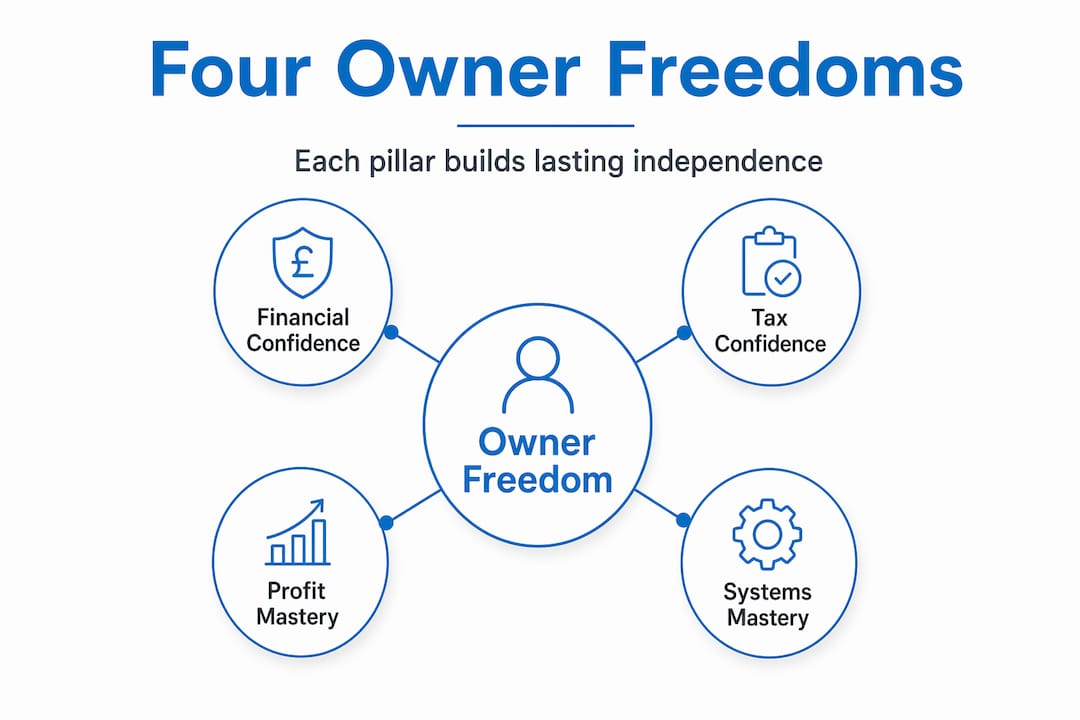
Owner freedom explained properly is not a single concept. It is built on four interconnected pillars, and these four freedoms must work together to prevent your business becoming a source of chronic stress rather than a source of opportunity.
Financial confidence means knowing exactly what money is coming in, what is going out, and what your business is genuinely worth. Without it, every month feels like a guessing game. Imagine running a business where you cannot confidently say whether you made a profit last quarter. That uncertainty keeps you permanently anxious and attached to the day-to-day.
Tax confidence means understanding your tax obligations and having a strategy around them. Far too many owners find out what they owe at the end of the tax year with no plan in place. Expert financial management can be the difference between a bill that blindsides you and a liability you planned for months in advance.
Profit mastery goes deeper than just revenue. It means understanding your margins, your pricing, your costs, and where your business actually makes money versus where it burns it. Lots of businesses have impressive turnover and terrible profits. Profit mastery gives you the clarity to fix that.
Systems mastery means your business has documented processes and capable people who can run operations without you hovering over every decision. This is the pillar most owners neglect longest, and it is the one that physically frees your time.
When even one of these is missing, the whole structure wobbles. Improving systems without addressing profit and tax still causes stress. You can have great processes but if you are haemorrhaging money, you are not free. You can have solid profits but if you cannot step away without things falling apart, you are equally stuck.
Here are the clearest signs that one or more freedoms are missing from your business:
- You check your bank balance every morning with a knot in your stomach
- You are the first one in and the last one to leave, every day
- Tax time feels like a crisis rather than a routine exercise
- Your team cannot answer basic customer questions without calling you
- You have not taken a real holiday in over a year
- Your pricing has not changed in three years because you are afraid of losing clients
Pro Tip: When you identify which of the four freedoms is most absent in your business, address that one first. Do not try to fix everything simultaneously. Focus creates progress.
Designing your business for optionality
The benefits of owner freedom go well beyond simply working less. Owner freedom includes the capacity to make strategic decisions about your business future, whether that means selling, delegating to a hired CEO, scaling to multiple locations, or simply working three days a week. This is what real optionality looks like.
Think of owner freedom as having genuine choices rather than being stuck in a single role forever. The three levers that create this optionality are time, cash flow, and wealth. Get all three working in your favour and the possibilities open up considerably.
Here is a sequential approach to engineering that freedom into your business:
-
Audit your current state. Document where your time actually goes each week, where your revenue comes from, and what your real profit margins look like. You cannot improve what you have not measured.
-
Build financial clarity. Get your numbers sorted, including your profit and loss, your tax position, and your cash flow projections. The SMB profitability checklist is a practical starting point for this step.
-
Systematise operations. Document your core processes. Train your team to handle decisions without you. This is the work that most directly buys back your time.
-
Test your freedom. Once you believe your systems are in place, step fully away from the business for a defined period. A formal 14-day removal from daily operations will reveal exactly which parts of the business still depend on you personally.
-
Design your preferred future. With working systems and financial clarity, you can now make real choices. Do you want to scale, sell, bring in a managing director, or simply work fewer days? All of these become possible once the first four steps are solid.
The fourth step trips people up. Most owners convince themselves that they could step away if they wanted to, but they never actually test it. The gap between believing you have freedom and proving it is where most owner freedom goals go quietly to die.
Pro Tip: Plan a deliberate two-week absence from your business and observe what breaks. Treat it as a diagnostic, not a holiday. The things that fail are your to-do list for building real freedom.
Freedom vs sovereignty: an important distinction
Here is where most conversations about owner freedom miss the point entirely. People chase freedom as if it means the absence of rules and obligations. But true liberty requires discipline and responsibility. Without internal rules, freedom becomes chaos.
Sovereignty is the better goal. Where freedom asks “what can I escape from?”, sovereignty asks “what rules will I design for myself so that I can operate exactly as I choose?” Discipline equals freedom: the owner who sets clear boundaries around their time, their communication, and their involvement in the business is the one who actually experiences freedom day to day.
Consider this contrast:
| Concept | What it looks like in practice | Long-term outcome |
|---|---|---|
| Freedom (without sovereignty) | No fixed working hours, always available, reactive | Burnout, chaos, dependency |
| Sovereignty | Clear office hours, defined decision rights, team empowered | Sustainable freedom, predictable growth |
Without boundary systems and discipline, owners remain permanently reachable and interrupted. The forty-hour workweek is a myth for most entrepreneurs who have not built these boundaries deliberately.
Practically, sovereignty means setting rules like: you do not answer client calls after 6pm; your team handles all complaints below a certain value; you attend only two internal meetings per week. These constraints sound restrictive. They are actually what freedom feels like from the inside.
My take on what owner freedom really takes
I have worked with hundreds of business owners who started out thinking that freedom was just around the corner. One more client, one more year, one more hire. The honest truth I have come to is this: most owners are waiting for permission to be free, and that permission never arrives from the outside.
What I have seen consistently is that the owners who achieve real freedom are not necessarily the most talented or the most profitable. They are the most deliberate. They decided what freedom meant to them personally, they built backwards from that vision, and they refused to let urgency drive every decision.
The most common misconception I encounter is that owner freedom is about working less. It is not. It is about working on what you choose, when you choose, in a business that does not collapse without you. Some of the most free business owners I know work extremely hard. The difference is that they are doing it by design, not by default.
The importance of owner freedom also extends to business value. A business that depends entirely on the owner is worth far less when it comes to sale. So building freedom is not just a lifestyle decision. It is a financial one.
If I were to give one piece of direct advice, it would be this: stop treating your freedom as a reward for working harder and start treating it as a design problem to be solved right now.
— Shane
Ready to build your owner freedom?
If reading this has made you realise how to achieve owner freedom is more structured than you expected, that clarity is the starting point. At Summitscale, we work directly with SMB owners to identify which of the four freedoms are missing, build the financial and operational foundations to recover them, and design a business that genuinely works without you at the centre of every decision.
Our business coaching services are built specifically for owners at your stage, focused on profit, time, and long-term business value. Whether you want to scale, step back, or simply stop feeling trapped by your own company, there is a structured path forward. Find out how investing in coaching transforms the ownership experience and what it could mean for your business in the next twelve months.
FAQ
What does owner freedom mean for a small business owner?
Owner freedom means having genuine control over your time, finances, and business direction without the business requiring your constant presence. It is the ability to make choices about your role rather than being dictated to by daily operations.
What are the four freedoms of owner freedom?
The four freedoms are financial confidence, tax confidence, profit mastery, and systems mastery. All four must work together. Addressing only one or two still leaves most owners feeling constrained and stressed.
How long does it take to achieve owner freedom?
There is no fixed timeline, but most owners who follow a deliberate process begin to notice meaningful change within twelve to eighteen months. The speed depends on which freedoms are missing and how quickly systems and financial clarity can be built.
What is the difference between freedom and sovereignty in business?
Freedom is the absence of constraints, while sovereignty means designing your own rules and boundaries to operate exactly as you choose. Sovereignty creates durable, sustainable freedom. Freedom without sovereignty typically leads to burnout and chaos.
How do I know if I have achieved owner freedom?
A practical test is to step fully away from your business for two weeks and observe what happens. If operations continue smoothly, decisions are made without you, and revenue holds steady, your business has reached a meaningful level of owner freedom.

