
Breaking free from daily firefighting can feel impossible when every decision hinges on you. For many American business owners, the real challenge is building a company that thrives without their constant involvement. Business freedom is the autonomy to operate your enterprise, make strategic decisions, and pursue growth opportunities with minimal undue interference. Understanding how legal rights, practical systems, and ethical frameworks interact is the first move towards reclaiming your time and focusing on growth.
Table of Contents
- Defining Business Freedom For Owners
- Types Of Freedom In Business
- Key Drivers Of Operational Autonomy
- Financial And Legal Implications For SMEs
- Common Obstacles And Avoidable Mistakes
Key Takeaways
| Point | Details |
|---|---|
| Understanding Business Freedom | Business freedom encompasses both legal autonomy and the operational capacity to act independently and strategically. Owners must ensure their business systems support this freedom to avoid being trapped in daily operations. |
| Types of Business Freedom | There are two types of freedom: ‘freedom from’ constraints and ‘freedom to’ take action. Both are essential for effective decision-making and innovation within a business. |
| Key Drivers of Autonomy | Achieving operational autonomy relies on strategic resource management, effective delegation, and established decision-making systems. These elements work together to empower owners without constant oversight. |
| Avoiding Common Pitfalls | Common mistakes include trying to do everything independently and neglecting financial planning. Owners should recognise these traps and actively delegate tasks and understand their financial metrics to foster business growth. |
Defining Business Freedom For Owners
Business freedom means something different to every owner. For some, it’s escaping the nine-to-five routine. For others, it’s the ability to make decisions without constantly second-guessing yourself or waiting for someone else’s approval. At its core, business freedom is the autonomy to operate your enterprise, make strategic decisions, and pursue growth opportunities with minimal undue interference. It’s not about operating without rules or responsibilities—rather, it’s about having the space and authority to run your business according to your vision whilst respecting the legal and ethical frameworks that protect your customers, employees, and market.
The concept isn’t entirely new. The freedom to conduct business is formally recognised in many regulatory systems as a fundamental right that balances individual autonomy with social responsibility. This means you have the legal foundation to innovate, make strategic choices, and operate your enterprise independently, but within frameworks that serve broader social functions like consumer protection and fair labour practices. The distinction is important: true business freedom isn’t lawlessness. It’s operating with clarity about what you can and cannot do, then using that space to build something meaningful.
What makes this relevant to you as a small or medium-sized business owner is that business freedom operates on two levels. First, there’s the legal and regulatory level—the framework that allows you to conduct operations without excessive bureaucratic burden. Second, there’s the practical level: the systems, team, and financial fitness you’ve built that let you step back from daily operations without everything collapsing. Many owners have the first without the second. You might have all the legal right to run your business, but if you’re trapped in the day-to-day work because your systems are weak or your team isn’t trained, you’re not truly free. Economic freedom within legal structures also involves fair market conditions and protections against systemic inequalities that might otherwise constrain your ability to grow.
This is where most owners get stuck. They’ve built a business, but the business hasn’t been built to operate without them. The goal of understanding business freedom is recognising that it requires two parallel paths: protecting your legal right to operate independently, and then actively constructing the operational systems that make that independence real.
Pro tip: Start by auditing where your time actually goes each week. If you’re spending more than 20 hours on tasks that someone else could do, you’re likely confusing business ownership with self-employment—and that’s the first barrier to freedom.
Types Of Freedom In Business
Business freedom isn’t a single thing. It’s actually two distinct types working together, and understanding the difference changes how you approach building autonomy in your business. The first type is freedom from: liberation from excessive control, bureaucracy, and oppressive rules that prevent you from operating effectively. The second is freedom to: the actual ability to act autonomously in pursuit of your business goals, including decision-making, innovation, and market participation. Most owners focus on one without realising they need both. You might have freedom from governmental red tape but still lack freedom to innovate because your team structure stifles new ideas. Or you might have the authority to make decisions but feel trapped by systems and processes you’ve created yourself.
Freedom From operates at the structural level. It’s about removing the obstacles and constraints that slow you down. Think of it as clearing the weeds from your path. This includes removing restrictive hierarchies and oppressive management styles that prevent open decision-making. In practical terms, this means eliminating unnecessary approval layers, reducing bureaucratic overhead in your own business, and stepping away from micromanagement. Many business owners actually create their own “freedom from” problems by building rigid processes that require their personal sign-off on everything. You might have the legal freedom to run your business, but if you’ve constructed a system where nothing happens without your approval, you’ve surrendered your autonomy.

Freedom To is the flipside. It’s not enough to remove constraints. You also need the capability and motivation to act on opportunities. This means having the ability to engage in productive and innovative activities aligned with your business objectives. Freedom to means you can experiment with new marketing approaches, pivot your product offering, invest in team development, or explore new markets without fear or analysis paralysis. It’s the confidence and systems to move forward. Building this requires three elements: clarity on what decisions you can make autonomously, a team capable of executing your vision, and financial stability to absorb calculated risks.
Here’s what matters for your business: you need both types operating simultaneously. Without freedom from, you’re suffocated by constraints. Without freedom to, you’re paralysed by endless possibilities. The owners who truly experience business freedom have deliberately built both. They’ve stripped away unnecessary complexity and created systems that empower their team to make decisions. They’ve removed themselves from the critical path whilst staying aligned with the vision.
To clarify the types of business freedom, here is a comparison of their characteristics and practical outcomes:
| Type of Freedom | Main Focus | Example Obstacles | Practical Outcome |
|---|---|---|---|
| Freedom From | Reducing constraints | Excessive approval processes | Faster decision-making |
| Freedom To | Enabling action | Lack of skilled team members | Ability to innovate and adapt |
Pro tip: Audit your organisation this week by asking: what decisions require my approval that shouldn’t? That’s your freedom from gap. Then ask: what decisions do I want to make but don’t have the information or team capacity for? That’s your freedom to gap.
Key Drivers Of Operational Autonomy
Operational autonomy doesn’t happen by accident. It’s built on specific drivers that work together to give you genuine control over your business without requiring your constant presence. Understanding these drivers transforms how you structure your organisation, delegate authority, and invest your resources. The three primary drivers that separate owners who truly experience freedom from those still trapped in their business are: strategic resource management, delegation architecture, and decision-making systems.
Strategic Resource Management is about knowing which resources you control and which dependencies you need to manage. Think of it as balancing what you have against what you need from external partners or team members. When you strategically select partnerships and manage resource dependencies, you maintain operational control whilst benefiting from external capabilities. This doesn’t mean doing everything yourself. It means being intentional about where you depend on others and where you maintain direct control. A manufacturing owner might outsource accounting but keep quality control in-house. A digital agency might partner with developers but maintain client relationship management internally. The key is choosing your dependencies deliberately, not defaulting to them out of necessity or habit.
Delegation Architecture is how you structure who makes which decisions. Delegating decision rights effectively combined with management practices that enhance both efficiency and motivation is what separates a self-managing business from one that revolves around you. This isn’t about handing tasks down and hoping for the best. It’s about creating clear decision frameworks where your team knows which decisions they can make autonomously, which ones require consultation, and which ones escalate to you. When you grant autonomy with clarity, your team moves faster and your business adapts more quickly. Project-relevant capital—the skills, tools, and resources your team has—determines how much autonomy you can safely grant. A new employee needs more guidance than a seasoned manager. Your job is matching decision authority to capability.
Decision-Making Systems is the infrastructure that makes delegation sustainable. Without systems, delegation becomes chaos. You need clear processes for how decisions get made, who needs to be consulted, what information matters, and how quickly things need to happen. When your team operates within clear systems, you can step back without losing control. The relationship between autonomy and resources is complex. Sometimes autonomy increases efficiency because decisions move faster. Sometimes it increases motivation because people feel trusted. Both outcomes strengthen your operation. These three drivers work together. Poor resource management creates unnecessary bottlenecks. Weak delegation means decisions concentrate at the top. Missing systems cause decisions to scatter unpredictably. But when all three align, you’ve built genuine operational autonomy.
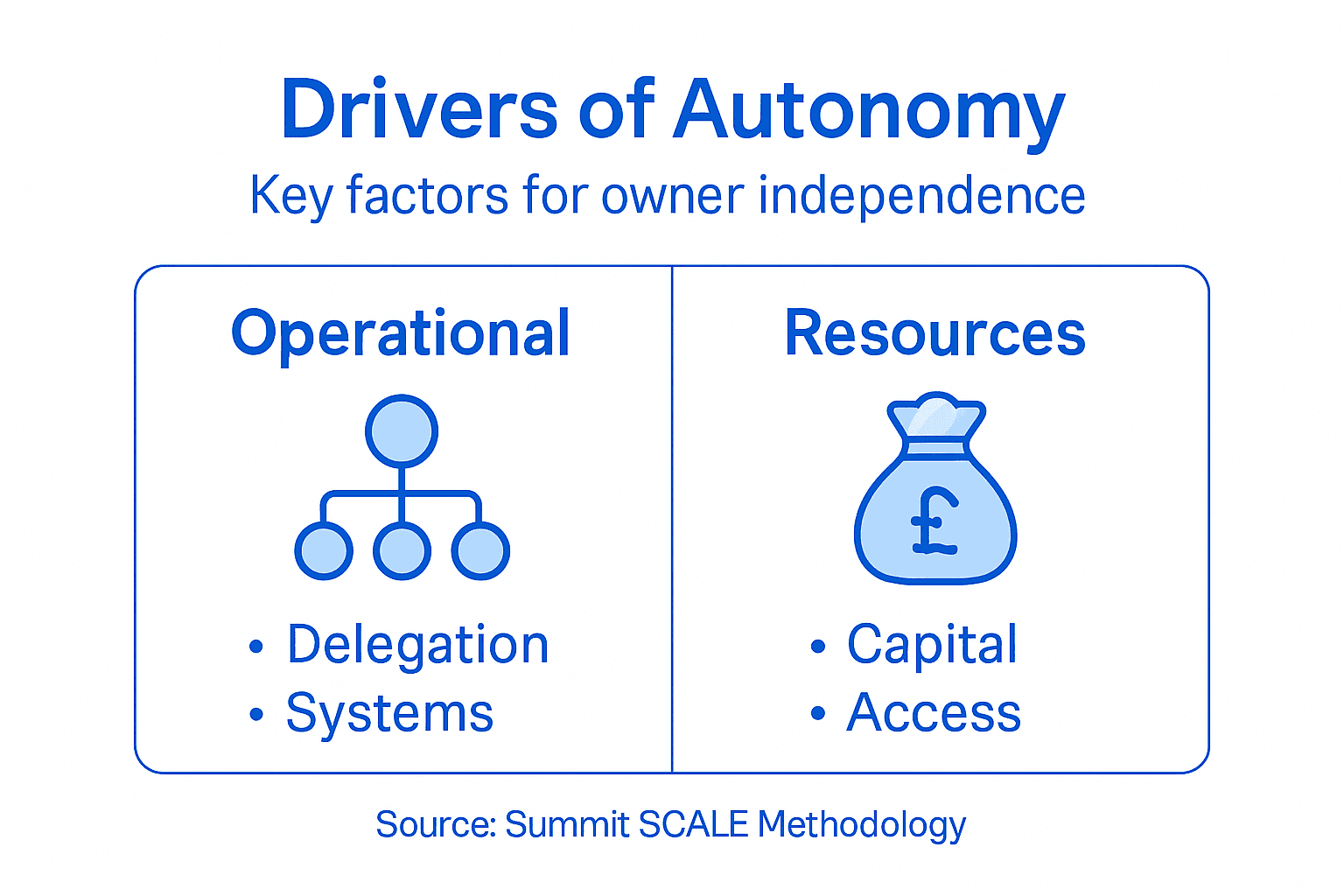
The following table summarises key drivers of operational autonomy and their impact on business freedom:
| Driver | Description | Positive Impact |
|---|---|---|
| Strategic Resource Management | Selecting which resources to control or outsource | Prevents bottlenecks, ensures focus |
| Delegation Architecture | Structuring decision rights among the team | Speeds up operations, motivates staff |
| Decision-Making Systems | Establishing clear processes for decisions | Enables independence, reduces chaos |
Pro tip: Map your top ten business decisions this week. For each one, note who currently makes it and who should make it in a truly autonomous business. The gap between those two columns is your roadmap for building operational autonomy.
Financial And Legal Implications For SMEs
Business freedom isn’t purely operational. It has real financial and legal dimensions that directly affect your ability to make autonomous decisions and control your destiny. As a small to medium-sized business owner, the regulatory environment you operate within, how you access capital, and your legal obligations shape how much freedom you actually possess. Understanding these implications helps you navigate constraints strategically rather than being blindsided by them.
The financial implications start with your regulatory framework. Strong legal institutions and reduced government intervention correlate with lower financial fragility amongst small and medium-sized businesses. This means that when your operating environment has clear rules, predictable enforcement, and genuine rule of law, your business becomes more stable. Conversely, unpredictable regulation or heavy-handed government intervention increases your financial risk. You might have operational autonomy in theory, but if regulatory changes can suddenly reshape your cost structure or compliance requirements, that autonomy is illusory. The lesson here is straightforward: understand your regulatory landscape thoroughly. Know which compliance obligations actually affect your bottom line. Identify which regulations are genuinely necessary and which create unnecessary friction. This awareness becomes the foundation for negotiating constraints rather than being crushed by them.
Capital access creates another critical tension. Government financing policies including loans and guarantees play a vital role in helping businesses grow, particularly when traditional lending is constrained. But here’s the catch: accepting external capital introduces legal obligations and compliance requirements that constrain your operational freedom. A government-backed loan might come with conditions about hiring, investment priorities, or financial reporting that limit your strategic choices. You gain capital but lose autonomy. This isn’t necessarily bad. Sometimes growth through constrained capital is better than stagnation through independence. But you need to enter these arrangements with eyes open. Ask yourself: what freedom am I trading for this capital? Can I afford it? Are there alternative financing approaches that preserve more autonomy?
The practical reality for most SMEs is balancing these forces. You need enough capital to grow, but not so much that lenders or regulators control your decisions. You need compliance frameworks to operate legitimately, but not so many that bureaucracy becomes your main business activity. The path forward involves three concrete steps: first, audit your financial health with brutal honesty, understanding where capital constraints actually limit your growth versus where they’re convenient excuses. Second, map your regulatory obligations and determine which genuinely matter versus which are legacy requirements you inherited without questioning. Third, evaluate any external capital offers against the autonomy they’ll cost. If a loan requires you to hire specific employees or invest in areas misaligned with your vision, it’s often better refused.
Pro tip: Schedule a meeting with your accountant or financial advisor this month specifically to answer one question: which financial or legal constraints are self-imposed versus genuinely external? You’ll often discover you’ve voluntarily accepted limitations you could negotiate or eliminate.
Common Obstacles And Avoidable Mistakes
The path to business freedom is littered with preventable failures. Most obstacles you’ll face aren’t unique. Thousands of owners before you have stumbled on the same rocks. The difference between those who achieve freedom and those who remain trapped often comes down to recognising these patterns early and avoiding them deliberately. Understanding common mistakes transforms them from potential disasters into learning opportunities you can sidestep entirely.
The biggest mistake is trying to do everything yourself. You tell yourself you’re being thorough or cost-conscious, but what you’re actually doing is building a business that depends entirely on you. Entrepreneurs often underestimate costs and attempt to do everything alone, which leads directly to burnout and slowed growth. This isn’t noble. It’s a path to exhaustion. When you refuse to delegate, you’re not protecting quality. You’re protecting your sense of control at the expense of your freedom. The antidote is strategic delegation paired with clear accountability. Start small. Identify one task that consumes your time but doesn’t require your expertise. Train someone. Let them own it. Track the results. This single step often transforms how owners think about their role.
Another critical mistake is inadequate financial planning. Many owners operate without truly understanding their numbers. Cash flow surprises them. Costs exceed projections. Profit margins compress. Small businesses commonly face financial constraints and skill gaps that could be mitigated with proper planning and awareness. You don’t need to become an accountant. You need to understand three core metrics: your gross margin, your operating costs, and your cash conversion cycle. These three numbers tell you whether your business is genuinely profitable or just busy. Review them monthly. Let them guide decisions about hiring, investment, and pricing. Most owners avoid their financials because they fear bad news. But bad news you ignore is worse than bad news you know. At least knowledge lets you act.
Technology underutilisation is another widespread obstacle. Owners often cling to manual processes or outdated systems because they’re familiar. But systems that work for a ten-person team don’t scale to thirty. Outdated processes become efficiency killers. The fix doesn’t require expensive enterprise software. Often it means investing in tools that automate routine work, centralise information, and reduce human error. When your team spends hours updating spreadsheets or hunting for information buried in email, that’s time stolen from meaningful work.
The most insidious mistake is misaligned strategy. Owners often build businesses based on what they think will work rather than what the market actually wants. They spend energy competing on price instead of differentiation. They market poorly or inconsistently. They chase every opportunity instead of building depth in core areas. True business freedom comes from having a focused strategy that the entire team understands and executes consistently. Not a perfect strategy. A clear one.
Pro tip: Conduct a sixty-minute audit this week. Write down your top five business challenges. For each one, ask: is this something I created through my own actions, or is it genuinely external? You’ll often find that half your obstacles are self-inflicted and within your control to fix.
Empower Your Business Freedom and Unlock True Autonomy Today
The challenges of balancing freedom from excessive control and freedom to act autonomously are real for many small and medium-sized business owners. If you find yourself overwhelmed by daily tasks, stuck in approval bottlenecks, or unsure how to delegate effectively, you are not alone. The key to true business freedom lies in building operational autonomy through strategic resource management, delegation architecture, and decision-making systems — exactly the areas where many owners struggle to find clarity and confidence.
At Summit SCALE, we specialise in guiding entrepreneurs through these critical transformations. Our tailored business coaching helps you shift from self-employment to genuine ownership, improving team capability, clarifying strategic priorities, and strengthening financial control. With our support, you will reduce bottlenecks, empower your team to act decisively, and reclaim time for what matters most in your business and life.
Ready to break free from the daily grind and accelerate your path to profitable growth and lasting autonomy?
Take the first step now by scheduling your free 15-minute assessment call at Summit SCALE. Discover personalised strategies designed to expand your business freedom and transform how you lead. Your independence and success start here.
Frequently Asked Questions
What is business freedom?
Business freedom refers to the autonomy that business owners have to operate their enterprises, make strategic decisions, and pursue growth opportunities without unnecessary interference. It involves both legal rights and practical systems that support independent operations.
What are the two types of freedom in business?
The two types of freedom in business are ‘freedom from’ and ‘freedom to’. ‘Freedom from’ is about eliminating constraints and bureaucratic obstacles, while ‘freedom to’ focuses on empowering owners and teams to make decisions and act autonomously towards achieving business goals.
How can I achieve operational autonomy in my business?
Achieving operational autonomy involves three key drivers: strategic resource management, effective delegation architecture, and robust decision-making systems. These components help structure your organisation so it can operate efficiently and independently without your constant presence.
What common mistakes do business owners make that hinder their freedom?
Common mistakes include trying to do everything themselves, inadequate financial planning, underutilising technology, and having a misaligned strategy. These issues can trap owners in daily operations and prevent them from experiencing true business freedom.

