
TL;DR:
- Most business owners underestimate the huge financial and growth impact of accountability within organizations.
- Effective accountability builds clarity, ownership, and measurable outcomes, which significantly boost profitability and engagement.
Most business owners understand that accountability matters. Few understand just how much its absence costs. Low employee engagement, driven largely by poor accountability, drains the global economy of $10 trillion every year. That is not a rounding error. It is a structural failure playing out inside businesses of every size, including yours. The role of accountability in growth goes far beyond ticking boxes or chasing people for results. It is about building a culture where clarity, ownership, and focus replace assumption, drift, and frustration. This guide shows you how.
Table of Contents
- Key takeaways
- What accountability really means for business growth
- The measurable impact of accountability on success
- Common barriers to accountability in your organisation
- How to implement accountability and drive growth
- My perspective: why accountability is the growth lever most owners ignore
- Ready to build accountability into your growth strategy?
- FAQ
Key takeaways
| Point | Details |
|---|---|
| Accountability is a financial control | Linking clear expectations to measurable outcomes directly reduces margin erosion and improves profitability. |
| Clarity beats willpower | Most accountability failures stem from ambiguity, not attitude. Define roles and outcomes precisely. |
| Culture of accountability pays | Teams with strong accountability are 50% more likely to meet or exceed performance expectations. |
| Leadership sets the tone | Manager engagement and accountability skills determine team performance far more than policies do. |
| Discipline, not punishment | Effective accountability is practised daily through coaching, feedback, and recognition — not reserved for crises. |
What accountability really means for business growth
Most people hear “accountability” and picture someone being called out for missing a target. That instinct is understandable. It is also exactly what holds businesses back.
True accountability is not enforcement. It is stewardship. The difference matters enormously. Enforcement says, “You failed. Now face consequences.” Stewardship says, “We agreed on an outcome. Let us understand what happened and what we do differently.” One builds fear. The other builds ownership.
Lack of clarity, not willpower, is the primary barrier to accountability in most organisations. When expectations are vague, people fill the gap with assumptions. Those assumptions diverge over time, and you end up with a team pulling in slightly different directions while everyone believes they are doing the right thing.
Here is what genuine accountability looks like in practice:
- Clear role expectations: Every person on your team knows precisely what they own, what success looks like, and by when.
- Measurable outcomes: Targets are specific and tied to business performance metrics, not just effort or activity.
- Regular feedback loops: Progress is reviewed consistently, not only when something goes wrong.
- Financial linkage: Ambiguity leads to margin erosion; tying accountability to your income statement makes performance visible and real.
Pro Tip: Before your next team meeting, write down one outcome you expect from each direct report. If you cannot articulate it in a single sentence, your team almost certainly cannot either.
The businesses that struggle most with accountability are rarely struggling because of bad people. They are struggling because no one has defined what “good” looks like with enough precision for anyone to aim at it.
The measurable impact of accountability on success
If you still think of accountability as a “soft” people skill, the data will change your mind.
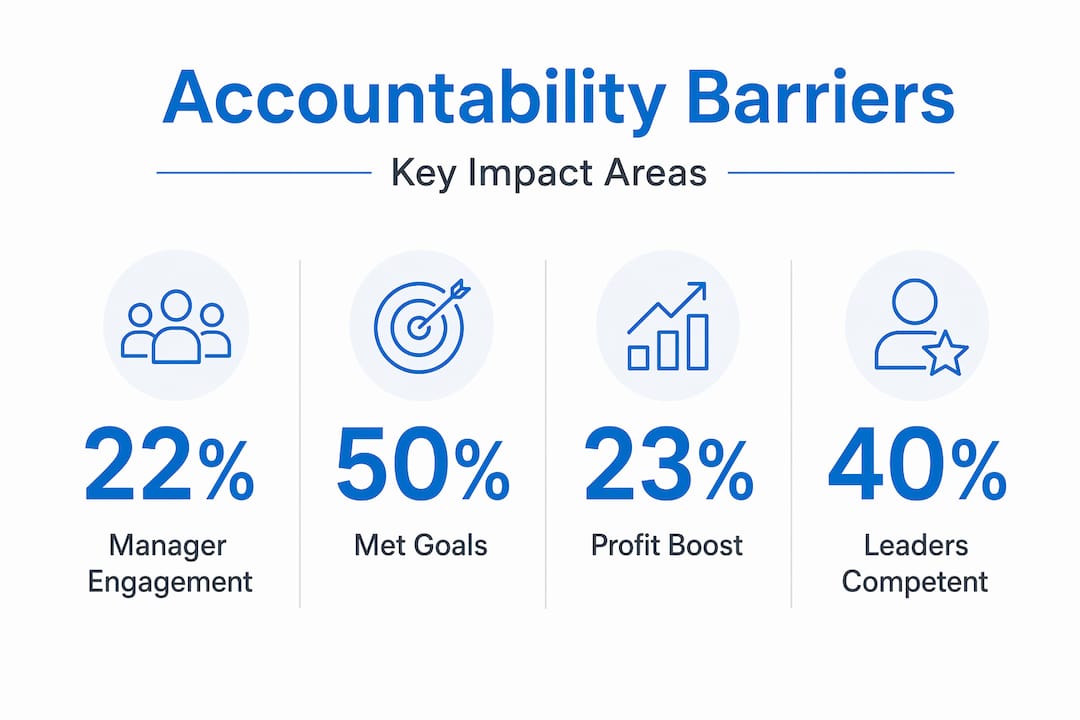
Teams with strong accountability are 50% more likely to meet or exceed expectations, and the organisations that support them report a 23% profitability premium over those that do not. These are not marginal improvements. They represent the difference between a business that scales and one that stalls.

| Accountability factor | Business outcome |
|---|---|
| High team accountability | 50% higher chance of meeting targets |
| Exceptional accountability leaders | 3x more engaged teams (51% vs. 17%) |
| Strong accountability culture | 23% profitability premium |
| Low engagement from poor accountability | $10 trillion global productivity loss annually |
The engagement data is particularly striking. Less than 40% of managers are rated as highly competent in creating accountability by their own leaders. Yet teams led by those rare exceptional leaders show engagement rates of 51%, compared to just 17% for the rest. Engagement, of course, is not just a morale metric. It drives discretionary effort, reduces turnover, and directly impacts your bottom line.
“Accountability is not about tightening the leash. It is about giving people enough clarity and confidence to run.”
The impact of accountability in personal development is equally compelling. Entrepreneurs who build accountability practices into their own routines, whether through a coach, a peer group, or structured reflection, consistently report faster progress towards their goals. How accountability drives entrepreneurial growth is a question with a clear answer: it removes the gap between intention and action.
Common barriers to accountability in your organisation
Knowing that accountability matters and actually building it into your culture are two very different challenges. Here is where most business owners get stuck.
The unspoken assumption debt
Your team is making dozens of quiet assumptions every week about priorities, decision ownership, and what “done” means. Gray work costs the average employee roughly four hours per week due to lack of clarity. Multiply that across your team and you are losing a full working day of output per person, every single week, to ambiguity that a single clear conversation could prevent.
Weak leadership communication
Manager engagement has dropped from 31% to 22% since 2022. When managers themselves feel disengaged or unclear about expectations, they cannot possibly model accountability for their teams. Accountability always flows downward from leadership. If the signal is weak at the top, it barely registers at the front line.
Confusing accountability with punishment
When accountability is reserved exclusively for corrective moments, people learn to associate it with blame. This creates a culture where people hide problems rather than surface them early. The moment your team starts concealing issues to avoid scrutiny, your ability to course-correct disappears.
Top leaders overestimating their own skills
Research shows that leaders frequently overestimate their accountability competency compared to how their managers actually rate them. This blind spot is costly. If you believe you are already doing accountability well, you stop looking for where it is breaking down.
Pro Tip: Ask three members of your team this question: “What do you believe my top priority for you is this month?” If the answers differ, you have an accountability gap worth closing immediately.
Overcoming these barriers requires a shift from reactive to proactive. Accountability is not something you reach for when performance drops. It is something you build into the rhythm of how your business operates every day.
How to implement accountability and drive growth
The good news is that building accountability does not require an expensive restructure or a new HR system. It requires disciplined leadership habits and a willingness to have clear conversations consistently.
Here is a practical framework you can start applying this week:
-
Define outcomes, not just tasks. For every key role on your team, write down three to five measurable outcomes that would tell you, unambiguously, whether that person is succeeding. Tasks are what people do. Outcomes are why they do it. Accountability attaches to outcomes.
-
Create a weekly accountability rhythm. Accountability as a regular discipline works far better than accountability as a crisis response. A 15-minute weekly check-in focused on progress, blockers, and priorities does more for performance than a quarterly review ever will.
-
Link accountability to your financial metrics. Your profit and loss statement is the clearest accountability tool you own. Linking execution to your P&L exposes where performance gaps are causing real margin loss. When your team can see the financial consequence of their output, accountability becomes concrete, not abstract.
-
Coach, do not just correct. The difference between a leader who creates accountability and one who enforces it lies in how they handle gaps. Coaching asks, “What support do you need to close this gap?” Correcting asks, “Why did you miss this?” One builds capability. The other builds resentment.
-
Recognise accountability visibly. When someone flags a problem early, delivers on a commitment, or takes ownership of a difficult outcome, name it publicly. Recognition is not just a morale tool. It signals to your entire team what behaviours you value and reward.
-
Build your team with accountability in mind. If you are scaling, the way you build your business team directly shapes whether accountability can take root. Hiring for cultural alignment, clarity of communication, and ownership mindset is as important as hiring for technical skill.
The benefits of accountability in teams compound over time. A team that operates within a clear, trust-based accountability structure becomes self-correcting. Problems surface faster. Solutions emerge collaboratively. And your role as a business owner shifts from constant firefighting to genuine strategic leadership.
My perspective: why accountability is the growth lever most owners ignore
I have worked with enough business owners to spot the pattern. The ones who say they want more growth but resist clarity conversations are the same ones whose businesses plateau year after year. Accountability feels uncomfortable because it is, at its core, a mirror. It reflects exactly where you and your team are against where you said you would be.
What I have seen consistently is this: the discomfort of that conversation is always smaller than the cost of avoiding it. One business owner I worked with had been tolerating vague targets and missed commitments for two years, convinced the problem was market conditions. Within six weeks of installing a clear weekly accountability rhythm, her team’s output increased, two persistent problem areas surfaced and were resolved, and she reclaimed almost a full day of her week that had been consumed by firefighting.
Accountability in professional growth is not just about your team. It starts with you. Are your own goals clear and measurable? Do you have someone holding you to them? The most disciplined entrepreneurs I know do not rely on willpower. They rely on structure. Accountability is that structure.
Creating a culture of accountability is not a one-time project. It is a leadership posture you hold every single day. The businesses that do it well do not just grow faster. They grow in a way that lasts.
— Shane
Ready to build accountability into your growth strategy?
If this article has made you realise that accountability could be doing more heavy lifting in your business, you are not alone. Most business owners know the gap exists. What they need is a structured way to close it.

At Summitscale, we work with small and medium-sized business owners to build accountability frameworks that connect directly to growth, profitability, and personal freedom. Whether you are trying to get more from your team, reclaim your own time, or finally hit targets that have been slipping for too long, coaching gives you the clarity and the structure to make it happen. Discover why investing in coaching is one of the highest-return decisions a business owner can make. You can also explore how coaching supports SMEs in building the accountability systems that scale.
Book your free 15-minute assessment call today and find out exactly what is holding your growth back.
FAQ
What is the role of accountability in growth?
Accountability creates the clarity, ownership, and follow-through that turn goals into results. Without it, ambiguity erodes performance and profitability over time.
How does accountability drive business results?
Teams with strong accountability are 50% more likely to meet targets and their organisations report a 23% profitability premium. The effect is measurable and consistent.
Why do most leaders struggle with accountability?
Fewer than 40% of managers are rated highly competent in accountability by their own leaders. The most common reason is insufficient clarity around expectations, not lack of effort.
How can I create a culture of accountability in my team?
Start by defining measurable outcomes for every key role, building a weekly check-in rhythm, and recognising ownership behaviours publicly. Accountability must be practised daily, not reserved for corrective moments.
What is the cost of poor accountability?
Unclear expectations cost the average employee approximately four hours per week in wasted effort. Across an organisation, weak accountability contributes to the $10 trillion annual global productivity loss driven by low engagement.

