
TL;DR:
- Most business owners lack a clear system to drive consistent sales growth and often react rather than plan. Implementing a step-by-step growth plan with measurable goals and detailed ownership ensures sustainable progress. Focusing on cycle optimization, retention, and targeted diagnostics accelerates revenue generation effectively.
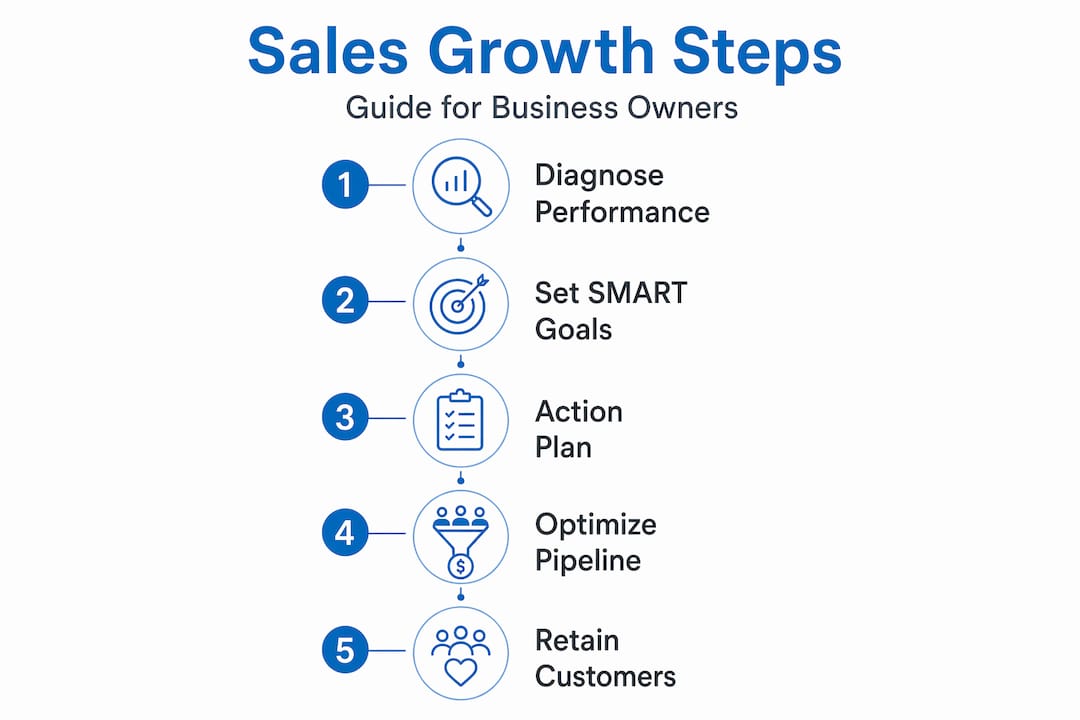
Most business owners want more sales but don’t have a clear system to make it happen consistently. Without a structured approach, you end up reacting to results rather than driving them. A proper step by step sales growth plan changes that. It gives you clarity on where you are, where you’re going, and exactly what needs to happen to close the gap. This article walks you through the precise steps to measure, plan, execute, and retain your way to real, sustainable growth.
Table of Contents
- Key takeaways
- Measuring and diagnosing current sales performance
- Setting clear SMART sales goals
- Building an action plan with ownership and timelines
- Optimising your sales pipeline for faster growth
- Leveraging retention and expansion for multiplied growth
- My honest take on what actually drives sales growth
- Ready to put this into practice?
- FAQ
Key takeaways
| Point | Details |
|---|---|
| Measure before you act | Calculate MoM, QoQ, and YoY growth rates to understand your true baseline before making any changes. |
| Set SMART goals with teeth | Sales targets only drive results when they are specific, time-bound, and tied to daily team actions. |
| Own every pipeline stage | Track conversion rates and dwell times at each stage to find and fix the leaks costing you revenue. |
| Retention multiplies growth | An NRR above 100% means your existing customers grow your revenue without you spending on acquisition. |
| Assign ownership to every action | Every improvement task needs a named owner and a deadline, or it simply won’t happen. |
Measuring and diagnosing current sales performance
You cannot fix what you haven’t clearly defined. Before you build a sales success roadmap, you need an honest picture of where your numbers actually stand. That starts with calculating your sales growth rate correctly.
The formula is straightforward. Sales growth rate measures the percentage change in revenue between two periods. For example, if your revenue was £450,000 last quarter and is £495,000 this quarter, your growth rate is (£495,000 minus £450,000) divided by £450,000, multiplied by 100. That gives you 10% quarter-on-quarter growth.
Choosing the right time horizon
Each measurement window tells a different story. Month-on-month (MoM) growth shows momentum and reacts quickly to changes in activity or market conditions. Quarter-on-quarter (QoQ) growth smooths out short-term noise and aligns well with planning cycles. Year-on-year (YoY) growth is the most reliable for spotting genuine trends because it removes seasonal distortion.
Most business owners only look at one horizon. That’s a mistake. A strong MoM figure can mask a declining YoY trend, and vice versa. Use all three together and they tell a much richer story.
| Metric | Best for | Watch out for |
|---|---|---|
| MoM growth | Spotting early momentum shifts | Seasonal spikes can mislead |
| QoQ growth | Quarterly planning and reviews | One strong month can inflate the figure |
| YoY growth | Identifying long-term direction | Masks short-term problems |
Pro Tip: Set up a simple dashboard in your CRM that pulls all three growth rates automatically. Staring at a spreadsheet once a month is not the same as seeing live trends every week.
Once you know your growth rate, dig into the pipeline itself. High pipeline value does not guarantee revenue if cycle velocity drops. Look at stage-to-stage conversion rates. Where are deals stalling? Where are prospects going quiet? These are your bottlenecks, and fixing them is where real stepwise sales improvement begins. A practical guide to diagnosing these issues is covered in the sales growth checklist Summitscale provides for SMB owners.
Setting clear SMART sales goals
Diagnosis without direction is just worry with data. Once you know your gaps, you need goals that give your team something concrete to aim for. SMART goals are the standard because they work. Here is what each element actually means in practice:
- Specific: “Increase close rate” is not a goal. “Increase close rate from 22% to 30% on qualified leads” is.
- Measurable: Every goal needs a number attached. If you can’t measure it, you can’t manage it.
- Achievable: A target that stretches your team is motivating. A target that feels impossible is demoralising. Know the difference.
- Relevant: Goals must connect to your broader business objectives. Chasing volume when your margin is too thin just creates busier losses.
- Time-bound: A deadline creates urgency. “By end of Q3” beats “soon” every time.
Setting SMART goals and translating them into structured actions with clear ownership is one of the most reliable ways to move from hope-based selling to a repeatable system.
Align your goals with your revenue metrics. If you track Annual Recurring Revenue (ARR), your sales goals should directly connect to ARR attainment. If quota is your main metric, individual targets should cascade clearly from the overall number. When team members can see exactly how their personal performance connects to the company goal, motivation becomes much less of a management problem.
Pro Tip: Cascade every sales goal to individual level. When your team member knows their specific target contributes to the company’s overall ARR goal, accountability becomes built-in rather than enforced.
Building an action plan with ownership and timelines
Goals are the destination. An action plan is the vehicle. This is the part most business owners rush through, and it’s where most growth strategies quietly collapse.
Break every goal into specific tasks. Each task needs three things attached to it: a clear action, a named owner, and a deadline. Without all three, the task exists in a grey area where everyone assumes someone else is handling it.
Here is a practical numbered structure you can use right now:
- Identify the top three pipeline bottlenecks from your diagnostic (see Section 1). Assign one owner to each bottleneck.
- Design a specific intervention for each bottleneck. If your discovery calls are weak, schedule objection handling training for the team. If proposals are stalling, standardise your proposal template and approval process.
- Choose your sales enablement tools. A CRM is non-negotiable. Beyond that, consider tools for call recording, proposal tracking, and rep coaching. Technology should support your process, not replace the thinking behind it.
- Schedule weekly review meetings. Not to read out numbers, but to discuss what is working, what isn’t, and what needs to change. These meetings are your feedback loop, and aligning sales goals, process clarity, and coaching mindset is what creates repeatable success rather than sporadic wins.
- Build a 90-day sprint. A full year plan is too abstract. Break your goals into 90-day blocks with specific milestones. Review and adjust at the end of each block.
The step by step business growth guide from Summitscale goes deeper on how to structure these 90-day plans for profitable scaling.
Optimising your sales pipeline for faster growth
Once your action plan is live, the next lever is making your existing pipeline move faster. Sales cycle optimisation increases revenue faster than adding more pipeline because it compounds. A shorter cycle means each deal costs you less time, and your team can handle more opportunities with the same resources.

Start by tracking pipeline velocity. This is the rate at which deals move through your stages. Then break your cycle down by stage and look at average dwell times. Which stage takes the longest? That is your primary bottleneck. Frontify, for example, reduced their sales cycle by 31% by improving discovery and using multi-threading to engage all buying committee members early. The revenue impact was significant, without adding a single new lead to the pipeline.
Shortening the cycle practically
For B2B businesses, compressing proofs of concept to 14 to 30 days with defined success criteria and weekly check-ins can dramatically reduce qualification time and improve deal flow. This is not about rushing your buyer. It is about removing the friction and delay that benefits nobody.
Top performers also use sales intelligence to time proposals to active buying windows rather than sending them on a fixed schedule. A proposal that lands when the buyer is mid-conversation with their finance team converts at a very different rate than the same proposal sent on day seven of your standard follow-up cadence.
Pro Tip: Run a strategy mismatch audit every quarter. Map your top three sales activities and score them against your actual goals. If your team is spending the most time on low-conversion activity, that contradiction is silently killing your growth.
Removing these contradictions is central to aligning strategy with execution, which research shows is one of the most overlooked causes of stalled growth in SMBs.
Leveraging retention and expansion for multiplied growth
Here is the truth that most guide to sales growth content ignores. Acquiring new customers is expensive. Keeping and growing existing ones is where the compounding begins.
Net Revenue Retention (NRR) is the metric that reveals this most clearly. NRR above 100% means your existing customer base is expanding faster than it is churning. Every percentage point above 100 is pure growth with no acquisition cost attached. One example: a SaaS business called CloudSync reached 115% NRR after focusing on expansion revenue and tightening their renewal process.
To build NRR into your growth engine, focus on these four areas:
- Onboarding and activation: Customers who see value quickly stay longer and buy more. Map your first 30 days post-sale and remove any friction that slows down their first win.
- Expansion playbooks: Define the triggers that indicate a customer is ready to upgrade or expand. Don’t wait for them to ask. Build a proactive process.
- Pricing model alignment: Growth plans should focus on levers: price, volume, acquisition, and retention. Make sure your pricing model rewards growth rather than penalising it.
- Health scoring and early warning systems: Track engagement, usage, and satisfaction signals. A customer who stops logging in, stops responding, or raises repeated service issues is signalling churn weeks before it happens. Catch it early and act.
Retention is not a customer success function that sits separate from your sales strategy. It is a primary growth engine, not a side metric. Treat it that way and your incremental sales strategies will compound rather than leak.
My honest take on what actually drives sales growth
I’ve worked with enough business owners to know that the biggest barrier to step by step sales growth is not a lack of tactics. It’s a lack of clarity on what to fix first. Most people I speak with have tried more lead generation, more reps, more tools. What they haven’t tried is turning the mirror around and asking, “Where exactly is our system breaking down?”
In my experience, diagnosing bottlenecks beats throwing more resources at the pipeline every single time. When you reduce cycle length, the effect compounds across every deal in your pipeline simultaneously. That is faster and cheaper than filling the top of the funnel with leads that will stall at the same broken stage anyway.
The other thing I’ve seen make a real difference is the link between SMART goals and daily habits. A goal on a slide deck is not a goal. A goal that is visible, owned, and reviewed weekly becomes a different thing entirely. It becomes a commitment, and commitment creates momentum.
I’d also encourage you to stop treating retention as someone else’s problem. NRR is the most honest reflection of whether your product and service are actually delivering value. If it’s below 100%, your growth strategy has a hole in the bottom. Fix that before you pour more resource into acquisition.
The sales growth tips for executives on the Summitscale site go into further detail on this compounding approach for 2026.
— Shane
Ready to put this into practice?
Growing your sales consistently requires more than a plan on paper. It requires accountability, honest diagnosis, and someone who can help you see the blind spots your team is too close to notice.
At Summitscale, the performance coaching programme is built specifically for business owners and managers who want to move from inconsistent results to a repeatable growth system. Whether you need help measuring your pipeline correctly, building your SMART goal framework, or creating an expansion strategy that multiplies your revenue from existing clients, coaching turns strategy into action. Explore coaching for SMEs or book a free 15-minute assessment call to find out exactly where your biggest opportunity lies.
FAQ
What is the formula for calculating sales growth rate?
Sales growth rate is calculated as: (Current Period Revenue minus Previous Period Revenue) divided by Previous Period Revenue, multiplied by 100. For example, revenue rising from £450,000 to £495,000 gives a 10% growth rate.
How do SMART goals improve sales performance?
SMART goals give your team a specific, measurable target with a clear deadline, which turns vague ambition into structured daily action. When goals cascade to individual level, accountability becomes a natural part of the process rather than a management burden.
What is Net Revenue Retention and why does it matter?
NRR measures whether your existing customer base is growing or shrinking in revenue terms. An NRR above 100% means expansions and upsells exceed churn, making retention one of the most cost-effective growth levers available to any business.
How can I shorten my sales cycle without pressuring buyers?
Focus on removing friction rather than rushing the process. Compress proofs of concept to clear 14 to 30-day windows with defined success criteria, engage all buying committee members early, and time proposals to active decision-making periods.
What is the first step in a sales improvement plan?
The first step is always diagnosis. Calculate your growth rate across MoM, QoQ, and YoY horizons, then map your pipeline stage by stage to identify where deals are stalling before you attempt any changes to your sales process.

