
TL;DR:
- Effective team building requires continuous effort focused on psychological safety and clear goals.
- Measuring impact through performance metrics and regular feedback ensures sustainable improvements.
- Small consistent behaviors and strong leadership are more impactful than one-off activities.
You have assembled talented, motivated people, yet somehow the results still disappoint. Deadlines slip, communication breaks down, and you sense that your team is working beside each other rather than truly together. The frustration is real, and it is far more common than most business owners admit. What separates high-performing teams from merely adequate ones is rarely about individual talent. Google’s research confirms that how a team works together matters far more than who is on the team. This guide gives you practical, evidence-backed steps to build exactly that kind of team.
Table of Contents
- What effective team building really means for business
- Preparation: how to design a team building programme that works
- Step-by-step: running team building for lasting impact
- How to measure success and embed continuous improvement
- Why most team building fails (and what really works for small businesses)
- Accelerate team results with expert support
- Frequently asked questions
Key Takeaways
| Point | Details |
|---|---|
| Psychological safety first | Teams thrive when members feel safe to share ideas and take risks together. |
| Preparation drives outcomes | Thoughtful planning and transparency make team building inclusive and effective. |
| Sustain with follow-through | The real value of team building comes from ongoing practices, not single events. |
| Measure and adapt | Track outcomes with feedback and performance data to improve each cycle. |
What effective team building really means for business
With the stakes and opportunity clear, let us define what team building really should look like in a successful business context.
Most business owners picture team building as a one-day workshop or a fun day out. Perhaps axe-throwing or a cooking class. Those experiences have their place, but they rarely shift behaviour back at the office. Taggd.in argues that most team building failures stem from a “one and done” approach, where a single event produces a short burst of goodwill before old patterns return within weeks. Effective team building is a continuous, structured practice woven into how your business actually operates every day.
Google’s Project Aristotle identified five pillars that reliably predict team success. Understanding them gives you a map, not just a mood:
| Pillar | What it means in practice |
|---|---|
| Psychological safety | People feel safe to speak up, take risks, and admit mistakes without fear |
| Dependability | Team members follow through on commitments reliably |
| Structure and clarity | Roles, goals, and processes are clearly defined |
| Meaning | Work feels personally significant to each individual |
| Impact | The team can see how their work makes a real difference |
Google’s re:Work guide places psychological safety at the top of this list, noting it as the single biggest differentiator between high-performing and average teams. Understanding this helps you see that team culture and profit are not separate conversations. They are the same one.
Common myths that hold managers back:
- Team building is a reward, not a strategy
- Fun activities automatically create trust
- A single event is enough to fix communication problems
- Only underperforming teams need structured team building
- Team building is the HR department’s job, not the leader’s
Continuous effort is what separates good intentions from real change. When you anchor team development to your business goals, review it regularly, and follow up deliberately, you build a team that improves with time rather than drifts back to old habits.
Pro Tip: Before planning any team activity, write down the specific business outcome you want to improve. Fewer missed deadlines? Better cross-department communication? Tie every team building effort to a real operational goal, and your results will speak for themselves.
Explore proven team-building steps that go well beyond one-off events and have been tested with real SMB teams.
Preparation: how to design a team building programme that works
Understanding what is effective sets the stage. Now discover how to lay the right groundwork for your own team building programme.

Good preparation is the difference between a team building experience that creates lasting change and one that costs money without moving the needle. Start by getting brutally honest about the specific problem you are trying to solve. Is trust low because of a recent restructure? Is collaboration breaking down between departments? Is onboarding leaving new people feeling isolated? Your answer shapes everything that follows.
Essential preparation checklist:
- Define a single, specific outcome you want to achieve
- Survey your team to understand their needs and concerns
- Identify any physical, religious, dietary, or personal requirements that need accommodation
- Set a clear budget and realistic time frame
- Choose a facilitation style that matches your team’s personality
- Communicate the purpose honestly before the event, not just the logistics
- Build opt-outs and alternatives into the programme design
- Confirm that any external facilitators understand your business context
Transparency matters more than you might expect. When employees understand why they are doing something, they engage far more meaningfully. A group that arrives knowing the event is designed to improve project handovers will focus their attention very differently to one that thinks it is just a social occasion.
Important: Team-building activities carry legal risk if they involve physical demands, activities that do not adequately accommodate disabilities, pregnancy, or other protected conditions, or if attendance is treated as compulsory in a way that creates wage and hour exposure. Before finalising your programme design, review your activities against your legal obligations and consult with an employment specialist if in doubt.
Safety and inclusion are not bureaucratic add-ons. They are part of what makes a team building experience genuinely respectful and effective. An employee who feels excluded or pressured is not going to build trust through the activity. They are going to build resentment instead.
When scoping your team building activities, look for formats that are genuinely adaptable, focus on collaboration rather than competition, and allow quieter personalities to contribute alongside more dominant voices.
Pro Tip: Send a short, anonymous pre-programme survey asking three questions: What would you most like to improve about how we work together? Is there anything you need us to accommodate? What type of activities energise you at work? The answers will save you from costly missteps and show your team you take their input seriously.
Your leadership coaching process matters here too. If your leadership approach is still developing, now is the ideal moment to reflect on how your own style is shaping the team’s readiness to engage.
Step-by-step: running team building for lasting impact
With thoughtful preparation, you can now deliver a team building experience. Here is how to get it right and sustain the results.
Execution is where most programmes either create genuine momentum or quietly fizzle. Follow this sequence to give your effort the best possible foundation for lasting change.
-
Launch with purpose and clarity. Open with a clear, honest statement of why you are here and what you hope the team will gain. Connect the activity to a real business challenge. People engage when they understand the relevance.
-
Model psychological safety yourself. Share a mistake you made, a lesson you learned the hard way, or a challenge you are currently navigating. When leaders show vulnerability, they give permission to everyone else to do the same. This is not weakness. It is the fastest way to build trust in a room.
-
Delegate ownership to capable people. Inc.’s leadership research consistently shows that giving capable team members genuine autonomy combined with clear expectations and aligned values produces far better results than micromanagement. Assign meaningful roles within the programme itself, not just in daily operations.
-
Facilitate, do not dictate. Your role as a manager during team building is to create the conditions for connection and honest dialogue, not to control every outcome. Ask open questions. Let silence do some work. Resist the urge to rescue every uncomfortable moment.
-
Debrief and track commitment. End every team building session with a structured debrief. Ask: What did we learn? What are we committing to change? Who is accountable for what? Write it down and revisit it within two weeks. This step alone separates teams that improve from teams that simply had an enjoyable afternoon.
Here is how surface-level activities compare to strategic programmes when you look at what actually counts:
| Factor | Surface-level activity | Strategic programme |
|---|---|---|
| Duration of impact | Days to weeks | Months to years |
| Transfer to daily work | Low | High |
| Inclusivity | Often inconsistent | Deliberately designed |
| Connection to business goals | Weak or absent | Explicitly linked |
| Measurement | Satisfaction score only | Performance metrics |
| Leadership involvement | Passive observer | Active participant |
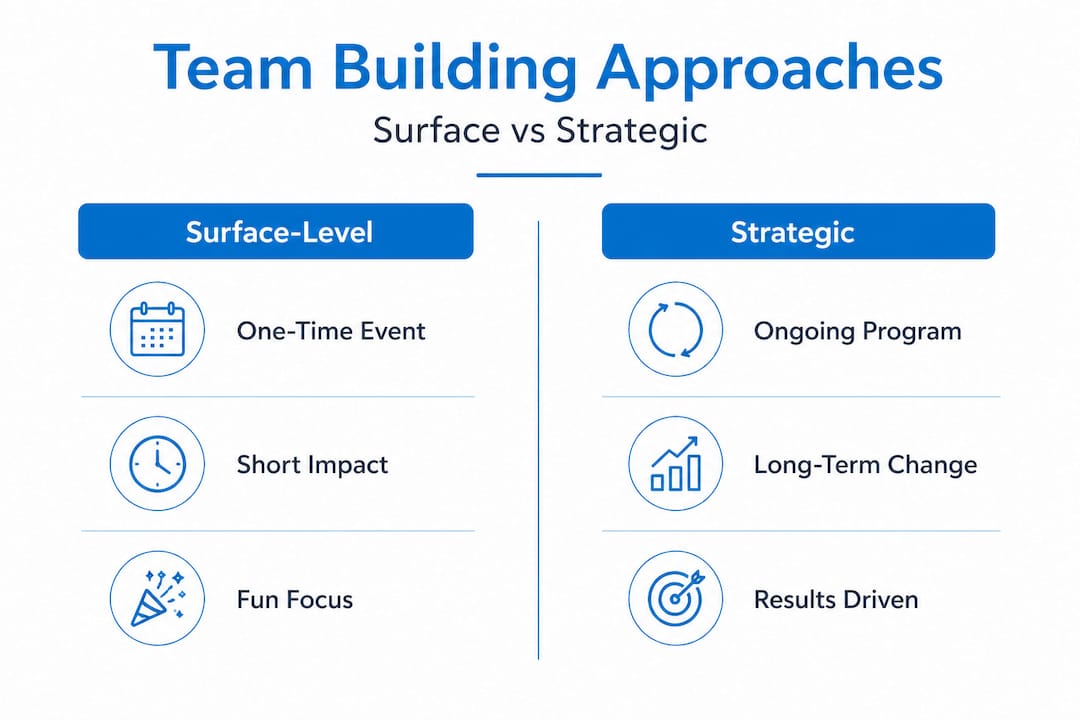
Your coaching skills as a leader are the single biggest variable in this table. Leaders who ask better questions, listen actively, and follow through on commitments will extract far more value from any team building investment than leaders who attend but do not truly participate.
Building a consistent leadership coaching workflow into your business rhythm gives you the infrastructure to make these outcomes stick well beyond any single event.
How to measure success and embed continuous improvement
Now that your team building efforts are in motion, the final step is to make sure progress is not lost. Here is how to measure and improve.
Feeling good after a team event is not the same as measuring impact. Satisfaction surveys have their place, but they tell you whether people enjoyed themselves, not whether your business has actually improved. You need a broader picture.
SmallBizTrends advises tracking team building impact through employee feedback combined with hard performance metrics, going well beyond simple satisfaction scores. Google’s Aristotle research reinforces this, showing that how teams work together has measurable consequences for business outcomes, not just morale.
Here is a practical before-and-after tracking framework:
| Metric | Before | After (90 days) |
|---|---|---|
| Team engagement score | Baseline survey | Repeat survey |
| Project delivery on time | % measured | % measured |
| Internal escalations or complaints | Number logged | Number logged |
| Cross-team collaboration frequency | Observed or surveyed | Observed or surveyed |
| Staff retention rate | % over prior 6 months | % over next 6 months |
| Customer satisfaction (where relevant) | Score or rating | Score or rating |
Common improvement levers to watch for:
- Shifts in attitude: are people more willing to raise problems early rather than hide them?
- Trust indicators: do team members cover for each other, seek each other’s input, and acknowledge contributions openly?
- Performance consistency: have outages, errors, or miscommunications reduced in frequency or severity?
- Meeting quality: are discussions more focused, decisions clearer, and follow-through more reliable?
Set a 90-day review point after any meaningful team building initiative. This gives change enough time to take root without losing momentum. If your metrics are moving in the right direction, build on that momentum. If they are not, that is equally valuable information. It tells you the root problem was different from what you originally diagnosed, and you can adjust your approach accordingly.
Connecting these gains to SMB profitability drivers helps you make the case internally for sustained investment in team development. When your leadership team can see that better collaboration reduces rework, speeds decisions, and retains your best people, team building stops being a “nice to have” and becomes a strategic line item.
Why most team building fails (and what really works for small businesses)
With measurement and iteration established, it is worth stepping back for an honest look at what really moves the needle for small and mid-sized teams.
Here is the uncomfortable truth that most team building providers will not tell you. The away-day, the trust fall, the ropes course — none of these will fix a team whose leader is unclear, inconsistent, or unavailable. Expensive events are often a way of avoiding a harder conversation about leadership and operating culture. For SMBs in particular, where budgets are lean and time is precious, this is a costly distraction.
What actually works is far less glamorous but far more effective. It is the Monday morning standup where the leader actually listens. It is the quick peer recognition at the end of a tough week. It is the clear agenda and reliable follow-through on action items. These small, repeated behaviours build the operating rhythm that creates psychological safety over time, not a single afternoon of team activities.
The most resilient small business teams we see are not those that had the best team building event last year. They are the ones where transparency is a daily habit, where people feel their voice counts in regular conversations, and where leadership models the behaviour it expects. Building team culture is not a programme you run once a year. It is something you practise every single week.
Pro Tip: Replace one large annual event with four quarterly check-ins built into your operational calendar. Keep each one focused on a single theme, such as communication, accountability, recognition, or decision-making. The cumulative effect will outperform any one-off event by a significant margin.
The businesses that thrive long-term treat team building as part of their operating system, not a side project they squeeze in when things go wrong.
Accelerate team results with expert support
If you are ready to accelerate business results and boost team engagement, consider taking the next step with proven coaching support.
Reading about team building is a strong start. Implementing it consistently, especially while running a business, is where most managers find they need a sounding board. At Summit SCALE, we work directly with SMB owners and managers to turn team-building principles into operational reality, not theory.
Understanding why investing in coaching pays dividends helps you make a confident decision. Whether you are building your first structured team development plan or looking to reset a team that has lost its way, our coaching approach meets you where you are. Explore the role of coaching for SMEs and discover how structured guidance accelerates results that feel out of reach alone. You can also explore how mentorship supports growth and dramatically improves your chances of building a business that truly performs. Book your free 15-minute assessment call today and take the first step towards a team that delivers.
Frequently asked questions
What is psychological safety and why does it matter for teams?
Psychological safety means team members feel safe to take risks, speak up, and admit mistakes without fear of embarrassment or punishment. Google’s re:Work research identifies it as the single most important driver of team effectiveness across all five pillars studied.
How do I make sure my team building event is legally compliant?
Ensure all activities are genuinely voluntary, publish physical requirements in advance, provide reasonable accommodations, and allow easy opt-outs. Legal risks arise when activities are physically demanding or fail to accommodate protected conditions such as disability or pregnancy.
How can I measure the impact of a team building programme?
Gather qualitative employee feedback and track objective metrics such as engagement scores, delivery rates, and staff retention before and after the programme. SmallBizTrends recommends going beyond satisfaction surveys to capture real performance data.
What if some employees do not want to participate?
Participation should always be voluntary. Build opt-outs and genuine alternatives into your plan from the start so that inclusion is a design feature, not a last-minute fix. Constangy’s guidance confirms that compulsory attendance without proper accommodation creates significant legal exposure for employers.
Recommended
- 7 Key Benefits of Coaching for Entrepreneurs
- Build a business team for growth in 2026: proven steps
- 7 Key Benefits of Professional Coaching for Business Owners
- 6 Powerful Benefits of Leadership Coaching for Business Owners
- Teambuilding – Kā uzlabot sadarbību ar izpletņu lēcieniem – Skydive Latvia
- Corporate event entertainment for memorable experiences

