
TL;DR:
- Sales growth is essential for business survival and long-term resilience.
- Balancing growth with profitability avoids cash flow issues and operational chaos.
- Steady, sustainable expansion relies on disciplined strategies like retention, pricing, and AI tools.
Profitability feels like the ultimate goal. You check your margins, watch your costs, and feel a quiet confidence when the numbers look healthy. But here is the uncomfortable truth: profit alone cannot save a business that stops growing. Sales growth is critical for covering operational costs, attracting the talent you need, and giving your business the resilience to compete against rivals with far bigger budgets. This guide unpacks why sales growth is the engine beneath every sustainable SMB, how to balance it with profitability, what benchmarks actually mean for your business, and the strategies that can get you moving in the right direction.
Table of Contents
- What makes sales growth critical for business survival?
- Sales growth versus profitability: Why balance matters
- Benchmarks: How much sales growth is ideal for SMBs?
- Winning strategies: How to drive sustainable sales growth
- Why most SMBs misunderstand sales growth
- Unlock sustainable sales growth with expert support
- Frequently asked questions
Key Takeaways
| Point | Details |
|---|---|
| Sales growth powers survival | Without steady sales growth, covering operating costs and enabling expansion is impossible for most SMBs. |
| Balance growth with profitability | The most resilient businesses combine consistent sales growth with disciplined profit focus. |
| Set informed growth targets | Aim for realistic annual percentage increases based on industry benchmarks, not hype or wishful thinking. |
| Leverage proven strategies | Tactics like customer retention, price management, and AI tools reliably drive sustainable sales growth. |
What makes sales growth critical for business survival?
Think of your business as a living thing. It needs fuel to function, and that fuel is revenue. Without consistent sales growth, even a “profitable” business can find itself slowly shrinking, unable to absorb rising costs or fund the next stage of development. Growth is not just about ambition. It is about survival.
Sales growth supports survival by funding costs, attracting skilled talent, and opening expansion paths that simply are not available to stagnant businesses. When your sales grow, you can afford better people, better tools, and better processes. When they flatline, you are constantly choosing between essentials.
Consider these critical reasons why sales growth matters beyond the profit column:
- Cost coverage and liquidity: Rising rents, wages, and supplier costs are constants. Growth ensures revenue keeps pace.
- Talent attraction: Top performers want to join businesses that are going somewhere. Growth signals opportunity.
- Strategic investment: New markets, technology, and product lines all require capital that only consistent growth can reliably generate.
- Resilience during downturns: A business with growing revenues has more buffer when the economy contracts.
- Long-term planning credibility: Lenders, investors, and partners all respond to upward trajectories.
The data paints a telling picture. Only 65% of SMBs were profitable in 2022, with average revenue sitting at £633,825, down 15% from the prior year. That drop underlines how fragile profitability is without the underpinning of consistent growth.
| Business state | Risk level | Growth dependency |
|---|---|---|
| Profitable, no growth | High | Revenue plateau risk |
| Growing, low profit | Medium | Cash flow pressure |
| Profitable and growing | Low | Sustainable trajectory |
| Neither | Critical | Business failure risk |
“A business that is not growing is slowly retreating. Sales growth is not optional for long-term survival — it is the foundation everything else is built upon.”
Building lasting business success starts with accepting that growth and profit must work together, not in competition. Once you see sales growth as infrastructure rather than ambition, your entire strategy shifts.
Sales growth versus profitability: Why balance matters
Now that we have separated sales growth from mere survival, it is crucial to explore how growth and profitability interact for SMBs across the US.

Most business owners fall into one of two camps. Either they chase revenue at all costs, or they guard margins so tightly that growth stalls. Neither extreme works. Pure sales growth without profit focus can leave you cash-poor despite strong revenues. Conversely, a profit-centric model that neglects sales development can quietly stagnate until a competitor or market shift exposes the weakness.
The research is striking. Companies prioritising profit over growth are 2.5 times more likely to become high-growth businesses. This does not mean ignoring sales targets. It means building a model where every growth action is assessed for its margin impact.
| Focus | Short-term outcome | Long-term risk |
|---|---|---|
| Growth only | Revenue spike | Cash flow crises |
| Profit only | Strong margins | Market share loss |
| Balanced approach | Steady, sustainable gains | Compounding advantage |
Healthy SMBs combine steady growth with tight margin control. They ask two questions simultaneously: “How do we grow revenue?” and “How do we keep this growth profitable?” Both answers must satisfy before a strategy moves forward.
Pro Tip: Review your gross margin every quarter alongside your revenue growth rate. If margin is shrinking as revenue rises, your growth is costing you more than it is earning. Adjust pricing, reduce acquisition costs, or improve delivery efficiency before scaling further.
When you align profitability and growth as twin objectives rather than opposing forces, you stop making decisions that optimise for one at the expense of the other. That clarity alone is a competitive advantage most SMBs never develop.
Benchmarks: How much sales growth is ideal for SMBs?
With the balance understood, how do you measure your sales growth ambitions against real-world SMB benchmarks? The answer depends heavily on your industry, your stage of development, and your business model.
Well-established SMBs aim for 5 to 10% annual growth, while tech startups often target 50% or more, and green energy businesses average around 15.06%. These are not arbitrary numbers. They reflect the competitive intensity, capital requirements, and market maturity of each sector.
| Business type | Ideal annual growth rate |
|---|---|
| Established SMB (most sectors) | 5 to 10% |
| Tech startup | 50%+ |
| Green energy | ~15% |
| Direct/in-person sales model | 20%+ (top performers) |
Here is what makes benchmarking genuinely useful:
- Industry context: A 7% growth rate in a mature manufacturing sector is excellent. The same rate in a fast-moving tech niche might signal underperformance.
- Business model impact: Direct and in-person sales models consistently drive accelerating sales growth, with over 37% of top-performing SMBs in this model hitting 20% year-on-year growth.
- Stage of development: Early-stage businesses need higher growth to establish market presence. Mature businesses focus on compounding smaller gains.
- Revenue base: Growing from $200,000 to $220,000 is a 10% gain. Growing from $2,000,000 to $2,200,000 is also 10%, but the absolute increase funds a very different level of investment.
Key stat: Direct sales-led SMBs outperform digital-only models in year-on-year growth rates, highlighting the enduring power of relationship-based selling.
Using benchmarks to set goals shifts you from guessing to planning. Explore proven sales growth strategies built around these benchmarks to find the right target for your stage, sector, and ambitions.
Winning strategies: How to drive sustainable sales growth
Now that you know what growth targets look like, which strategies will get you there without sacrificing sustainability?
Retention and expansion, pricing levers, AI tools, and direct sales channels consistently drive above-average growth for SMBs. These are not trends. They are proven levers that high-performing businesses pull deliberately.
-
Adjust your price, volume, and acquisition levers. Most SMBs undercharge. A 5% price increase, applied to your existing customer base, can deliver significant revenue gains without adding a single new client. Review your pricing annually against market rates and your value delivery.
-
Use AI and digital tools to sharpen prospecting. Platforms that automate lead scoring, follow-up sequencing, and pipeline management free your sales team to focus on closing. Even enterprise-level sales tools are now accessible to SMBs at scalable price points. This levels a playing field that was once tilted toward big-budget competitors.
-
Invest in customer retention as a growth strategy. Acquiring a new customer costs significantly more than retaining an existing one. Build loyalty programmes, automate check-ins, and create upsell pathways that expand the value of every relationship you already have.
-
Develop repeatable sales playbooks. When your best salesperson leaves, what happens to their process? Documenting successful sales conversations, objection responses, and closing techniques creates institutional knowledge that survives staff changes and accelerates onboarding.
Pro Tip: Track your Net Revenue Retention (NRR) rate, which measures how much revenue you keep from existing customers after churn and expansion. A rate above 100% means your existing base is growing, which is one of the most powerful and underappreciated profitability drivers available to any SMB.
“The businesses that grow consistently are not necessarily the boldest. They are the most disciplined. They build systems, measure what matters, and keep showing up.”
Start with a thorough review using a solid sales growth checklist and identify which levers in your business have the most untapped potential. Then build from there. For a broader view of what is working across sectors, explore practical strategies to boost sales and choose the approaches that fit your current capacity.
Why most SMBs misunderstand sales growth
Here is the perspective that most growth articles will not give you. The SMBs that struggle most are not the ones ignoring growth. They are the ones chasing it too hard, too fast, without the foundations in place to sustain it.
Rapid, uncontrolled growth creates cash shortages, team burnout, and operational chaos. It turns a manageable business into an unpredictable one. We have seen owners double their revenue and feel worse than before, because the systems never scaled with the sales.
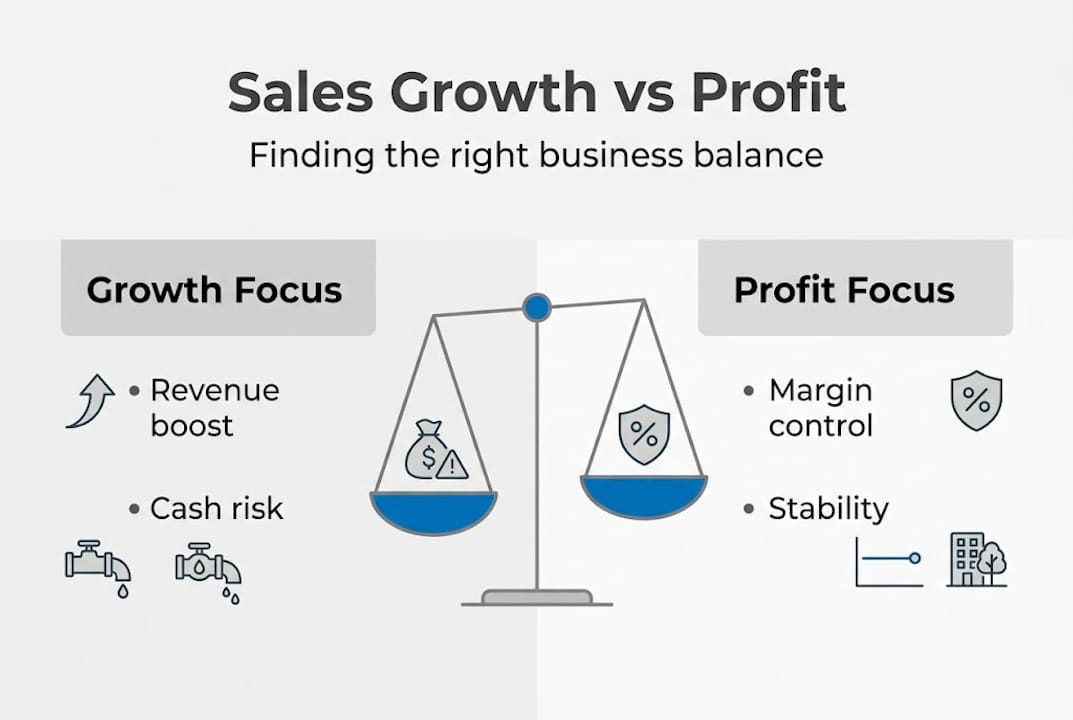
The smartest approach is not a growth hack. It is steady, measurable, profitable expansion built on strong retention, clear pricing, and a team that knows exactly what to do. Sustainable SME success comes from compounding small wins, not from headline numbers.
Adopt the playbooks. Watch your retention. Protect your margins. Let growth be the result of doing the right things consistently, not the goal you chase at the expense of everything else.
Unlock sustainable sales growth with expert support
Putting these insights into action requires more than reading. It requires a structured approach tailored to your specific business, stage, and goals.
At Summit SCALE, we work directly with SMB owners to build the clarity, focus, and strategy that turns revenue ambition into real, sustainable growth. Whether you are exploring why invest in coaching for the first time or ready to implement proven sales growth strategies for 2026, we have the tools and expertise to support your journey. Discover how coaching for SMB growth can transform the way you lead, sell, and scale. Book your free 15-minute assessment call today and take the first step towards a business that grows with confidence.
Frequently asked questions
Why is sales growth more important than just focusing on profit?
Sales growth fuels business survival by funding operations, attracting new talent, and enabling expansion. Profit without growth can result in stagnation or risk long-term viability when costs rise or markets shift.
How much sales growth should an SMB target each year?
Most SMBs should aim for 5 to 10% annual growth, though industry dynamics, business model, and development stage can push that target higher or lower.
What is the biggest pitfall of pursuing sales growth too aggressively?
Aggressive, unprofitable growth can strain cash flow and create unsustainable cost structures. Growth at all costs often leads to operational chaos and threatens long-term stability.
Which strategies do the fastest-growing SMBs use for sales growth?
They focus on customer retention, price optimisation, AI-powered prospecting tools, and direct sales channels. Retention and pricing levers consistently deliver the highest and most sustainable growth rates for SMBs.

