
Most british business development models highlight one surprising truth: focusing on sustained growth is just as crucial for small American enterprises as it is for global giants. With over 60 percent of small businesses in the United States facing hurdles in market expansion, understanding the foundations of business development can unlock new pathways to success. This guide approaches growth strategies with real-world advice tailored for entrepreneurs who want lasting profitability and greater personal freedom.
Table of Contents
- Business Development Principles And Definition
- Types Of Business Development Strategies
- Key Drivers And Characteristics
- Risks And Mistakes In Business Development
- Benefits For Owners And Enterprises
Key Takeaways
| Point | Details |
|---|---|
| Understanding Business Development | Emphasises long-term value creation through strategic market expansion and relationship management. |
| Tailored Strategies | Each organisation should adapt its business development approach based on unique industry contexts and competitive landscapes. |
| Risk Awareness | Identifying and mitigating risks, such as strategic miscalculations, is essential for sustainable growth. |
| Continuous Review | Regular assessments of strategies and market opportunities are crucial for maintaining competitive advantage. |
Business development principles and definition
Business development represents a strategic approach for organisations to create sustainable growth through systematic expansion of opportunities, capabilities, and market positioning. At its core, this discipline focuses on developing long-term value creation across customer relationships, markets, and organisational capabilities.
The fundamental principles of business development encompass several critical dimensions. These include strategic planning, market research, relationship management, and continuous innovation. Businesses must understand their core competencies, identify potential growth pathways, and develop robust strategies for penetrating new markets or deepening existing market presence. Unlike traditional sales functions, business development takes a holistic view of organisational growth, integrating insights from marketing, strategic planning, and relationship management.
Moreover, business development is not a one-size-fits-all approach. Each organisation must tailor its strategy to its unique context, industry dynamics, and competitive landscape. The process involves rigorous analytical preparation, identifying potential opportunities through comprehensive market analysis, and systematically implementing growth initiatives. Contextual barriers and growth determinants play a significant role in shaping these strategies, particularly for small and medium enterprises navigating complex business environments.
Professional Insight: Develop a systematic approach to business development by creating a quarterly review process that critically evaluates your growth strategies, market opportunities, and organisational capabilities.
Types of business development strategies
Business development strategies are multifaceted approaches designed to drive organisational growth and competitive advantage. Strategic approaches vary significantly depending on an organisation’s specific context, resources, and market dynamics. Businesses typically deploy five core strategic approaches to expand their market presence and capabilities.
The first category encompasses market penetration strategies, which focus on deepening engagement within existing markets. These strategies aim to increase market share by enhancing product offerings, improving marketing effectiveness, or optimising pricing models. The second approach involves product development, where businesses innovate and create new offerings to attract additional customer segments or address emerging market needs.
A third strategic approach is market development, which involves expanding into new geographical regions, customer segments, or distribution channels. Competitive strategy typologies such as those developed by Miles and Snow illustrate how businesses can be categorised based on their growth orientation. These include defender strategies emphasising efficiency, prospector strategies focused on aggressive market exploration, and analyzer strategies balancing innovation with stability.

The fourth strategy is diversification, where organisations enter entirely new markets or product categories to mitigate risk and create additional revenue streams. Strategic partnerships represent the fifth approach, enabling businesses to leverage complementary strengths, access new capabilities, and accelerate growth through collaborative ventures.
The following table summarises the five main business development strategies and highlights their distinct organisational benefits:
| Strategy | Key Objective | Organisational Benefit | Typical Challenge |
|---|---|---|---|
| Market Penetration | Expand within existing markets | Increased market share | Saturated competition |
| Product Development | Innovate new offerings | Access to new customer segments | High development costs |
| Market Development | Enter new regions/segments | Diversified revenue streams | Regulatory barriers |
| Diversification | Enter new markets/products | Reduced business risk | Uncertain market demand |
| Strategic Partnerships | Collaborate for growth | Enhanced capabilities | Alignment of objectives |
Professional Tip: Conduct a quarterly strategic review to assess which business development strategies align most effectively with your current organisational capabilities and market opportunities.
Key drivers and characteristics
Business development is driven by a complex interplay of strategic elements that shape organisational growth and competitive positioning. Multidisciplinary approaches characterise modern business development across various industries, integrating insights from marketing, sales, innovation, and relationship management. These drivers collectively create a comprehensive framework for sustainable enterprise expansion.
The primary characteristics include strategic market analysis, which involves deep understanding of customer needs, competitive landscapes, and emerging opportunities. Client relationship management stands as a critical driver, focusing on building long-term partnerships that generate recurring value. Strategic resource allocation becomes paramount, enabling businesses to invest intelligently in growth initiatives, technology adoption, and talent development.
Growth barriers in small enterprises highlight another crucial characteristic: organisational adaptability. Successful business development requires continuous learning, rapid response to market changes, and the ability to recalibrate strategies swiftly. This involves maintaining flexibility in operational models, supply chain integration, and innovative problem-solving approaches that can navigate complex business environments.
Key drivers also encompass technological innovation, digital transformation, and data-driven decision-making. Businesses must continuously evolve their capabilities, leverage emerging technologies, and create robust feedback mechanisms that allow for rapid strategic adjustments. The most effective organisations view business development not as a static process, but as a dynamic, iterative journey of continuous improvement and strategic exploration.
Professional Tip: Develop a structured quarterly review process that systematically evaluates your business development drivers, identifying potential gaps and opportunities for strategic enhancement.
Risks and mistakes in business development
Business development inherently involves navigating complex strategic landscapes fraught with potential pitfalls and challenges. Risks encompass multiple organisational dimensions, ranging from resource misallocation to strategic miscalculation, which can significantly impede an enterprise’s growth trajectory. Understanding these risks becomes crucial for proactive mitigation and sustainable business expansion.
Primary risks emerge from strategic misconceptions, including overestimating market opportunities, underestimating competitive dynamics, and failing to adapt to rapidly changing business environments. Small and medium enterprises frequently encounter challenges such as inadequate market research, poor financial planning, and ineffective resource allocation. These mistakes can lead to diminished competitive positioning, reduced operational flexibility, and potential financial instability.
Enterprise risk management strategies demand comprehensive approaches that integrate systematic identification, assessment, and mitigation of potential threats. Critical risk categories include operational risks (inefficient processes), financial risks (cash flow challenges), legal risks (compliance failures), and strategic risks (incorrect market positioning). Successful organisations develop robust mechanisms for continuous risk evaluation, maintaining organisational resilience and adaptability.
Moreover, common business development mistakes often stem from cognitive biases and strategic myopia. These include neglecting supply-chain dynamics, stereotyping business activities, and maintaining rigid operational models that cannot respond to market transformations. Entrepreneurs must cultivate a dynamic perspective, continuously reassessing their strategies, embracing flexibility, and developing sophisticated risk management frameworks that anticipate and neutralise potential challenges.
The table below compares major risks in business development with recommended mitigation approaches:
| Risk Category | Typical Issue | Mitigation Method |
|---|---|---|
| Operational | Inefficient processes | Streamline workflows |
| Financial | Cash flow challenges | Robust financial planning |
| Legal | Compliance failures | Continuous regulatory monitoring |
| Strategic | Incorrect market positioning | Regular market analysis |
Professional Tip: Implement a quarterly risk assessment protocol that systematically reviews your business development strategies, identifying potential vulnerabilities and developing preemptive mitigation plans.
Benefits for owners and enterprises
Business development offers transformative advantages that extend far beyond traditional growth metrics. Long-term value creation emerges as a fundamental benefit, enabling organisations to build sustainable competitive advantages through strategic innovation and market positioning. These benefits manifest across multiple dimensions, fundamentally reshaping how businesses perceive and actualise their growth potential.
For business owners, the strategic advantages are particularly profound. Improved profitability becomes achievable through systematic market exploration, enhanced customer engagement, and optimised resource allocation. By developing robust cross-functional collaboration mechanisms, organisations can create integrated approaches that simultaneously address operational efficiency, sales performance, and strategic positioning. This holistic perspective allows entrepreneurs to transcend conventional growth limitations and develop more resilient, adaptable enterprise models.
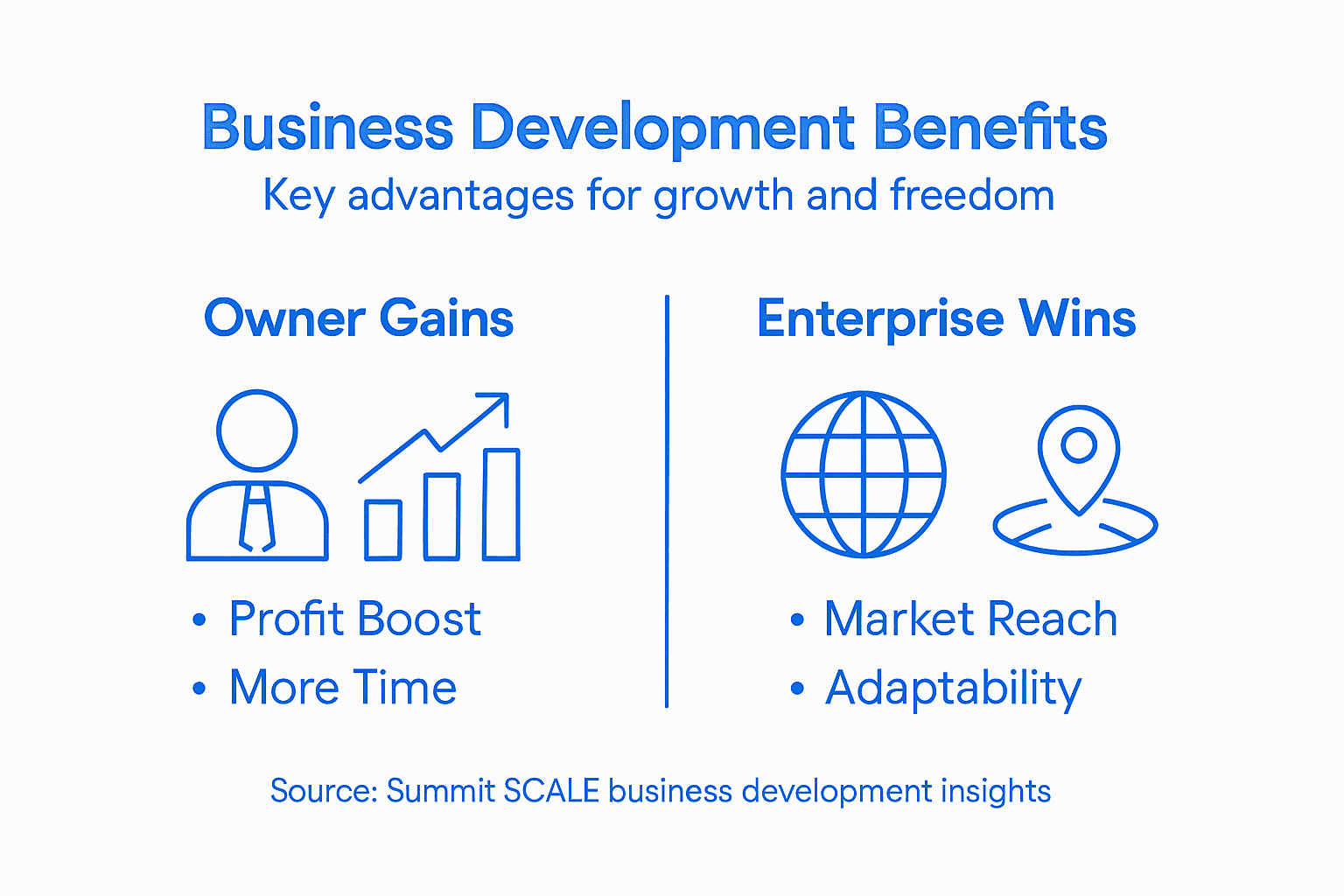
Strategic adjustments in enterprise development unlock remarkable opportunities for small and medium enterprises. These benefits include overcoming traditional growth barriers, achieving greater market competitiveness, and facilitating more nuanced strategic decision-making. Critically, business development empowers organisations to develop sophisticated capabilities that enable continuous learning, rapid market response, and proactive opportunity identification.
Moreover, the intangible benefits cannot be overstated. Business owners gain increased personal and professional autonomy, reduced operational stress, and enhanced strategic clarity. The process of systematic business development cultivates a growth mindset, transforms entrepreneurial vision into executable strategies, and creates frameworks for sustainable, meaningful enterprise evolution. By embracing these principles, business leaders can convert potential challenges into opportunities for remarkable organisational transformation.
Professional Tip: Conduct a comprehensive quarterly review of your business development strategies, systematically assessing progress, identifying emerging opportunities, and recalibrating your approach to ensure continuous growth and adaptability.
Unlock Sustainable Growth and Freedom Through Expert Coaching
The article emphasises the importance of strategic business development principles such as market analysis, risk mitigation, and tailored growth strategies to overcome common challenges faced by small to medium enterprises. If you are seeking to deepen your market presence, innovate your product offerings, or build effective partnerships yet feel overwhelmed by complex strategic decisions and growth barriers, you are not alone. Many entrepreneurs struggle with adapting to market changes, allocating resources efficiently, and developing a long-term value creation mindset.
At Summit SCALE, we understand these pain points and focus on empowering business owners like you with personalised coaching that targets key objectives including sales growth, cost control, and team building. Our approach integrates the same strategic insights discussed in the article—such as continuous innovation, organisational adaptability, and comprehensive risk assessment—to help you achieve not just growth, but also the freedom that comes with scalable and profitable success. Discover how our coaching programs can transform your business growth journey by visiting the Summit SCALE homepage and learn more about our impactful services that bring your vision to life.
Unlock your potential today and start building a resilient business that thrives in any market environment.
Ready to take your strategic development further? Experience the difference of expert guidance now.
Take the first step by scheduling a free 15-minute assessment call with Summit SCALE. Visit our website to book your consultation and begin your path towards growth, profitability, and business freedom.
Frequently Asked Questions
What is the definition of business development?
Business development refers to a strategic approach for organisations to create sustainable growth by expanding opportunities, capabilities, and market positioning. It focuses on long-term value creation through customer relationships, markets, and organisational capacities.
What are the key principles of business development?
Key principles include strategic planning, market research, relationship management, and continuous innovation. Organisations must understand their core competencies and create tailored strategies to navigate their unique business contexts and competitive landscapes.
What are the common business development strategies?
Common strategies include market penetration, product development, market development, diversification, and strategic partnerships. Each approach offers distinct benefits and is designed to enhance market presence and organisational capabilities.
What are the risks associated with business development?
Risks can include resource misallocation, strategic miscalculation, inadequate market research, and poor financial planning. Effective businesses implement risk management strategies to identify, assess, and mitigate potential threats to their growth efforts.
Recommended
- Where Are You In The Five Steps to Freedom? | Summit SCALE®
- The Business Owner’s Personal Growth Blueprint
- 4 Ways Your Company Can Begin to Grow Again – Summit Scale
- Levers for Profit Growth | Summit SCALE® Coaching
- What Is B2B Sales and Its Digital Impact
- Business Setup in Dubai | New Company Formation in Dubai

