
TL;DR:
- Organisational culture is the most influential factor in sustainable business growth, shaping employee behaviour and decision-making. Strong culture improves engagement, retention, and financial performance, with leadership behaviours playing a critical role in its long-term success. Measuring and embedding culture as a management discipline drives measurable growth and competitive advantage.
Organisational culture is the single most powerful determinant of sustainable business growth, shaping how your people behave, make decisions, and commit to shared goals every day. When culture is strong, employees know what is expected, believe it is the right way to work, and trust that aligned behaviour will be recognised and rewarded. The result is low-friction execution, higher retention, and measurable financial performance. The role of culture in growth is not a soft HR concept. It is a hard business lever, and the 2026 data proves it.
How does culture influence employee engagement and retention?
Culture defines the unwritten rules of your organisation. It tells employees how to relate to leadership, how to treat colleagues, and what kind of effort is genuinely valued. When those rules are clear, consistent, and positive, engagement follows naturally. When they are absent or contradictory, people disengage quietly before they leave loudly.
The numbers here are difficult to ignore. More than half of employees who rate their organisational culture poorly are actively looking for another job or watching for opportunities. That is not a dissatisfied minority. It is a majority of your disengaged workforce already mentally out the door. Gallup’s 2026 data reinforces this: 51% of US employees were actively seeking or watching for new roles in Q4 2025, signalling that labour-market mobility remains high and culture is the primary retention lever available to you.
Engagement is the mechanism that connects culture to performance. Research published in F1000Research found that culture positively affects engagement, which then acts as the strongest predictor of performance outcomes. Think of engagement as the bridge metric. Culture shapes it, and engagement shapes results. If your culture is weak, engagement drops, and performance follows. The sequence is that direct.
Managers sit at the centre of this chain. Their daily behaviours operationalise culture more than any values poster or leadership offsite ever will. A manager who recognises effort, communicates transparently, and models accountability reinforces culture in real time. One who ignores these behaviours quietly dismantles it. Understanding how leadership shapes retention is therefore not optional for growth-focused leaders. It is foundational.
Key cultural impact areas on engagement include:
- Psychological safety: Employees who feel safe to speak up contribute more and leave less.
- Recognition practices: Consistent, meaningful recognition signals that effort aligns with values.
- Growth opportunities: Younger employees in particular rate learning and development above compensation in engagement surveys.
- Leadership transparency: Open communication from senior leaders builds the trust that sustains commitment through uncertainty.
Pro Tip: Track your employee Net Promoter Score (eNPS) quarterly. A sudden drop is almost always a leading indicator of culture erosion, giving you time to act before turnover spikes.
How do different culture types affect financial performance?
Not all cultures produce the same outcomes. Culture Amp’s 2026 research identified a category called “Peak Performance” organisations, defined by high engagement scores combined with high confidence in business performance. The results are striking. These organisations achieved a 25% share price increase in one year and 36% over two years, with a 47% advantage over culture laggards. That is not a marginal edge. It is a structural competitive advantage built on people.

Motivosity’s 2026 State of Workplace Culture report adds further weight. Culture leaders show 2x revenue growth and 8x more trust in leadership compared to organisations with weak cultures. Eighty-three per cent of employees say they stay primarily because of culture and people, not compensation. These figures reframe the conversation entirely. Culture investment is not a cost centre. It is a growth driver with a measurable return.
The table below contrasts the key outcomes associated with different cultural states:
| Culture state | Engagement level | Revenue growth | Leadership trust | Retention risk |
|---|---|---|---|---|
| Peak Performance | High | 2x above average | 8x higher | Low |
| Developing | Moderate | Average | Moderate | Medium |
| Disengaged | Low | Below average | Minimal | High |
| Toxic | Very low | Declining | Near zero | Critical |
The pattern is consistent across industries. Strong culture compounds over time, while weak culture creates a drag on every growth initiative you attempt. Hiring costs rise, institutional knowledge walks out the door, and leadership energy is consumed by reactive people management rather than strategic growth.
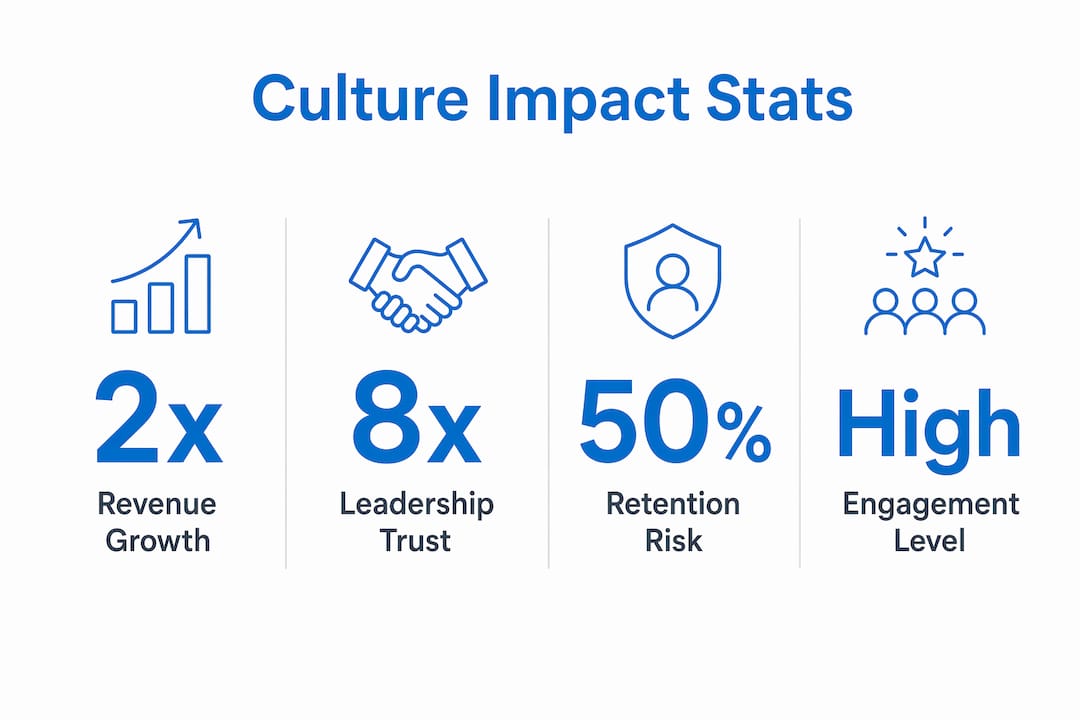
Treating culture and performance as a unified system rather than competing priorities is the defining shift that separates culture leaders from laggards. When your engagement targets and your revenue targets sit in the same planning conversation, you stop making trade-offs and start making multipliers.
Pro Tip: In your next quarterly business review, place engagement metrics alongside revenue and margin data. The correlation you see will change how your leadership team prioritises culture investment.
Why do leadership and well-being shape culture’s long-term impact?
Culture is not a fixed state. It is a living system, and leadership behaviour is its primary input. A longitudinal study published in Scientific Reports found that leader behaviours and employee well-being influence each other reciprocally over time. When leaders act with consistency and care, well-being improves. When well-being improves, employees engage more deeply, which in turn reinforces positive leadership behaviours. The cycle either builds or erodes culture depending on which direction it runs.
This has a practical implication that many leaders miss. Culture change is not a project with a start and end date. It is an ongoing management discipline. Organisations that treat culture as a campaign, launching it with fanfare and then returning to business as usual, consistently fail to sustain the gains. The cultural impact on development only compounds when it is embedded in daily management rhythms rather than periodic initiatives.
Consider what this means for your role as a leader. The behaviours you model in a Monday morning team meeting carry more cultural weight than a values workshop held once a year. Recognition given in the moment, feedback delivered with clarity, and decisions made transparently all send signals that either reinforce or contradict your stated culture. Employees, particularly younger ones who place high value on growth and transparency, read these signals acutely.
The feedback loop matters too. Continuous culture feedback through regular pulse surveys, one-to-one conversations, and open forums gives leaders the data they need to course-correct before small misalignments become systemic problems. Episodic annual surveys are too slow. By the time the data arrives, the culture has already shifted.
Key leadership behaviours that sustain a growth culture:
- Consistent recognition tied to specific behaviours, not just outcomes.
- Transparent communication about business direction and challenges.
- Active listening in one-to-one meetings, not just task reviews.
- Modelling the learning mindset you want to see across the team.
Pro Tip: Build a simple culture rhythm: weekly team check-ins, monthly one-to-ones with a culture question included, and quarterly pulse surveys. Consistency matters more than complexity.
Practical steps to embed culture for sustainable growth
Embedding culture for growth requires moving it out of the HR department and into your daily management operating system. The organisations that do this well do not rely on culture programmes. They rely on culture habits. Here is a practical framework for business leaders and managers to follow:
-
Define your culture explicitly. Write down the three to five behaviours that, if practised consistently, would produce the outcomes you want. Vague values like “integrity” are insufficient. Specific behaviours like “we give direct feedback within 24 hours of an issue arising” are actionable.
-
Hire and promote for cultural fit alongside capability. Skills can be developed. Behavioural alignment is much harder to teach. Use structured interviews with culture-specific questions and involve multiple team members in the assessment.
-
Build recognition into your management cadence. Recognition is not a bonus event. It is a weekly discipline. Tools like Motivosity or even a structured shout-out in a team meeting reinforce which behaviours matter and signal that the culture is real, not aspirational.
-
Measure culture with the same rigour as revenue. Use engagement metrics, eNPS, and turnover data as leading indicators. Organisations that miss early warnings in these metrics consistently find themselves reacting to culture crises rather than preventing them. Understanding engagement analysis for HR leaders is a practical starting point for building this capability.
-
Align culture explicitly with your growth strategy. If your growth goal requires speed and experimentation, your culture must reward calculated risk-taking and learning from failure. If it requires deep client relationships, your culture must prioritise patience and service. Misalignment between strategy and culture is one of the most common and costly growth blockers in SMEs.
-
Develop your managers as culture carriers. Your frontline managers are the most powerful culture delivery mechanism you have. Invest in their development through leadership skills training and coaching, and hold them accountable for the cultural environment they create.
For a deeper look at how team culture drives SMB profitability, Summitscale has explored the specific mechanisms that connect cultural investment to measurable financial outcomes for smaller businesses.
Key takeaways
Culture is the defining growth lever for any organisation: when it is strong, engagement rises, retention improves, and financial performance follows with measurable consistency.
| Point | Details |
|---|---|
| Culture drives retention | Over half of employees with poor culture ratings are actively seeking to leave, making culture the primary retention tool. |
| Peak Performance culture pays | Culture Amp’s research links high-engagement cultures to 25 to 36% share price gains and a 47% market value advantage. |
| Engagement is the bridge metric | Culture shapes engagement, and engagement is the strongest predictor of performance outcomes in empirical research. |
| Leadership is the delivery mechanism | Manager behaviours operationalise culture daily; consistent recognition and transparency are non-negotiable. |
| Measure early and often | Tracking eNPS, engagement scores, and turnover data as leading indicators prevents culture problems from becoming growth blockers. |
Culture as the ultimate growth multiplier: my perspective
I have worked with enough business owners and managers to say this with confidence: culture is not what you say it is. It is what your managers do on a Tuesday afternoon when no one senior is watching. That gap between stated values and lived behaviour is where most culture efforts quietly collapse.
The leaders I see succeed with culture share one habit. They treat it as a management discipline, not a communications exercise. They review engagement data the same way they review sales pipelines. They ask culture questions in one-to-ones the same way they ask about project status. They do not wait for an annual survey to tell them something has gone wrong.
The timeline question is one I hear constantly. How long does culture change take? Honestly, you will feel early momentum within three months if you are consistent. Meaningful, measurable shifts in engagement and retention typically take six to twelve months. Structural changes in how your organisation performs in the market take two to three years. That is not a reason to delay. It is a reason to start now, because every month you wait is a month your competitors who have already invested in culture are compounding their advantage.
One more thing. Do not underestimate the measurement blind spots. Most leaders I speak with are surprised by their own engagement data when they first look closely. The numbers are rarely as good as the informal conversations suggest. Get the data, face it honestly, and use it as fuel rather than a verdict.
— Shane
Ready to build a culture that drives real growth?
Culture does not build itself. It is built by leaders who are clear, consistent, and committed to the long game. If you are ready to move from knowing culture matters to actually embedding it as a growth driver in your business, professional coaching can accelerate that process significantly.
At Summitscale, the coaching for SME growth programme is designed specifically for business owners and managers who want to develop the leadership behaviours, management systems, and team culture that produce sustainable results. From defining your culture explicitly to building the management rhythms that keep it alive, the process gives you clarity, confidence, and a practical path forward. Book your free 15-minute assessment call today and take the first step towards a culture your business can grow on.
FAQ
What is the role of culture in business growth?
Culture defines how employees behave, make decisions, and commit to shared goals. Strong cultures produce higher engagement, lower turnover, and measurably better financial performance, with Culture Amp’s 2026 research linking peak-performance cultures to a 47% market value advantage over laggards.
How does culture affect employee retention?
More than half of employees who rate their organisation’s culture poorly are actively seeking or watching for new roles. Culture is the primary retention lever available to leaders, outweighing compensation in most employee surveys.
Can culture improvements be measured financially?
Yes. Motivosity’s 2026 data shows culture leaders achieve 2x revenue growth and 8x more leadership trust than culture laggards. Tracking engagement scores, eNPS, and turnover rates alongside revenue data reveals the financial return on culture investment.
How long does it take to change organisational culture?
Early engagement improvements are typically visible within three months of consistent leadership behaviour change. Meaningful shifts in retention and performance metrics generally take six to twelve months, with structural market-value gains compounding over two to three years.
What is the manager’s role in sustaining culture?
Managers are the primary delivery mechanism for culture. Their daily behaviours, including recognition, communication, and feedback, either reinforce or contradict stated values. Developing managers through structured leadership development programmes is one of the highest-return culture investments a business can make.

