
TL;DR:
- Most founders fail to realize that their biggest growth obstacle is their own leadership development, not product, market, or funding. Building self-awareness, receiving structured feedback, and applying proven change frameworks like Kotter’s model are essential for scalable leadership. Investing early in leadership growth through coaching and team-building efforts enables sustainable startup success and continuous personal improvement.
Most founders discover too late that their biggest growth constraint is not the product, the market, or the funding. It is them. The startup leadership development guide most entrepreneurs never receive is not about management theory. It is about turning the mirror around on yourself with honesty and then building the structures, skills, and team around you that allow the business to genuinely scale. Founders who repeatedly reinvent their leadership style as the company grows consistently outperform those who rely on the instincts that got them started.
Table of Contents
- Key takeaways
- Preparing the ground: mindset and prerequisites
- Running 360-degree feedback that actually works
- Applying Kotter’s 8-step model for lasting change
- Building and coaching your leadership team
- Measuring progress and maintaining momentum
- My perspective: what founders rarely hear about leadership growth
- How Summitscale can accelerate your leadership growth
- FAQ
Key takeaways
| Point | Details |
|---|---|
| Self-awareness comes first | Identify your blind spots through structured feedback before attempting to lead others through change. |
| 360-degree feedback drives growth | A properly facilitated feedback process surfaces the three strengths and three growth areas that matter most. |
| Kotter’s model beats improvisation | Applying a sequenced change framework prevents the costly missteps that sink most organisational shifts. |
| Teams scale what founders cannot | Building and coaching a leadership team is what separates founders who plateau from those who grow freely. |
| Progress requires measurement | Setting SMART goals and scheduling follow-up check-ins turns feedback into sustained behavioural change. |
Preparing the ground: mindset and prerequisites
Before you pick up any leadership framework, you need to do the work that most founders skip. And that work is uncomfortable. It starts with self-awareness. Specifically, it starts with acknowledging that there are things about your leadership you genuinely cannot see. The Johari Window model describes this well. It maps what you know about yourself, what others see that you do not, and the blind spots neither party has yet uncovered. For founders, that hidden quadrant is usually where the most damaging patterns live.
Growth mindset is not a platitude here. It is a practical requirement. If you receive feedback and immediately defend yourself, or file it away without acting on it, you have wasted everyone’s time and quietly signalled to your team that honesty is not welcome. Building psychological safety within your leadership circle means actively rewarding candour, even when it stings.
Before you launch any formal leadership development effort, identify who your key stakeholders are. These are the people whose perspectives on your leadership will be most useful: your co-founders, direct reports, key clients, and investors. Their input shapes everything that follows.
Here are the foundational leadership competencies worth assessing from the outset:
- Self-regulation: How do you behave under pressure? Does your team feel settled or anxious when things get difficult?
- Strategic clarity: Can you articulate the direction simply and confidently enough that others can act without you?
- Communication: Do people leave conversations with you feeling clear, or confused and second-guessing themselves?
- Accountability: Do you model the standards you expect from your team, or do different rules apply to you?
- Resilience: Can you absorb setbacks without passing the anxiety downward?
| Competency | Why it matters for startups | Development focus |
|---|---|---|
| Self-awareness | Prevents blind spots from derailing teams | 360-degree feedback, coaching |
| Strategic thinking | Keeps the team aligned during change | Planning workshops, mentoring |
| Coaching others | Scales leadership capacity beyond the founder | Internal coaching practice |
| Emotional intelligence | Builds trust and psychological safety | Reflective practice, peer groups |
| Decision-making under pressure | Startups move fast; poor decisions compound | Scenario planning, post-mortems |
Pro Tip: Before scheduling any formal feedback sessions, spend one week simply listening in meetings without steering the conversation. What you notice about team dynamics in that silence will tell you more than most surveys.
Running 360-degree feedback that actually works
The 360-degree feedback process is one of the most powerful tools in your entrepreneurship leadership guide, but it only works when done properly. Most founders who try to run it informally get polite, useless feedback. The method matters.
A complete leadership 360 review involves 10 to 15 one-on-one interviews lasting 30 to 60 minutes each, with the full process typically taking three to six weeks. That is a meaningful commitment, and it is worth every hour.
Here is a straightforward process for startup founders:
- Select your participants. Choose eight to fifteen people who interact with you regularly across different contexts: direct reports, peers, board members, and key external stakeholders. Diversity of perspective matters more than seniority.
- Brief participants on anonymity. People tell the truth when they trust the process will protect them. Make the confidentiality commitment explicit and credible.
- Use a trusted facilitator. True anonymity requires a facilitator who sits outside your reporting line, ideally someone external. They collect and synthesise responses so no single voice can be identified.
- Conduct structured interviews. Open-ended questions work better than rating scales for founders. Ask things like: “Where do you see this leader holding the business back?” and “What is the one thing they should stop doing?”
- Synthesise into themes. A good facilitator distils feedback into three strengths and three development areas with supporting evidence. Raw data without synthesis is overwhelming and easy to dismiss.
- Share results with the team. Transparency here is not optional if you want to build trust. You do not need to share every detail, but naming two or three themes you heard and committing to specific changes signals that the process was genuine.
| Approach | Internal facilitation | External facilitation |
|---|---|---|
| Cost | Lower | Higher |
| Anonymity | Often compromised | Reliably maintained |
| Depth of insight | Can be surface-level | More candid and specific |
| Trust from participants | Variable | Consistently higher |
| Best suited for | Small, high-trust teams | Most startup contexts |
Pro Tip: Schedule the debrief session with your coach or facilitator within 48 hours of receiving your results. The longer you sit with raw feedback alone, the more likely you are to rationalise rather than act.
Applying Kotter’s 8-step model for lasting change
Once you know what needs to change, you need a framework for actually changing it. Kotter’s 8-step model is one of the most proven tools in any leadership training for startups, and it is far more applicable to early-stage companies than most founders realise.
Kotter’s model is sequential and energy-based, which means each step builds momentum for the next. The eight steps move from creating urgency and forming a guiding coalition, through communicating the vision and removing blockers, to generating short-term wins and embedding change in culture. Skipping or rushing phases is the primary reason 70% of organisational change efforts fail, which should tell you everything about the temptation to move too fast.
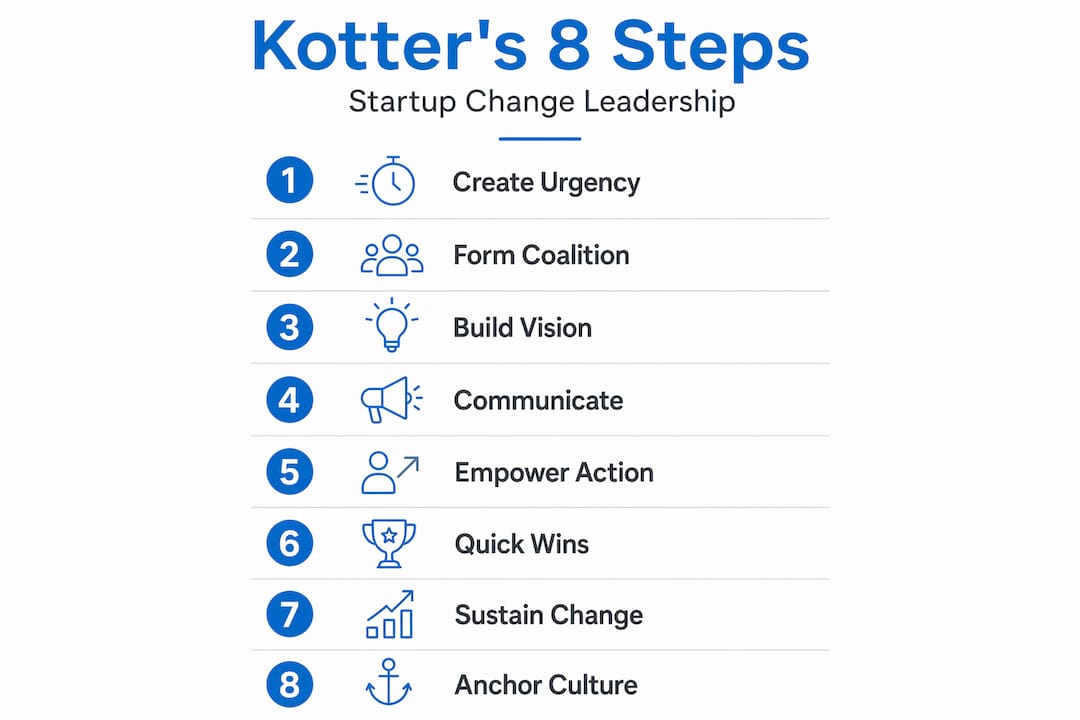
The most common mistake founders make is relying too heavily on logic. Most founders underestimate the role of emotional communication in inspiring change. People do not change their behaviour because the spreadsheet says they should. They change when they feel something. Your job as a leader is to make the case emotionally before you make it rationally.
Key principles for applying Kotter’s model in startup contexts:
- Form a genuine coalition. Your guiding coalition cannot just be people who already agree with you. Include sceptics who have credibility with the team.
- Make the urgency real, not manufactured. Teams see through artificial pressure. Ground urgency in genuine market data, competitive threats, or customer feedback.
- Celebrate short-term wins loudly. Early wins are not just morale boosters. They provide the evidence your coalition needs to maintain momentum and silence doubters.
- Embed change in systems, not just culture talk. If you want a new behaviour to stick, build it into performance reviews, team rituals, and decision-making processes.
Pro Tip: Treat Kotter’s model as a network rather than a checklist. You will often need to loop back to earlier steps as new obstacles emerge. That is not failure. It is how change actually works.
Building and coaching your leadership team
You cannot scale a startup on your own leadership alone. This is one of those things that sounds obvious but takes most founders years to truly accept. Every hour you spend being the decision-maker on something a capable team member could handle is an hour the business is not growing. Understanding why building a leadership team unlocks growth is not just a strategic insight. It is a mindset shift that changes how you hire, delegate, and develop people.
Here are the startup management skills to actively develop across your leadership team:
- Ownership mentality: Leaders who treat decisions as theirs to make, rather than waiting for your approval, create a faster and more resilient organisation.
- Coaching capability: Managers who develop their own people multiply your investment in leadership training many times over.
- Conflict resolution: Healthy disagreement, handled well, produces better decisions. Unmanaged conflict drains energy and stalls momentum.
- Cross-functional thinking: Leaders who understand the whole business make better local decisions.
Coaching your team does not require a formal programme. It requires consistent one-to-one conversations with a genuine interest in each person’s growth, clear feedback delivered promptly, and the patience to let people learn through mistakes. Research consistently shows that leadership coaching improves profitability and growth for businesses that invest in it deliberately.
Pro Tip: Run a monthly “leadership learning” session where one team member shares a lesson from a failure or a decision they would make differently. Normalising learning from mistakes is one of the fastest ways to build a high-trust team.

Measuring progress and maintaining momentum
Feedback and frameworks only matter if you track what changes. Sustained behavioural change requires concrete development goals and ongoing accountability, not just a one-off review and good intentions.
Here is a practical sequence for monitoring your leadership development progress:
- Set SMART goals from your feedback. Translate each development area into a specific, measurable goal. “Improve communication” is not a goal. “Conduct a 20-minute one-to-one with each direct report every week for three months” is.
- Schedule a follow-up 360 review. Plan a repeat of the feedback process six to twelve months after the first. 360-degree feedback leads to significant behavioural improvement only when paired with a development plan and ongoing coaching.
- Build in qualitative check-ins. Monthly conversations with a coach or mentor keep you honest about progress and help you adjust when circumstances shift.
- Recognise short-term wins. When you see yourself handling a difficult conversation differently, or a team member stepping up because you gave them space, name it. Progress reinforces itself when it is noticed.
- Revisit and revise your plan quarterly. A startup in month eight looks nothing like it did in month two. Your leadership development priorities should reflect where the business actually is, not where it was.
Pro Tip: Share your development goals with two or three people from your feedback group. Accountability to the people who gave you the feedback is far more motivating than accountability to yourself.
My perspective: what founders rarely hear about leadership growth
I’ve worked with enough founders to know that most of them come into leadership development looking for techniques. They want the frameworks and the tools, and yes, those matter. But what I’ve seen make the real difference is something harder to package: a willingness to be genuinely changed by the process.
The founders who struggle most are the ones who treat 360-degree feedback as information to be managed rather than truth to be acted on. They read the report, thank the facilitator, and go back to leading exactly as they did before. That is not leadership development. That is compliance theatre.
What actually shifts things is emotional intelligence in leadership. The ability to sit with uncomfortable feedback, feel the discomfort honestly, and then choose a different path. I’ve seen founders completely restructure their leadership teams not because a consultant told them to, but because the feedback process helped them see clearly for the first time that they were the bottleneck. That kind of clarity is worth more than any model.
My honest view is that most founders wait too long to invest in structured leadership development. They treat it as something for later, when the business is bigger or the team is more settled. But the patterns you embed at the beginning are the hardest to change. Start now. Invest in yourself first.
— Shane
How Summitscale can accelerate your leadership growth
Building a stronger version of yourself as a leader is not a solo project. The most effective founders we work with at Summitscale treat their own development as seriously as their product roadmap.
At Summitscale, our coaching programmes are built specifically for entrepreneurs and emerging business leaders who are ready to stop winging it and start leading with clarity and confidence. Whether you need help processing 360-degree feedback, applying change frameworks, or building the leadership team that will carry your business forward, our coaches work alongside you at every stage. If you are curious about why investing in coaching pays for itself in growth and freedom, that is a conversation worth having. You can also explore the types of business coaching available and find the approach that fits your stage. Book your free 15-minute assessment call with Summitscale today.
FAQ
What is a startup leadership development guide?
A startup leadership development guide is a structured framework helping founders build the mindset, skills, and team dynamics needed to lead effectively through business growth and change.
How does 360-degree feedback work for startup founders?
It involves structured interviews with eight to fifteen stakeholders, facilitated by a trusted third party, resulting in three key strengths and three development areas the founder can act on directly.
How long does a leadership 360-degree review process take?
A full process typically takes three to six weeks, including 10 to 15 one-on-one interviews of 30 to 60 minutes each.
What is Kotter’s 8-step model and why does it matter for startups?
Kotter’s model is a sequenced change framework that builds emotional momentum across eight stages, helping startup leaders drive cultural and organisational shifts without losing their teams along the way.
How do I measure leadership development progress in a startup?
Set SMART goals from your feedback results, schedule a follow-up 360 review after six to twelve months, and hold regular coaching check-ins to track behavioural change and adjust your development plan as the business evolves.

