
TL;DR:
- A sales growth strategy provides a structured plan to increase sales and profitability deliberately.
- SMEs should choose growth strategies based on their current goals, resources, and market position.
- Regularly tracking key metrics and maintaining strategic discipline are essential for sustained sales growth.
Sales growth strategy: a guide for small business success
Most business owners believe that more effort equals more sales. They push their teams harder, run more promotions, and spend longer hours chasing leads. Yet, despite all that energy, growth stays stubbornly flat. The truth is, working harder without a clear direction is like running faster on a treadmill. You exhaust yourself, but you never actually move forward. A well-crafted sales growth strategy changes everything. It gives your effort direction, your team clarity, and your business real momentum. This article walks you through exactly what sales growth strategy means, which types work best for SMEs, how to build one, and how to measure whether it is actually working.
Table of Contents
- Understanding sales growth strategy
- Types of sales growth strategies for SMEs
- How to build an effective sales growth strategy
- Tracking and measuring sales growth success
- A fresh perspective: what most SMEs get wrong about sales growth strategy
- Unlock next-level sales growth support
- Frequently asked questions
Key Takeaways
| Point | Details |
|---|---|
| Strategy beats tactics | A well-crafted sales growth strategy delivers better, more sustainable results than ad hoc efforts. |
| Match strategy to goals | Select growth strategies that fit your business resources, market, and targets for maximum impact. |
| Measure what matters | Tracking the right sales metrics ensures your growth strategy stays on course. |
| Iterate to succeed | Regularly review and adapt your approach to stay competitive and achieve lasting growth. |
Understanding sales growth strategy
With the myths out of the way, it is crucial to understand what a sales growth strategy actually is. The term gets used loosely, but precision matters here.
Sales growth strategies are structured plans that outline how a business can increase sales and profitability. They are not random collections of promotional tactics. They are deliberate, sequenced frameworks that guide how you attract customers, retain them, and grow revenue over time. Think of it as the difference between a map and a series of guesses. Tactics are individual actions, such as sending a follow-up email or running a discount campaign. Strategy is the overarching logic that determines which tactics you use, in what order, and why.
Many SMEs fall into the trap of ad hoc sales efforts. A campaign here, a promotion there, perhaps a new product launch without clear positioning. The result is wasted budget, confused messaging, and teams that feel like they are always busy but never quite winning. Understanding why sales growth matters for long-term profitability is the first step to thinking strategically rather than reactively.
An effective sales growth strategy typically includes several core components:
- A clear definition of your target customer segments, including their pain points, buying behaviour, and where they spend their time
- Revenue and market share objectives with specific, measurable targets rather than vague aspirations
- A defined value proposition that communicates precisely why your offer is the best choice for your ideal customer
- Sales channels and processes that describe how prospects move from awareness through to purchase and repeat business
- Resource allocation covering budget, personnel, and tools required to execute the plan
- A measurement framework with key performance indicators (KPIs) that signal whether your strategy is delivering results
Businesses that operate with a documented sales growth strategy see stronger, more predictable revenue. When your team understands the destination and the route, every action carries more weight. Clarity breeds confidence, and confident teams close more sales.
Statistic callout: Research consistently shows that businesses with a formal sales growth strategy outperform those relying on intuition alone, often generating significantly higher revenue growth rates within 12 to 24 months of implementation.
Types of sales growth strategies for SMEs
Now that you know what a sales growth strategy is, let’s explore the main types available to SMEs. There are several sales growth strategies that SMEs can adopt depending on business goals, market conditions, and resources. Choosing the right one is not about following trends. It is about matching the strategy to where your business actually stands today.
Here are the five most relevant types for small and medium businesses:
-
Market penetration involves selling more of your existing products or services to your current market. This could mean improving your sales process, offering loyalty incentives, or increasing your marketing frequency. It is generally the lowest-risk option because you already know your customer and your product.
-
Market development means taking your existing offer into a new market, whether that is a new geographic region, a different industry segment, or a new demographic group. For example, a business coaching firm serving retail owners might expand into serving hospitality businesses with the same core frameworks.
-
Product expansion refers to adding new products or services to your existing customer base. This works well when you already have strong relationships and credibility with your clients. Think about a business that offers marketing consulting and then adds a sales training programme to its suite.
-
Diversification is the boldest move. It involves entering a new market with a new product or service. It carries the highest risk but also the highest potential reward. For most SMEs, this strategy is best reserved for when the other options have been exhausted or a clear opportunity demands it.
-
Partnerships and referral strategies leverage the audiences, credibility, and networks of complementary businesses to generate new leads and sales. A well-structured partnership can deliver warm leads at a fraction of the cost of traditional advertising.
| Strategy type | Risk level | Time to results | Best suited for |
|---|---|---|---|
| Market penetration | Low | Short term | Established SMEs with growth headroom |
| Market development | Medium | Medium term | Businesses with proven, portable offers |
| Product expansion | Medium | Medium term | SMEs with loyal, trusting client bases |
| Diversification | High | Long term | Businesses with strong capital and resilience |
| Partnerships | Low to medium | Short to medium term | SMEs seeking fast lead generation |
You can explore a curated sales growth strategies list to find approaches that suit your stage of growth and available resources.

Pro Tip: Do not try to pursue more than two strategy types at once. SMEs have limited resources, and spreading effort across too many fronts dilutes your impact. Choose the strategy that addresses your most pressing growth constraint and focus there first.
How to build an effective sales growth strategy
Understanding the available strategies is only half the battle. Here’s how to put a tailored plan into action for your business.
Building a sales growth strategy is not a one-afternoon exercise. It requires honest self-assessment, careful planning, and the discipline to follow through. Here is a step-by-step process to get you started:
-
Define your growth targets clearly. Begin by asking: what does growth actually mean for your business right now? Is it a 20% increase in revenue, a new customer segment, or improved profit margins? Vague goals produce vague results. Specific, time-bound targets give your strategy teeth.
-
Analyse your current position. Look honestly at your sales pipeline, conversion rates, average deal size, and customer retention figures. Where are the leaks? Which stages of the sales process are underperforming? This audit reveals where your energy will have the greatest impact.
-
Identify your ideal customer. Not all customers are worth pursuing with equal intensity. Focus on the customer profiles that generate the highest lifetime value and the fewest headaches. Refine your messaging and outreach specifically for them.
-
Select your strategy types. Based on your targets and current position, choose the growth strategies that fit. Refer back to the table above. If you have strong client relationships but flat revenue, product expansion may be your fastest path. If your current market is saturated, market development might be the answer.
-
Break the strategy into actionable steps. Setting clear sales goals, tracking performance, and adapting based on real results are key to success. Translate your strategy into a 90-day action plan with specific tasks, owners, and deadlines. This makes execution tangible and manageable.
-
Assign ownership. Every element of your plan needs a responsible person. Strategies that belong to everyone end up belonging to no one. Make accountability explicit.
-
Review and adapt regularly. A strategy is not a document you write once and file away. Set monthly check-ins and quarterly strategy reviews to assess what is working and what needs adjusting.
Common pitfalls to avoid include:
- Setting goals without the budget or team capacity to pursue them
- Skipping the customer analysis phase and assuming you already know your buyer
- Treating the strategy as finished once written rather than as a living guide
- Changing direction too frequently based on short-term results rather than trend data
For hands-on guidance, reviewing practical sales tips designed for small businesses can save you months of trial and error. If you are planning to scale significantly, a business scaling guide will help you understand which operational changes need to happen alongside your sales efforts.
Pro Tip: Build your strategy around your constraints, not your aspirations. If your biggest bottleneck is lead generation, do not invest heavily in retention tools. Fix the constraint first, then build outward.
Tracking and measuring sales growth success
Building a strategy is vital, but it is consistent measurement and adaptation that turn plans into results.
Many SMEs invest real effort in creating a sales strategy and then fail to track whether it is actually working. Without measurement, you are flying blind. You might be winning or losing, and you simply would not know until it is too late to course correct.
Tracking the right metrics such as revenue growth rate, customer acquisition cost, and conversion rate helps SMEs understand the impact of their sales strategies. Each of these metrics tells a different part of the story.
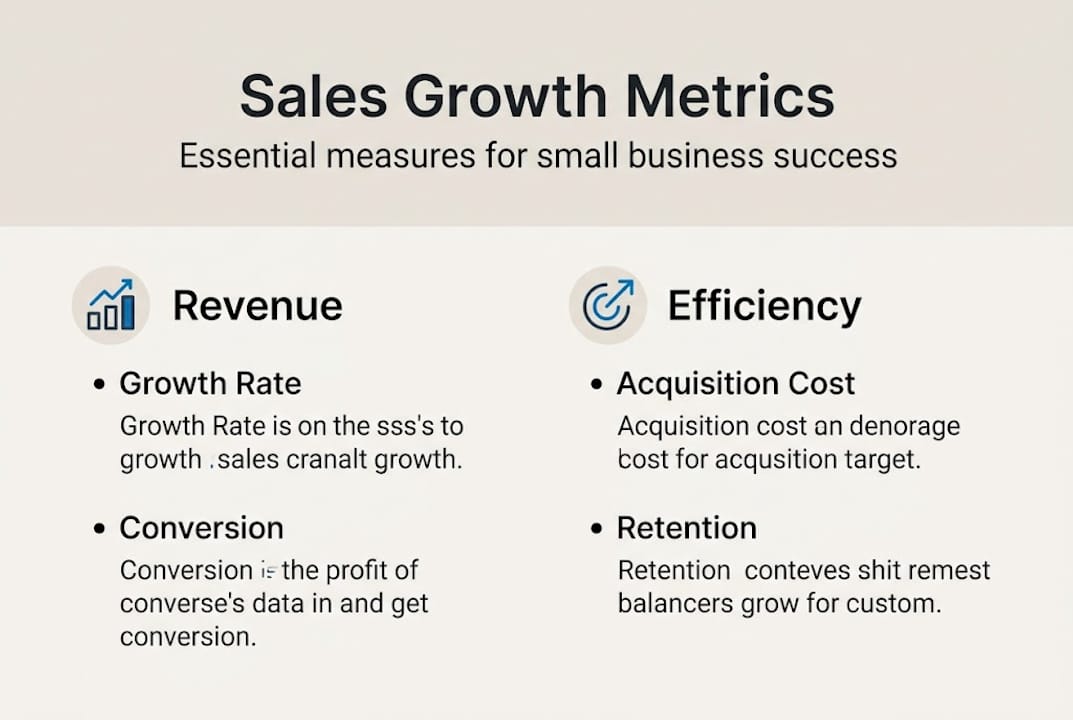
Here is a breakdown of the key sales growth metrics every SME should be monitoring:
| Metric | What it measures | Why it matters |
|---|---|---|
| Revenue growth rate | Percentage increase in revenue over a period | Shows whether your overall sales efforts are moving the needle |
| Customer acquisition cost (CAC) | Total cost to acquire one new customer | Reveals the efficiency and sustainability of your sales spend |
| Conversion rate | Percentage of prospects who become customers | Identifies weaknesses in your sales process or messaging |
| Customer lifetime value (CLV) | Total revenue expected from one customer | Guides how much you can afford to spend acquiring customers |
| Sales cycle length | Average time from first contact to closed deal | Longer cycles drain resources; shorter cycles free up capacity |
| Retention rate | Percentage of customers who return or renew | Indicates satisfaction and reveals upselling or cross-selling opportunities |
Understanding what each number means is just as important as collecting it. A falling conversion rate, for example, might signal that your lead quality has dropped, your messaging has drifted, or your sales team needs additional training. Context always matters.
Timing and consistency also play a major role in measurement. Looking at a single month’s numbers can be misleading, particularly in seasonal businesses. Always compare performance over equivalent periods and look for trends rather than isolated data points.
Practical advice for regular reviews:
- Hold a brief weekly sales meeting focused on pipeline status and immediate obstacles
- Conduct a monthly review of core KPIs against your targets
- Run a deeper quarterly strategy review that examines whether your assumptions still hold and whether your chosen strategy types remain appropriate
- Use an essential sales checklist to structure each review session and ensure nothing important is overlooked
Statistic callout: SMEs that review sales performance at least monthly are significantly more likely to hit their annual revenue targets than those who review performance only quarterly or less frequently.
Measurement is not about creating bureaucracy. It is about giving yourself the information you need to make better decisions faster. Think of your metrics as the dashboard of your business. You would not drive a car with the instruments covered.
A fresh perspective: what most SMEs get wrong about sales growth strategy
With the tools and frameworks clear, it is worth exploring why many SMEs still struggle even when they have the best resources available to them.
Here is an uncomfortable truth: most business owners treat their sales growth strategy like a project rather than a discipline. They build the plan, feel energised for a few weeks, and then drift back to firefighting mode when daily pressures mount. The strategy document gathers dust, and the business returns to ad hoc tactics. Sound familiar?
The danger of what we call “shiny object syndrome” is real and persistent. A new social media platform, a trendy sales framework, or a competitor’s apparent success can lure you away from a strategy that simply needs more time to compound. SMEs often focus too quickly on tactics and quick results, missing the long-term value of a strategic approach.
The businesses that achieve sustained growth are not necessarily the ones with the cleverest tactics. They are the ones with the discipline to stay focused on a coherent strategy, even when early results are modest. Small, consistent improvements compound powerfully over 12 to 36 months in ways that no single campaign ever can.
If you are working with senior leadership or executive teams, exploring growth tips for executives can help embed a culture of strategic discipline at every level of your organisation.
Unlock next-level sales growth support
For SMEs ready to accelerate sales growth, expert resources can turn plans into profit. Knowing what to do is one thing. Having the right support to actually do it consistently is another.
At Summit SCALE, we work directly with business owners to build tailored, results-driven sales growth strategies that create real and lasting change. If you have ever wondered why invest in coaching when you could figure it out alone, consider this: the right coaching relationship compresses your learning curve and protects you from the costly mistakes that slow most SMEs down. Explore our sales growth strategies for 2026 resources or review our business growth workflow to see how we structure sustainable results for businesses just like yours. Book your free 15-minute assessment call today.
Frequently asked questions
What is the difference between a sales strategy and sales growth strategy?
A sales strategy is the overall plan to sell products or services, while a sales growth strategy specifically focuses on methods to increase sales volume or revenue. Put simply, sales growth strategies are structured plans that outline how a business can increase sales and profitability, making them a more targeted subset of broader sales planning.
How do I choose the right sales growth strategy for my SME?
Assess your business goals, available resources, and current market position, then select approaches that best align with those factors. Remember that several sales growth strategies are available to SMEs, and the right choice depends on your specific circumstances rather than industry trends.
Which metrics matter most for tracking sales growth?
Key metrics include revenue growth rate, customer acquisition cost, conversion rates, and retention rates. Tracking the right metrics such as these gives SMEs a clear picture of whether their sales strategies are genuinely delivering results.
How often should I review my sales growth strategy?
Review your strategy at least quarterly to adjust for market shifts, actual results, and emerging opportunities. Monthly reviews of core KPIs, combined with a deeper quarterly strategic review, give you the responsiveness needed to stay on track without constant disruption to your team’s focus.

