
More than 60 percent of british and American business leaders admit confusion about what executive coaching really involves. For entrepreneurs aiming to sharpen their competitive edge, understanding these misconceptions can mean the difference between meaningful professional growth and wasted resources. This article clarifies executive coaching’s core purpose, breaks down common myths, and highlights how targeted guidance can accelerate your leadership success in demanding markets.
Table of Contents
- Executive Coaching: Definition And Misconceptions
- Distinct Approaches To Executive Coaching
- How Coaching Drives Strategic Growth
- Key Skills And Behaviours Developed
- Obligations, Costs, And Choosing A Coach
- Common Mistakes And Maximising Value
Key Takeaways
| Point | Details |
|---|---|
| Executive Coaching Enhances Leadership | Targeted coaching improves leadership performance through personalised guidance and strategic support. |
| Select the Right Coach | Ensure compatibility by evaluating coaches’ methodologies and their alignment with your developmental goals. |
| Focus on Outcomes | Establish clear objectives and maintain commitment for effective coaching experiences and sustainable growth. |
| Avoid Common Mistakes | Embrace the transformational nature of coaching by actively participating and integrating insights into daily practices. |
Executive coaching: Definition and misconceptions
Executive coaching represents a targeted professional development approach designed to enhance leadership performance through personalised guidance and strategic support. Leadership effectiveness interventions focus on supporting behavioural change and psychological growth for senior professionals seeking transformative development.
At its core, executive coaching involves a confidential one-to-one relationship between a trained professional coach and a business leader, aimed at unlocking potential, addressing performance challenges, and creating sustainable personal and organisational improvement. Unlike traditional training programmes, coaching provides individualised attention that targets specific leadership capabilities, psychological barriers, and strategic objectives. Emerging leadership development research suggests coaching interventions can significantly impact individual resilience, self-efficacy, and organisational adaptability.
Numerous misconceptions persist about executive coaching, often stemming from limited understanding of its nuanced approach. Common myths include assumptions that coaching is remedial, only for underperforming executives, or a quick fix for complex organisational challenges. In reality, executive coaching represents a sophisticated, collaborative process focused on proactive personal and professional development. Successful coaching engagements require mutual commitment, clear goal-setting, and a willingness to explore personal growth strategies.
Pro tip: Before engaging an executive coach, conduct thorough interviews to ensure their methodology aligns with your specific leadership development goals and organisational context.
Distinct approaches to executive coaching
Executive coaching has evolved significantly, embracing diverse methodological frameworks that accommodate different organisational needs and individual learning preferences. The contemporary coaching landscape encompasses multiple intervention strategies, ranging from traditional face-to-face interactions to innovative technology-assisted formats that enhance accessibility and personalisation.
Traditional one-on-one coaching remains the foundational approach, offering deep personalised engagement between coach and client. Emerging coaching methodologies have expanded to include group coaching sessions, virtual coaching platforms, and blended learning models that integrate multiple interaction techniques. These approaches allow for more flexible, adaptive developmental experiences tailored to specific leadership challenges and organisational contexts.
The sophistication of modern executive coaching is evident in its nuanced application across different scenarios. Some approaches focus on performance enhancement, while others target psychological resilience, strategic thinking, or interpersonal skill development. Coaches now utilise advanced assessment tools, psychometric instruments, and structured intervention techniques to create comprehensive development programmes that address complex leadership challenges more holistically.
Pro tip: Select an executive coaching approach that aligns with your specific developmental objectives, considering factors such as learning style, time constraints, and desired outcomes.
To clarify key distinctions among executive coaching methods, consider the following comparison:
| Approach | Personalisation Level | Interaction Format | Typical Use Cases |
|---|---|---|---|
| One-to-one coaching | Highly tailored | In-person or virtual | Strategic development, C-suite |
| Group coaching | Custom group focus | Small team or peer groups | Team dynamics, peer learning |
| Blended learning model | Flexible and scalable | Mix of online and live | Adaptive skills, ongoing support |
| Virtual platforms | Convenient, less direct | Online video or chat-based | Remote leadership, global teams |
How coaching drives strategic growth
Executive coaching serves as a powerful catalyst for strategic growth, transforming leadership capabilities by enabling entrepreneurs to develop more nuanced approaches to organisational challenges. By providing targeted interventions, coaches help business leaders enhance their decision-making processes, strategic thinking, and adaptive capacities, ultimately driving sustainable business performance.
The strategic impact of coaching extends beyond individual skill development to broader organisational transformation. Comprehensive leadership development strategies focus on aligning personal growth with organisational objectives, creating a synergistic approach to business evolution. Coaches work closely with entrepreneurs to identify potential roadblocks, develop innovative solutions, and create robust frameworks for scaling businesses effectively.
Key strategic growth drivers facilitated by executive coaching include enhanced self-awareness, improved emotional intelligence, and the ability to create more effective team dynamics. Entrepreneurs learn to navigate complex business environments more strategically, developing skills that allow them to anticipate market changes, make more informed decisions, and create resilient organisational structures that can withstand competitive pressures.
Pro tip: Integrate regular coaching sessions into your strategic planning process, treating them as strategic investments rather than mere developmental expenses.
Key skills and behaviours developed
Executive coaching fundamentally transforms leadership capabilities by developing critical cognitive skills that enable entrepreneurs to navigate complex business environments more effectively. The process focuses on enhancing self-awareness, emotional intelligence, and strategic decision-making abilities that form the cornerstone of sustainable business leadership.

Leadership competency development encompasses several key behavioural dimensions. These include advanced communication strategies, emotional regulation techniques, and the capacity to build high-performing teams. Entrepreneurs learn to develop a growth mindset that allows them to view challenges as opportunities, transforming potential obstacles into strategic advantages through improved psychological resilience and adaptive thinking.
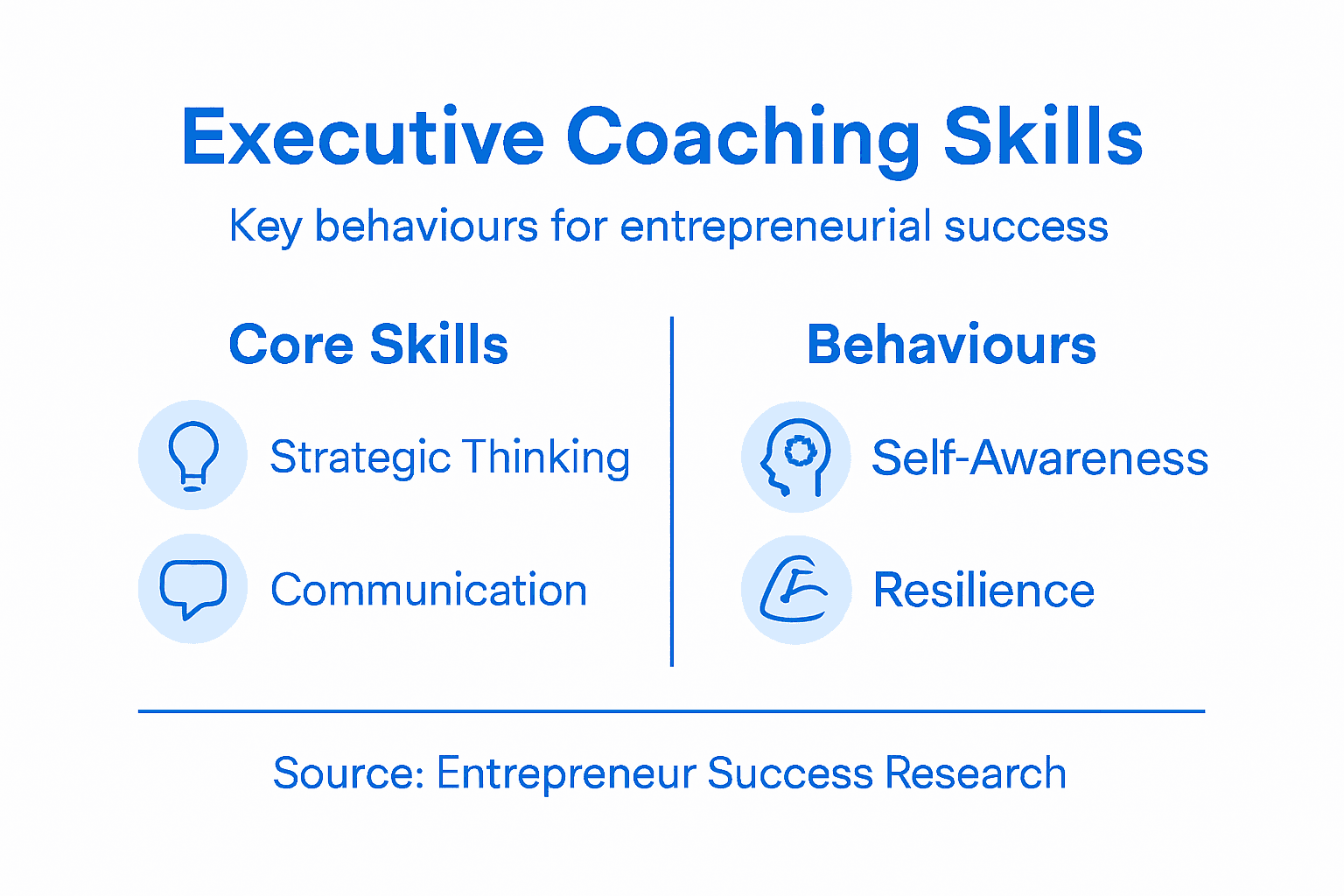
The most transformative skills cultivated through executive coaching include enhanced strategic thinking, improved interpersonal communication, and the ability to maintain emotional equilibrium under pressure. Coaches work meticulously to help entrepreneurs develop a nuanced understanding of their leadership style, identifying potential blind spots and providing targeted interventions that support personal and professional growth. This holistic approach ensures that skill development is not just theoretical but pragmatically aligned with real-world business challenges.
Pro tip: Regularly document your leadership growth journey, creating a reflective practice that allows you to track and validate the skills developed through executive coaching.
Here is a summary of essential skills developed through executive coaching:
| Skill Area | Example Benefit | Impact on Leadership |
|---|---|---|
| Emotional intelligence | Improved self-management | Better team relationships |
| Strategic thinking | Enhanced decision quality | Informed, long-term planning |
| Communication techniques | Greater message clarity | Increased influence and trust |
| Resilience and adaptability | Faster recovery from setbacks | Sustained performance in change |
| Building high-performing teams | Efficient delegation and collaboration | Achievement of complex goals |
Obligations, costs, and choosing a coach
Selecting an executive coach requires careful consideration of multiple factors, including professional coaching qualifications and precise alignment with specific business needs. The investment involves not just financial resources, but a significant commitment of time, energy, and organisational support to ensure meaningful professional development.
Coaching engagement costs vary substantially, typically ranging from £500 to £5,000 per month depending on the coach’s expertise, experience, and the complexity of coaching interventions. Key obligations for entrepreneurs include maintaining transparency, establishing clear performance metrics, demonstrating personal commitment to growth, and creating a collaborative environment that supports ongoing learning and development.
The coach selection process demands thorough due diligence. Entrepreneurs should evaluate potential coaches based on their professional credentials, industry experience, coaching methodology, and proven track record of supporting businesses similar to their own. Critical assessment criteria include the coach’s ability to understand unique organisational challenges, provide tailored strategies, and maintain strict confidentiality throughout the coaching relationship.
Pro tip: Request comprehensive references and conduct preliminary discussions with potential coaches to assess their compatibility with your specific leadership development objectives.
Common mistakes and maximising value
Executive coaching can falter when entrepreneurs fail to establish clear strategic objectives for their developmental journey. The most prevalent mistakes include insufficient preparation, vague goal-setting, and a lack of commitment to sustained personal transformation, which can significantly undermine the potential impact of coaching interventions.
Effective coaching implementation demands a structured approach that goes beyond superficial engagement. Entrepreneurs must actively participate, provide transparent feedback, and demonstrate willingness to challenge existing leadership paradigms. Maximising coaching value requires creating a comprehensive feedback ecosystem, regularly reviewing progress, and maintaining alignment between individual growth objectives and broader organisational strategies.
Critical mistakes that diminish coaching effectiveness include treating the process as a transactional interaction, resisting vulnerability, and failing to integrate learned insights into daily leadership practices. Successful coaching demands a holistic commitment where entrepreneurs view the engagement as a transformative experience rather than a temporary performance intervention. This requires developing a growth mindset, embracing continuous learning, and creating sustainable behavioural change mechanisms that extend beyond formal coaching sessions.
Pro tip: Establish quarterly review points with your coach to assess progress, recalibrate objectives, and ensure ongoing alignment between personal development and strategic business goals.
Unlock Your Entrepreneurial Potential with Expert Executive Coaching
The article highlights the crucial role of executive coaching in transforming leadership capabilities and driving strategic business growth. Many entrepreneurs face challenges such as unclear goal-setting, evolving organisational demands, and the need to build resilience and emotional intelligence. These pain points align perfectly with Summit SCALE’s tailored coaching solutions designed to guide business owners through strategic sales growth, team building, and sustainable performance improvement.
Summit SCALE offers personalised business coaching that empowers entrepreneurs to realise true business freedom by mastering key leadership skills and overcoming organisational challenges. By aligning coaching interventions with your specific growth objectives, you can experience meaningful transformation that leads to more time, money, and control over your business future. Discover how a strategic coaching partnership can elevate your decision-making and unlock your full potential at Summit SCALE.
Ready to start your journey towards confident leadership and scalable success
Take the first step now by scheduling your free 15-minute assessment call with Summit SCALE and learn how expert coaching can help you overcome leadership hurdles and accelerate your business growth. Visit Summit SCALE coaching services and turn your ambitions into tangible results today.
Frequently Asked Questions
What is the purpose of executive coaching?
Executive coaching is designed to enhance leadership performance through personalised guidance and strategic support, enabling business leaders to address performance challenges and create sustainable personal and organisational improvement.
How does executive coaching differ from traditional training programmes?
Unlike traditional training, which often provides generalised information, executive coaching offers personalised attention tailored to specific leadership capabilities and psychological barriers, focusing on individual growth and development.
What are some common misconceptions about executive coaching?
Common misconceptions include the belief that coaching is solely for underperforming executives or that it serves as a quick fix for complex organisational issues. In reality, coaching is a proactive and sophisticated process aimed at personal and professional development for leaders at all levels.
What key skills can be developed through executive coaching?
Executive coaching helps develop critical skills such as emotional intelligence, strategic thinking, effective communication, resilience, and the ability to build high-performing teams, all essential for navigating complex business environments.

