
Running a business means constantly adapting to new opportunities and challenges. Understanding the core concepts in business development terminology helps British and American business owners clarify strategies, improve internal communication, and make smarter decisions. By mastering key categories, acronyms, and strategic language, you gain practical tools to increase sales and drive operational efficiency in a competitive market.
Table of Contents
- Core Concepts In Business Development Terminology
- Types And Categories Of Business Development Terms
- Key Features And Common Business Jargon
- Role Of Terminology In Strategy And Operations
- Mistakes To Avoid In Using Terms
- Practical Impact On Growth And Efficiency
Key Takeaways
| Point | Details |
|---|---|
| Fundamental Concepts | Business development focuses on market analysis, strategic partnerships, revenue generation, and capacity building for growth. |
| Effective Communication | Mastering business jargon and terminology is essential for precise communication and strategic alignment. |
| Avoiding Miscommunication | Professionals should be cautious about jargon overuse, misinterpretations, and context misalignment to maintain clarity. |
| Continuous Learning | Regular updates through workshops and industry events can enhance understanding and application of business terms. |
Core concepts in business development terminology
Business development represents a strategic approach to organisational growth that transcends traditional sales and marketing techniques. It encompasses a comprehensive set of practices designed to create long-term value through identifying new market opportunities, building strategic partnerships, and systematically expanding business capabilities.
At its core, business development involves several fundamental concepts that drive organisational expansion:
- Market Analysis: Understanding potential growth segments and customer needs
- Strategic Partnerships: Identifying and cultivating relationships that create mutual business advantages
- Revenue Generation: Developing innovative approaches to increasing organisational income streams
- Organisational Capacity Building: Enhancing internal capabilities to support scalable growth
Business development professionals frequently employ integrative organisational practices that require deep understanding of both internal capabilities and external market dynamics. These practices involve comprehensive processes that blend strategic planning, relationship management, and continuous improvement methodologies.

The discipline requires professionals to balance analytical thinking with creative problem-solving, continuously evaluating potential opportunities while mitigating associated risks. Successful business development demands a nuanced understanding of how different organisational components interact and contribute to overall growth strategies.
Pro tip: Develop a systematic approach to tracking potential opportunities by creating a structured database of market insights, strategic contacts, and emerging industry trends.
Types and categories of business development terms
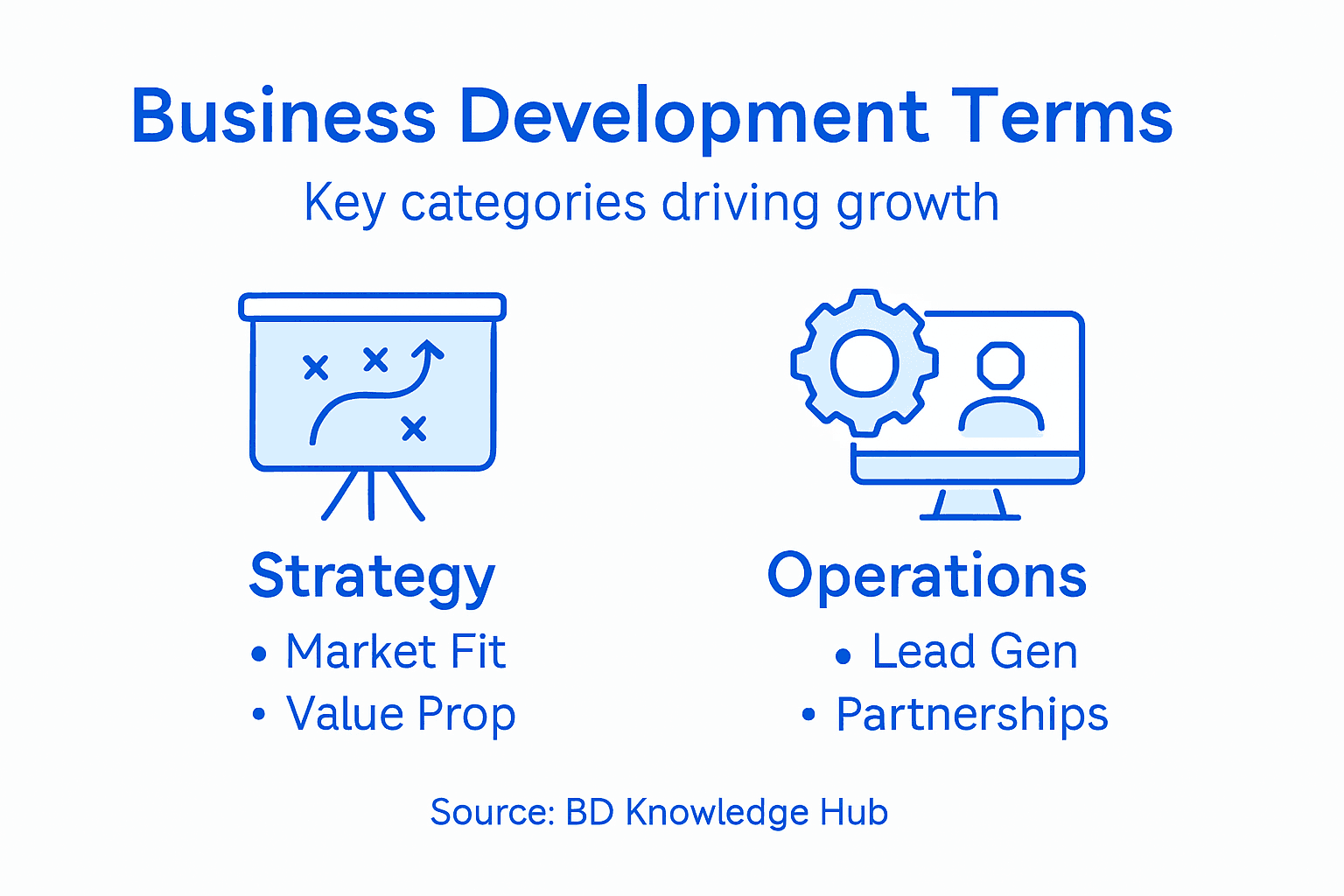
Business development terminology can be systematically categorised into distinct groups that reflect the multifaceted nature of organisational growth strategies. Business development glossaries typically segment these terms into comprehensive categories that help professionals navigate the complex landscape of strategic expansion.
The primary categories of business development terms include:
- Strategic Terms: Concepts related to long-term organisational planning and vision
- Operational Terms: Language describing day-to-day business development activities
- Relational Terms: Terminology focusing on partnership development and stakeholder engagement
- Financial Terms: Vocabulary associated with revenue generation and economic performance
- Market-Oriented Terms: Phrases describing market analysis, segmentation, and opportunity identification
Within these categories, business development professionals must understand nuanced distinctions between related concepts. For instance, strategic partnerships differ from simple vendor relationships, requiring a deeper understanding of mutual value creation and long-term collaborative potential.
The evolution of business development language reflects changing organisational dynamics, with emerging terms continuously expanding the professional lexicon. Modern business development terminology increasingly incorporates digital transformation concepts, highlighting the intersection of technological innovation and strategic growth methodologies.
Here is a comparison of how different categories of business development terminology facilitate organisational success:
| Category | Typical Focus | Business Advantage |
|---|---|---|
| Strategic Terms | Long-term planning | Drives sustained growth |
| Operational Terms | Everyday activities | Improves workflow efficiency |
| Relational Terms | Partnerships | Enables stakeholder engagement |
| Financial Terms | Revenue metrics | Enhances financial transparency |
| Market-Oriented | Market analysis | Identifies new opportunities |
Pro tip: Regularly update your professional vocabulary by attending industry conferences, participating in professional networks, and following thought leadership publications in business development.
Key features and common business jargon
Business jargon serves as a critical communication tool, enabling professionals to articulate complex concepts efficiently. Common business acronyms provide shorthand for intricate financial and operational metrics that drive strategic decision-making.
Key financial and operational jargon includes:
- CAC (Customer Acquisition Cost): The total expense of acquiring a new customer
- EBITDA: Earnings Before Interest, Taxes, Depreciation, and Amortisation
- CapEx: Capital Expenditure representing investments in long-term assets
- ROIC: Return on Invested Capital, measuring efficiency of capital allocation
- KPI: Key Performance Indicator tracking organisational progress
Understanding these technical terminologies goes beyond mere vocabulary – it represents a language of strategic communication. Professionals who master these terms can quickly decode complex business discussions, transforming abstract concepts into actionable insights.
The landscape of business jargon continuously evolves, reflecting technological advancements and shifting organisational paradigms. Modern terminology increasingly incorporates digital transformation concepts, artificial intelligence references, and data-driven performance metrics, demonstrating the dynamic nature of professional communication.
Below is a concise reference table of prominent business jargon and their practical organisational impact:
| Acronym | Full Meaning | Practical Impact |
|---|---|---|
| CAC | Customer Acquisition Cost | Informs marketing investment |
| EBITDA | Earnings Before Interest, Taxes, Depreciation, and Amortisation | Reveals core profitability |
| CapEx | Capital Expenditure | Tracks asset investments |
| ROIC | Return on Invested Capital | Measures capital efficiency |
| KPI | Key Performance Indicator | Guides progress monitoring |
Pro tip: Create a personal glossary of business terms, updating it regularly to stay current with emerging industry language and technological developments.
Role of terminology in strategy and operations
Terminology plays a critical role in bridging the gap between strategic planning and operational execution. Strategy terminology enables precise communication that transforms abstract business objectives into actionable organisational frameworks, ensuring alignment across different departments and hierarchical levels.
Key strategic terminology functions include:
- Alignment: Creating shared understanding across organisational levels
- Precision: Defining exact expectations and performance metrics
- Communication: Establishing clear frameworks for discussing business goals
- Implementation: Translating conceptual strategies into practical operational steps
- Performance Tracking: Establishing standardised measurement approaches
The language of strategy serves as a critical translation mechanism, converting high-level conceptual thinking into granular operational instructions. This linguistic precision enables organisations to break complex strategic initiatives into manageable, executable components that can be systematically implemented and evaluated.
Modern organisations recognise that effective terminology is not merely about communication, but about creating a shared cognitive framework that drives collective understanding and coordinated action. By developing a robust, consistent strategic language, businesses can reduce ambiguity, minimise misinterpretation, and accelerate strategic implementation across diverse teams and functional areas.
Pro tip: Develop a standardised internal glossary that defines key strategic and operational terms, ensuring consistent interpretation across your organisation.
Mistakes to avoid in using terms
Navigating business development terminology requires precision and strategic awareness. Common communication mistakes can significantly undermine professional credibility and organisational effectiveness, making it crucial to understand potential linguistic pitfalls.
Frequent terminology mistakes include:
- Overusing Jargon: Replacing clear communication with unnecessarily complex language
- Misinterpreting Acronyms: Assuming universal understanding of specialised abbreviations
- Inconsistent Definitions: Using terms differently across organisational departments
- Vague Terminology: Employing imprecise or ambiguous language
- Context Misalignment: Applying terms without understanding their specific contextual meaning
Professionals must recognise that precise language is not about sounding sophisticated, but about creating clear, actionable communication. Misunderstandings arising from terminology errors can lead to strategic misalignments, operational inefficiencies, and potentially costly miscommunications.
The most effective approach involves developing a nuanced understanding of business language, recognising that terminology evolves continuously. Staying current requires ongoing learning, active listening, and a willingness to clarify terms when uncertainty emerges, ensuring comprehensive and accurate professional communication.
Pro tip: Create a departmental glossary that standardises key terms, ensuring consistent understanding across your organisation.
Practical impact on growth and efficiency
Business development terminology directly influences organisational performance by creating frameworks that translate strategic vision into actionable outcomes. Business development activities fundamentally drive enterprise capabilities, enabling organisations to adapt rapidly and innovate strategically.
Key growth and efficiency impacts include:
- Strategic Alignment: Ensuring consistent understanding across organisational levels
- Resource Optimization: Facilitating precise communication about operational capabilities
- Performance Measurement: Establishing clear metrics for tracking organisational progress
- Innovation Acceleration: Creating shared language that supports collaborative problem-solving
- Decision-Making Speed: Reducing ambiguity and enhancing communication clarity
The linguistic precision of business development terminology transforms abstract strategic concepts into concrete operational instructions. This translation mechanism allows organisations to convert high-level objectives into granular, executable steps, significantly reducing implementation friction and enhancing overall operational efficiency.
Modern enterprises recognise that effective terminology is not merely a communication tool, but a strategic lever for driving organisational performance. By developing a robust, standardised professional language, businesses can streamline internal processes, reduce misunderstandings, and create a more agile, responsive organisational culture that can quickly adapt to changing market dynamics.
Pro tip: Conduct quarterly terminology alignment workshops to ensure consistent understanding and evolve your organisational language in response to strategic changes.
Unlock Strategic Growth with Expert Business Development Coaching
Effective business development terminology is essential for clarifying complex growth strategies and aligning your team. If you struggle with turning strategic concepts like market analysis, revenue generation, and partnership cultivation into practical action, you are not alone. These common challenges can delay growth and cause miscommunication within your organisation. At Summit SCALE, we help business owners tackle these pain points by simplifying strategic language and embedding it into tangible coaching plans focused on sales growth, team building, and long-term value creation.
Our tailored coaching approach transforms confusing jargon into clear, actionable steps that drive business efficiency and profitability. By engaging with our Business Growth Archives – Summit Scale resources and personalised coaching, you gain the tools and confidence to speak the language of success and empower your organisation to scale effectively.
Ready to transform your business development challenges into growth opportunities now?

Discover how clarifying your business language and aligning your growth strategy with expert coaching can unlock new levels of performance. Visit Summit SCALE to schedule your free 15-minute assessment call and take the first step towards greater business freedom and profitability. Explore additional insights in our Business Systems Archives – Summit Scale and strengthen your financial understanding with resources from our Business Finance Archives – Summit Scale to build a complete growth framework.
Frequently Asked Questions
What is the role of market analysis in business development?
Market analysis plays a crucial role in identifying potential growth segments and understanding customer needs, thus driving informed decision-making and strategic planning.
How do strategic partnerships contribute to business growth?
Strategic partnerships enable businesses to cultivate relationships that create mutual advantages, facilitating resource sharing and enhancing competitive positioning within the market.
What are some common operational terms used in business development?
Common operational terms include concepts like customer acquisition cost (CAC), earnings before interest, taxes, depreciation, and amortisation (EBITDA), and key performance indicators (KPIs) that help track performance and operational efficiency.
How can businesses ensure consistent understanding of terminology across departments?
Businesses can create a departmental glossary that standardises key terms and provides clear definitions, ensuring alignment and reducing miscommunication across different teams and functions.
Recommended
- Business Development Explained: Driving Growth and Freedom
- The 4 Areas to Target to Grow Sales – Summit SCALE® Coaching
- 7 Business Development Best Practices for Growth
- 7 Examples of Business Growth Strategies for Owners
- Pete Ketchum | Organizational Psychologist & Author
- Complete Guide to Business Telephony Terms Explained – Voipcom

