
Most business owners don’t wake up thinking, “Today, I need to improve alignment.”
They wake up thinking about sales targets, staffing issues, cash flow, and the never-ending list of decisions sitting on their desk.
And yet, in over two decades of working with small to medium-sized business owners, I’ve found this:
Alignment is often the most underdeveloped skill in leadership — and the one that quietly determines whether a business scales or stalls.
You can have a strong vision.
You can have a capable team.
You can even have solid systems.
But if your people aren’t aligned — truly aligned — you become the bottleneck.
Let’s unpack why.
The Three Critical Components of Leadership: Vision, Alignment, Execution
Most leadership frameworks boil down to The Three Critical Components of Leadership: Vision, Alignment, Execution.
- Vision: Where are we going?
- Alignment: Are we all pulling in the same direction?
- Execution: Are we consistently delivering results?
Here’s the problem.
In my experience, business owners tend to spend:
- 70% of their time on execution
- 25% thinking about vision
- And maybe… 5% (if that) on alignment
That imbalance is where things start to break.
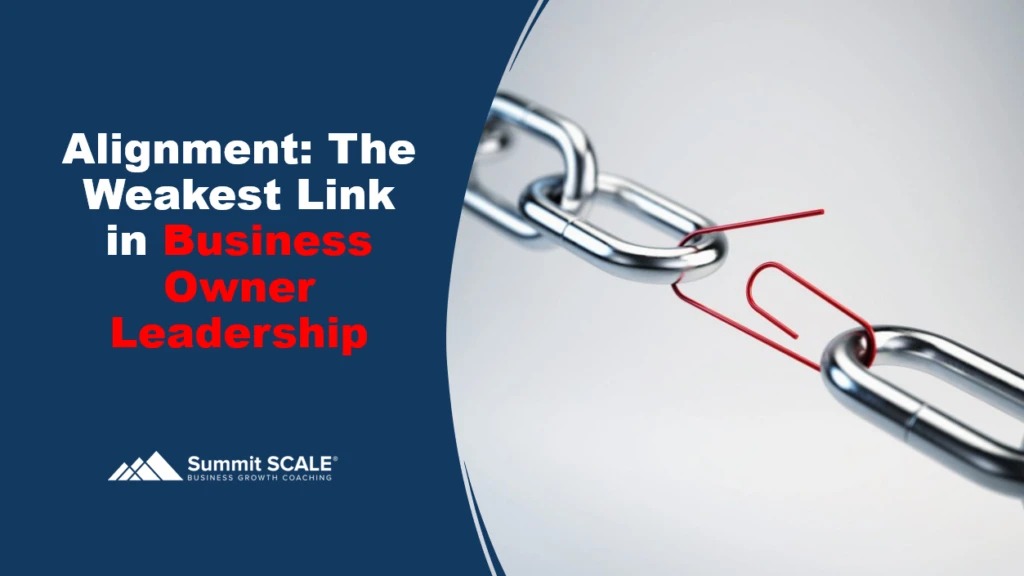
Because alignment is the bridge between vision and execution.
Without it:
- Vision stays in your head
- Execution becomes inconsistent
- And your team starts making their own interpretations of what “good” looks like
Why Alignment Breaks Down in Growing Businesses
Let me give you a real-world example.
I worked with a growing agency that had:
- A clear growth target
- A talented team
- Plenty of work coming in
But they were constantly firefighting.
Deadlines slipped.
Clients chased.
Margins were squeezed.
When we looked closer, the issue wasn’t effort — it was misalignment.
Each department had a slightly different understanding of:
- What “great delivery” meant
- What the priorities were
- Where the boundaries sat
No one was wrong.
But no one was aligned either.
This is what misalignment looks like in practice:
- Sales promising what delivery can’t fulfil
- Team members solving problems differently
- Managers interpreting standards inconsistently
- The owner stepping in… again and again
Sound familiar?
The Importance of Building Alignment
This is where The Importance of Building Alignment becomes clear.
Alignment isn’t about control.
It’s about consistency.
It ensures that:
- Decisions don’t rely on you
- Standards don’t vary by person
- Progress doesn’t depend on constant intervention
When alignment is strong:
- Your team makes better decisions without you
- Execution speeds up
- Friction reduces across the business
And perhaps most importantly…
You stop being the central point of translation.
The Three Drivers of Alignment: Clarity, Dialogue, Inspiration
If alignment is the missing link, how do you actually build it?
It comes down to three things:
1. Clarity
Alignment starts with Clarity.
Not vague direction. Not “we all kind of know what we’re doing.”
Real clarity.
- What does success look like?
- What are the non-negotiable standards?
- What matters most right now?
Most business owners think they’ve communicated this.
But in reality, they’ve said it once… and assumed it’s landed.
It hasn’t.
Clarity requires repetition, simplification, and consistency.
If your team is unclear, they will fill the gaps themselves.
2. Dialogue
Next comes Dialogue.
This is where many leaders fall short.
They communicate to their team — but not with them.
Alignment is not a broadcast. It’s a conversation.
You need:
- Regular check-ins
- Open discussions about priorities
- Space for questions and challenge
Because here’s the truth:
Misalignment hides in silence.
If people don’t feel safe to question, clarify, or challenge — they’ll nod… and then go off and do their own version anyway.
3. Inspiration
Finally, there’s Inspiration.
This is what moves alignment from compliance to commitment.
Your team doesn’t just need to know:
- What they’re doing
- And how to do it
They need to understand why it matters.
When people feel connected to the purpose:
- Standards rise
- Ownership increases
- Energy improves
Without inspiration, alignment becomes mechanical.
With it, it becomes powerful.
The Cost of Getting This Wrong
Let’s be direct.
When alignment is missing:
- You work harder than your team
- You solve problems that shouldn’t be yours
- Growth feels chaotic rather than controlled
And over time, it leads to:
- Burnout
- Frustration
- Plateaued performance
This is why so many business owners say:
“I’ve got a team… but it still all comes back to me.”
That’s not a people problem.
That’s an alignment problem.
A Simple Leadership Shift That Changes Everything
If you take one thing from this, let it be this:
Your job is not just to set the vision or drive execution.
Your job is to create alignment at scale.
That means:
- Repeating the vision until it becomes second nature
- Creating structured dialogue (not ad-hoc conversations)
- Connecting daily work to a bigger purpose
It also means asking yourself regularly:
- Where is my team guessing instead of knowing?
- Where are standards open to interpretation?
- Where am I stepping in because alignment is missing?
Those questions will tell you everything.
Final Thoughts: Alignment Is the Lever
Business growth isn’t just about doing more.
It’s about doing things better, faster, and more consistently — without everything relying on you.
And that only happens when:
- Vision is clear
- People are aligned
- Execution becomes predictable
So if your business feels harder than it should…
If your team isn’t quite delivering at the level you know they’re capable of…
If you’re still the glue holding everything together…
Don’t just look at systems.
Don’t just look at people.
Look at alignment.
Because more often than not, it’s not the obvious problem.
But it is the real one.
Ready to Take Action?
Start simple.
This week, pick one area of your business and ask:
- Is the expectation clear?
- Has it been discussed, not just told?
- Do people understand why it matters?
Fix that — and you’ll feel the shift immediately.
Because when alignment improves…
Everything else gets easier.
If you’d like some help with developing your leadership skills – or making things in your business run more smoothly and more effectively – let’s get on a call to discuss coaching. You can book an initial 15-minute call with me here at www.TimeWithShane.com

